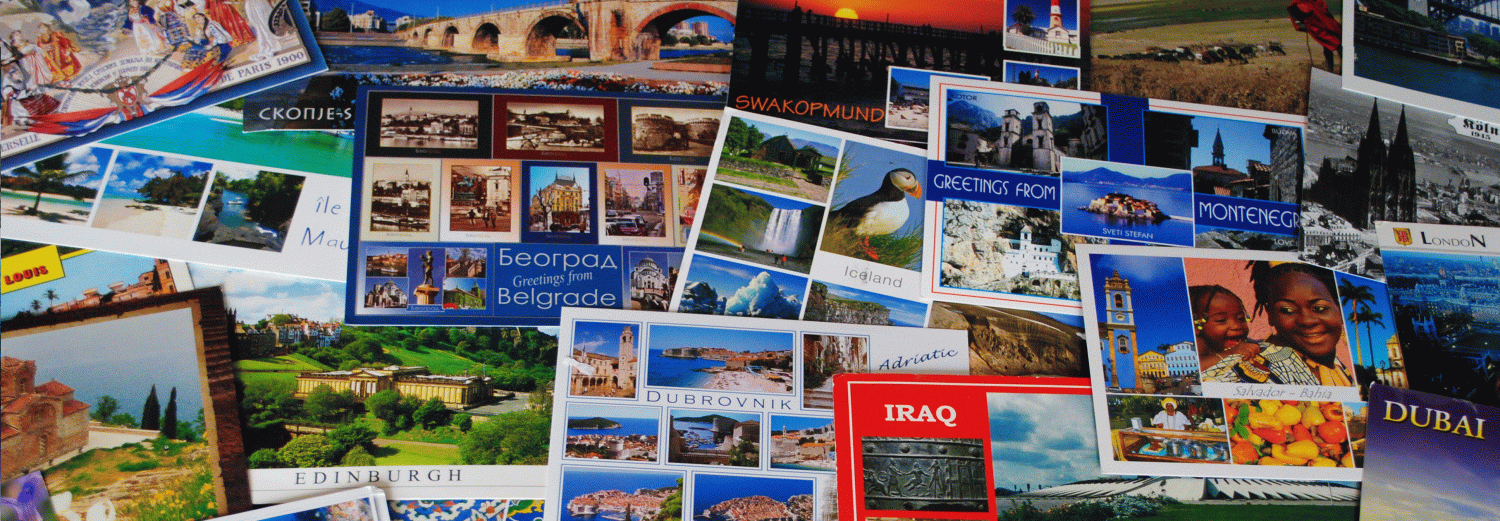
It took us nearly five hours to drive the last 150 miles of winding mountain roads between Višegrad, Bosnia & Herzegovina and the Croatian coast. I rarely drove faster than 45 mph simply because the speed limit and conditions didn’t allow it, and I likely would have made even myself carsick. V and A were excellent passengers. V only complained once, and he was probably right; it really can be alarming to be a passenger and have no control as you roll through narrow tunnels black as night, uphill past slow trucks that drift into your lane, and around blind corners, every once in a while a bit too fast even with a driver as pokey as myself. We crossed the Croatian border without incident and the vast jewel of the Adriatic lay before us.
Tag: Culture
Balkan Summer 2022 Trip, Part III: Kragujevac to Višegrad
The town where V’s brother V2 lives, Kragujevac, is Serbia’s fourth-largest city with just under 175,000 inhabitants. Situated about an hour and a half south of Belgrade, Serbia’s capital, the region is proud of the more affordable living and rural beauty it offers while still boasting plenty of nearby shopping and amenities commensurate with the big city. V2 and his wife D – whose family hails at least three generations back from Kragujevac – made it a point to show us around, welcoming us to town with a dinner out that included a large group of their extended friends and family.
Balkan Summer 2022 Trip, Part II: Skopje to Kragujevac
For the first five days of my trip to the Balkans, my husband V, my stepdaughter A, and I stayed in Macedonia’s capital city, Skopje, at his childhood home. We enjoyed quality time with his mom, and took over the upstairs portion of her home. V’s niece, the eldest of his brother’s six children, usually lived upstairs alone, but was away on extended holiday in Greece with a boyfriend.
We went shopping, hung out in cafes, visited with old friends, and spent time in the city center and the Turkish part of town known as Stara Čaršija, or the Old Bazaar. Sometimes A hung out with us, and sometimes she hung out with friends she’d made on her many prior family visits, including five years before while doing a summer internship at the Peace Corps Skopje office. During those days we also finalized the tentative plans we’d been discussing to rent a car for a 10-day road trip around Serbia, Bosnia & Herzegovina, and Croatia. Our itinerary was still a little flexible, but the purpose of the trip was twofold: to visit V’s brother who had settled in Kragujevac, Serbia with his wife and younger children, and to treat A to a couple of countries she hadn’t yet seen, albeit not for as long a duration as we would have liked.
Balkan Summer 2022 Trip, Part I: Heading to Macedonia
At the end of July, I went to an Incubus show a couple of hours south of DC by myself. V and his daughters had already left a couple of weeks prior for the Balkans, and had been enjoying traveling together in Macedonia and Greece while I stayed home alone in Virginia, worked, and held down the fort. I would travel to Macedonia myself for a few weeks the day after the show. I was going to miss my 19-year old stepdaughter D, who had to return to the States before my arrival in Europe to prepare for her sophomore year in college in Tennessee. But V and my 23-year old stepdaughter A, who is in graduate school in North Carolina, would be awaiting my arrival to spend some family time with V’s relatives in Macedonia and Serbia, and the three of us were planning a road trip to cities across the former Yugoslavia, including Sarajevo and the Croatian coast.
Road Trips 2022
I’m not yet ready to publish a reflection on 2022 as a whole, but as we get ready to welcome 2023, I added up my 2022 solo/sole driver road trip stats and was amazed.
Giving From Abundance
While abroad, many Foreign Service Officers find community through professional and social networks at the embassies or consulates where they serve. The Community Liaison Office at a post, known as the CLO, does a lot to foster this, hosting social events, planning outings, and celebrating American holidays. Participating in this community, which also includes locally engaged staff, can help us navigate a new environment while still holding on to a little bit of home. Especially during service at small or high-hardship posts, or where the culture is very different than in the United States, for example, the embassy community tends to be strong. Despite our perception in Uzbekistan that it was a bit of a fishbowl, that community was important in connecting us with information there, where we – and especially V, who’d had no Russian training – faced a higher bar to speaking the language, self-organizing domestic trips and outings, and performing daily activities. Alternatively, Australia was an English-speaking country where we were as likely to hang out with our Australian neighbors as with our American colleagues despite having two hard-working CLOs. Two posts – two different types of community, and yet both played the same role in terms of a community abroad.
And in Mexico, a much different scenario despite the warmth and hospitality of the CLO and the Mexican people. We arrived and departed during the COVID-19 pandemic, never fully settling in or getting a sense – beyond virtual events here and there – of what we understood had been a vibrant, robust consulate community. If that weren’t challenging enough, after a year of “we’re in it together” protective measures against the coronavirus, the whiplash of my feeling left behind when society decided 96% of people being safe actually was good enough and removed their masks as the Delta variant arrived and I suspected, correctly, that asymptomatic spread was occurring, made me feel erased from the consulate community in Juárez entirely.
Of course, we still had the broader El Paso community only four miles away – a key benefit of serving on the border. But ultimately it wasn’t enough, and as I could no longer stay safe in my workplace or expect the same chance everyone else there had received to emerge immunized from the pandemic, I decided to remove myself from that environment. It was in this context that I arrived just under three months ago in my adopted home state of northern Virginia feeling angry, isolated, and ejected from any sense of equity or belonging to the people and space around me.
No Basement at the Alamo
In mid-November, I connected Veterans Day, a Mexican holiday, and one day of leave to a weekend, which equaled five days off. I crossed the border and took another solo road trip, this time across Texas to San Antonio and Fort Worth. In San Antonio I visited the Mission San Antonio de Valero (better known as the Alamo), Missions San Jose and Concepción dating back 300 years, and the city’s famed Riverwalk. I actually liked the Riverwalk so much I went there both during the day and later at night – thanks to my awesome AirBnB tiny house hosts who let me know the city would be turning on the holiday lights my first full day in town.
After a couple nights I headed to Fort Worth to see my friend K, who had visited us in El Paso in May during a trip home to Arizona to see her parents. K and I served in Peace Corps Macedonia together 18 years ago, and lived near each other for a handful of years in DC after I finished grad school in Australia. She was also a bridesmaid in my wedding, but this is the closest we’ve lived to one another in years. V and I had stopped by her place on our way to Juárez during the pandemic summer of 2020, and I was determined to make it back out there.
Reunited
In October we had our first visitors to Ciudad Juárez – my dad and stepmom L. My dear friend K visited last spring, but stayed in El Paso because she was road-tripping around the southwest with a big dog and no Global Entry card; my dad and L were the first to actually come into Juárez. When I suggested several months ago over the phone that, pandemic depending, V and I were planning a fall trip to Playa del Carmen and they should come with us, I didn’t think they’d necessarily want to go that far into Mexico or spend that much money doing so. It’s over 2,000 miles southwest of Juárez and on the Caribbean Sea where we’d spent our 2013 honeymoon.
But I hadn’t considered two things. One, my dad had made frequent scuba diving trips to nearby Cozumel over the past 30 years and was familiar with the area. And two, that 18 months of pandemic isolation had made them just as lonely and excited as we were about vacationing in a luxurious venue with ocean, sand, and unlimited cocktails, particularly after they’d relocated from the California coast to rainy Washington state in 2018. It occurred to me that not seeing them between August 2019 and October 2021 due to the pandemic is about the length of a standard Peace Corps Volunteer service – definitely too long to not see your parents, especially at this age.
To my delight they not only agreed, but made reservations. We decided first they’d spend a few days in Juárez with us, and then we’d fly south together. Then we all crossed our fingers that the pandemic wouldn’t interfere. Somehow in the luckiest streak of a rough 2021, I got boosted and they visited during what I now see was the lull between the Delta and Omicron variants.
Life on the Border: 10 Times When Heading ‘Across Town’ Can Be More Than You Bargained For
Serving at U.S. Consulate General Ciudad Juárez as a Foreign Service posting has had the unique benefit of proximity to the United States: El Paso, Texas is less than five miles away. Ciudad Juárez and El Paso in many regards feel like one city. If you read about the history of this area and in particular the resolution of the Chamizal dispute in the 1960s over 600 acres of disputed border territory, you will start to see how the geographical, historical, social, and economic ties in the second-largest U.S. border community (behind San Diego and Tijuana) have been tightly interwoven over hundreds of years. And despite the border closure to non-essential travel between March 21, 2020 and November 8, 2021, those ties remain strong.
However, proximity doesn’t always equal easy or convenient access, even for the most privileged of us. FSOs could be forgiven for being lulled into complacency routinely traveling back and forth between Ciudad Juárez and El Paso when it feels like a run across town, only to be slapped with the reality of it actually technically being diplomatic travel to and from your country of assignment across an international border. This is highlighted only when something goes wrong and you realize, this would have been a lot easier were I only driving across town. Here are 10 examples (plus one bonus) of times going across town was more than I bargained for during the last year and a half.
It’s Not Cinco de Mayo
Today is el Día de la Independencia de México, or Mexican Independence Day. A lot of Americans think Mexican Independence Day falls on the fifth of May, but they would be wrong. (Cinco de Mayo actually commemorates a battle victory in Mexico’s war with France during the 1860s.)
No, Mexican Independence Day is on September 16. It was on this day in 1810 that a famous priest in the town Delores, Mexico rang the church bell and issued a call to arms. His shout, “The Cry of Delores,” marked the beginning of Mexico’s war for independence from Spain. If it weren’t for the coronavirus pandemic, I could have had a chance to see the re-enactment; every year on the eve of the holiday, the president of Mexico delivers “el grito” (the shout) from the balcony of the National Palace in Mexico City. But unsurprisingly, the festivities for 2020 have been mostly cancelled or virtual.
Postcard Flashback: Our Only Visitor to Uzbekistan
During my first tour in Tashkent, Uzbekistan, we only had one visitor – my mom. She came to visit in August 2016 and although I mentioned it twice (here and here) and shared a handful of photos before we then jetted off to Budapest and Moscow together, I never followed up with the promised travelogue about her visit. Since it’s been almost four years, some details have now faded, and there are hundreds of pictures that are hard to choose between. However, thanks to really good Facebook photo captions I made at the time, everything she went through to get there, and my ongoing belief that I could have done a better job showing more about Uzbekistan during my tour, I decided it was now or never to make this post.
Area Studies: Mexico (ASWHA7006)
During this past week, I was in the State Department’s Mexico area studies course put on by the Bureau of Western Hemisphere Affairs (WHA) at the Foreign Service Institute (FSI). It was similar to the two week Russia/Eurasia course I did in 2014 while preparing for my assignment to Uzbekistan. Most area studies classes at FSI are regionally-focused, but the complexity, depth, and breadth of the U.S.-Mexico bilateral relationship means Mexico has its own dedicated course, and it was both useful and fun. Narcotics, crime, migration, American Citizen Services emergencies, difficulties in determining citizenship, film, art, culture, indigenous issues, trade, mariachi bands, and tacos – what else do you want?
Spanish (LQB100): Week 15 Language Immersion in Ecuador, Part II
I recently wrapped up my 15 day language immersion trip in Ecuador with a graduation ceremony and a trip to some thermal springs before returning to a DC winter. Here I reflect on my last days in Ecuador and the value of a language immersion program.
[This is the last blog post in a series of four on my Spanish immersion experience in Ecuador. If you missed the previous posts, you can find them at these links: part one, part two, and part three.]
Spanish (LQB100): Week 15 Language Immersion in Ecuador, Part I
During the first part of week 15 in Spanish (and the second week of my language immersion in Ecuador), I continued enjoying the great outdoors while generally getting my butt kicked by high altitude, thin air, humidity, inflammation and old injuries, and stairs. I had the last laugh though, because I practiced my Spanish, saw new and cool things, and made it through each challenge without quitting.
[This is the third blog post in a series of four on my Spanish immersion experience in Ecuador. If you missed either the first post or the second post, you can find them at the links.]
Spanish (LQB100): Week 14 Language Immersion in Ecuador, Part II
During the first week I was in Ecuador, I also had the opportunity to visit one of Quito’s most famous basilicas, explore a variety of local foods and markets, party on a fiesta bus (chiva), and hike a volcano. The latter was one of the most physically grueling activities I’ve ever done, not only because I ascended to an altitude of over 15,500 feet (4,800 meters) without being in great shape, but also because of the thin air.
[This is the second blog post in a series of four on my Spanish immersion experience in Ecuador. If you missed the first post, you can find it here.]
