
I have both been writing this post for months and procrastinating finishing it. I normally publish my annual recap and blog stats in January, or at least earlier in the year.
But I hesitated to relive the personal and professional difficulties I experienced in 2025. A stressful international move, a life-threatening accident, family illness, job insecurity, work-related chaos, and policy whiplash were all lowlights in 2025. It’s a lot of work to dig through it all and think about how to organize and convey the details in a way that’s interesting to people aside from me.
Upon reflection, though, in characteristic form, I decided that feels like all the more reason to write this post — even if it took me a while to find the words, and even if no one else particularly notices whether I keep up what has quietly become an annual tradition. I would notice. And as the memories slowly fade around the edges, I think in the future I would regret letting a year like this pass without summary.
I published 48 blog posts in 2025 — a year widely described by many of my colleagues as a “breaking point” for the Foreign Service and for federal employees more broadly. At work, we faced overlapping shocks: hiring freezes, the dissolution of aid programming, legal battles and collapsing morale, fear and ambiguity surrounding mass layoffs, and unfunny invitations to “take the fork.”
I wrote a series of posts chronicling my perspectives on Foreign Service-related topics, including a history of all my family’s Christmas holidays in the Foreign Service, the reasons why the United States long ago adopted a non-partisan career federal workforce, a series of posts chronicling my 45 weeks studying Burmese, the surreal firing of almost 250 Foreign Service Officers, our first visit in a decade to Foreign Affairs Counterthreat Training (also known as FACT or “Crash Bang”) in Virginia, my experience bidding for my sixth tour, and struggling through the longest U.S. government shutdown in history.
It’s probably safe to say the professional and societal challenges of 2025 crept into most of our personal lives, too. I will remember 2025 as the year I navigated a very trying time learning Burmese, wrapped up our lives in the United States, moved to and (kind of) settled our household in Burma, only to almost get killed in an accident in front of my own house three months into a one-year tour.
Year in Review
In January, after a lovely holiday with my dad and then my younger stepdaughter D who each visited us in Virginia, I really dreaded going back to FSI as language classes resumed. I was still stinging from my second progress evaluation in Burmese class which I’d bombed in December. Little did I know things were going to get worse. I spent weeks despairing about ever making progress as the snow fell.
Towards the end of the month, I welcomed small learning breakthroughs while a new presidential administration ushered in a government-wide hiring freeze. I will never forget the shock and disbelief I felt when an email called “Fork in the Road” hit my work inbox.
A bright spot for V and I in January was attending the Orthodox New Year masquerade ball at the Macedonian Embassy in Washington, DC.
In February, I reached the halfway point of my 44-week Burmese course and tried to celebrate small wins.
Thousands of my colleagues from USAID were unceremoniously placed on administrative leave or fired, and FSO friends lost roles or assignments tied to aid programs. Some I had known for 15 years.
My older stepdaughter A came for a fun DC visit, and then she and her dad took a trip to the Balkans for a month to see his side of the family.
I was in such a poor state of mind worrying about my job security that I was actually grateful to have some quiet time home alone. I spent most of my time glued to the news. I tried to keep my stress from becoming a pollutant to the atmosphere and everyone around me. In the hallways at work people whispered in small groups. When I’d walk into the bathroom I’d notice conversations would halt and people would avert their eyes, fearful and mistrusting. Our workplace culture was changing and not for the better.
In March, I began preparing for our upcoming PCS: scheduling medical appointments and pre-departure vaccinations, shredding unnecessary documents, giving away or selling unneeded items, and taking our cat to the vet to ensure he would be ready to travel in August. I also fretted about generating my TMTWO (request for orders) and how to enroll in FACT pre-departure security training.
In stark contrast to the daffodils that bloomed across the Foreign Service Institute (FSI) campus and the cherry blossoms we toured in DC’s Tidal Basin, fear was palpable in the halls of FSI as DOGE-driven layoffs picked up steam. I passed my third Burmese progress evaluation with surprisingly minimal angst.
As March drew to a close, a 7.7-magnitude earthquake struck Burma’s third-largest city of Mandalay, causing the widespread destruction of homes and infrastructure. The quake killed thousands of people and injured many more. It left millions displaced and in desperate need of humanitarian assistance in a country already beset by civil war and a collapsing economy.
In April, vague plans surfaced to eliminate or merge hundreds of offices within the State Department. I hit the 75% completion mark of my Burmese course and moving to Burma started to feel more real. Our Burmese class changed formats after two advanced students graduated, leaving my original language classmate and me with our teacher again; we continued studying the language at a more fun and relaxed pace.
I fretted, awaiting orders. As no orders materialized, it held me up from getting my vaccinations, applying for our visas to Burma, making flight arrangements, or even getting an embassy mailbox assigned and doing my change of address notifications.
In May, anxiety was widespread throughout the Foreign Service as court battles over the legality of the mass layoffs ensued. Affected employees were stuck in limbo, unsure for how much longer they might have an income. I was stunned to realize that the layoffs appeared to be predicated on an FSO’s assignment on a particular calendar date. It made no sense to me, since we are generalists and routinely rotate through assignments and tours that begin and end independently of the broader terms of our employment.
I finally shared reflections on a story about a message from beyond, which had taken place almost two years before, around the time of my stepmother’s fall 2023 death from pancreatic cancer (part one and part two).
As highlights, V and I went on a road trip to visit D at college in Chattanooga, Tennessee. We also attended SerbFest DC in Potomac, MD and the Saint Sophia Greek Festival in northwest DC.
June was a peak government layoff anticipation period as we entered our last month of Burmese class before the End of Training Test (EOT). Signals emerged that thousands of layoffs were imminent. It felt like waiting for an axe to drop while we were expected to simultaneously put our full effort and energy towards an international PCS move.
V and I attended an awards ceremony at work. Warmer weather allowed us to launch a multi-weekend backyard clean-up of leaves and winter debris that had accumulated at our rental house.
We even reconnected with V’s former boss who we’d served with several years earlier in Canberra who now lived right around the corner from us in northern VA. We offered her back a rocking chair we’d purchased for $20 when it missed her packout and she gratefully picked it up.
In July the axe did indeed drop as the State Department laid off approximately 1,300 employees, including around 250 FSOs. It was the most visible shock yet, as total workforce reductions approached nearly 3,000 including resignations and sudden retirements. There was also mass confusion around some employees reportedly receiving erroneous notices. I felt sick and angry for my colleagues, relieved and still afraid for myself, and very worried for our institutions.
The Reductions in Force (RIFs) started hitting email inboxes within 24 hours of my Burmese EOT; my boss’s EOT was scheduled for the following day. The moment he came out of his EOT and regained access to his phone, the first thing he did was check to see if he still had a job. It’s hard to explain how uncharted it all felt.
I came to FSI that day to mail myself a box of work items through the official pouch to Burma. I noticed people staring at me, because it was lay-off day and I was holding a box. It was all unbelievable to deal with even as we were finishing a 10-month effort to prepare for an onward assignment, packing out our families and homes, and organizing consumables shipments.
In the midst of this uncertainty, July otherwise made me feel like I was being crushed with to-dos, stress, and deadlines so close together there was nothing to do but survive. In typical PCS season fashion, we only had one business day between the end of my Burmese EOT and going out of town for FACT; we had zero business days between FACT and our packout.
The packout itself was chaotic, longer than projected, and mishandled by the moving company in a variety of unpleasant ways. And the day after it ended, I hit the road cross-country by myself to drop off my car with my dad in Washington state for a year and spend far too quick a time with family. And then I got on the big plane.
In August I hit 20 years of federal service on the very day our flight touched down in Burma. It was our first time living in a country with a big monsoon season, and we felt its effects right away.
As I settled into my new job at U.S. Embassy Rangoon, started figuring out my way around, and even attended a cooking class, other employees who had already been laid off received promotion notices. Perceptions of institutional distrust and arbitrary, incoherent decision-making reigned. USAID Burma closed after first opening in 1961, closing in 1988, and reopening in 2012.
In September, even as fired civil servants were leaving the State Department, a new orientation class came in the door. The “fire then hire” seemed a contradiction. Many were angry and had hard questions about wasted training investment and strategic goals.
After four weeks at post, we moved with our cat from our temporary apartment housing into our permanent house. It was tough to do an extra move — what would eventually be our third move in one year — but it was worth it in the end to be in a standalone house with more space and less noise than an apartment community offered.
And by mid-September, our air freight (UAB) arrived, almost two months after we’d packed it out in Virginia. Sixth tour bidding snuck up on me when I hadn’t even been at post a couple of months, and while I was still trying to get to know my new environment and find the words to describe it.
As if all that weren’t enough, October brought us the longest U.S. government shutdown in history. The federal government underwent a massive wave of buyouts and retirements – hundreds of thousands across the sector.
V and I still took the opportunity to spend my birthday weekend in Bangkok, despite the fact that we were not being paid and were not sure when our paychecks would resume. Some of the 15 banana trees around our house were fruiting with bananas and we spent long weekend days swimming at a local pool.
The American Club Yangon’s Oktoberfest party was the hottest weather I could imagine for a “fall” event, and as I felt mildly homesick for autumn in Virginia we celebrated the Burmese Full Moon of Thadingyut holiday at a local pagoda. We also took a CLO road trip with colleagues to the nearby town of Bago to see its 16th century landmarks.
What can I say about November. It tried to start off strong with the beautiful Marine Ball on the first day of the month. However, that very night V ended up in a Burmese emergency room with a problem that quickly resulted in his medical evacuation to Bangkok for gallbladder removal surgery. I could not accompany him. It was a frustrating period as the Internet went down in Burma for weeks and I could hardly communicate with anyone.
By mid-month, the U.S. government shutdown finally ended and V returned from medevac. A mere two days later, I was hit as a pedestrian by a speeding truck and knocked unconscious while crossing the street right in front of our house. I had serious injuries, including head trauma and bilateral concussion, two broken ribs, four pelvic fractures, a lung contusion, whiplash, a broken toe, and cuts, bruising, and abrasions from head to toe.
The accident would turn my life upside-down for months. While hospitalized on medevac to Thailand, I spent a lot of time grappling with the aftermath of the accident and trying to cope with the sudden loss of freedom and mobility. It was a complete shock to have my life change overnight in this way and the nightmares reliving the accident were frequent.
On about the third day of my hospitalization, V unfortunately had to take Emergency Visitation Travel and fly to the Balkans for a month to help his mother with her living situation. This meant I saw him the first couple of days I was hospitalized and would not see him again until two days before Christmas in Rangoon.
I spent Thanksgiving in the hospital by myself, but was comforted by recent visitors and a cooked meal one of my American colleagues serving in Bangkok kindly brought over.
As the month closed, planned Foreign Service layoffs were delayed due to the shutdown and legal issues, and Congress temporarily restricted agencies from executing layoffs.
I spent the majority of December still in the hospital in Thailand trying to recover from my accident and relearn to walk. I was also heavily focused on bidding for my sixth tour. It felt absurd and surreal to do on-camera interviews considering I couldn’t walk and my face and body were all banged up. But I absolutely refused to surrender to the circumstances and turned in my bids on time.
I FaceTimed with V and A who were in Macedonia, where A also selected her wedding dress. Once V and I had both returned to Burma, it was intentionally one of the least traditional Christmases we have ever had in the Foreign Service — no gifts purchased or exchanged, no Christmas tree, music, or decorations, and no traditional Christmas cookie baking or cooking. We simply were not physically able.
At that stage, V was still recovering from abdominal surgery, and I was unable to do so much as carry a glass of water from one room to another. I needed to keep weight off my left side and relied heavily on my walker to take slow, painful steps, unable to use my hands for anything other than bearing weight.
V and I marked the end of the year in a deliberately subdued way, attending a New Year’s Eve party at the ambassadorial residence with shuttle service to and from the event.
Meanwhile, turmoil in the Foreign Service continued. Career-ending decisions were finalized for many just before the holidays, while others faced ongoing lawsuits and uncertainty. I submitted my bid list from a horizontal position and hoped for the best. I think we both took a deep breath saying goodbye to 2025 and embraced a spirit of gratitude for what 2026 might offer.
Blogging in 2025
- I wrote 48 new posts, 13 posts more than in 2024.
- I wrote at least one post per month, writing most often in August with seven posts.
- Blog readership in 2025 was up over 2024. Unique page and post views increased to an all-time high of 45,695, beating the previous record set in 2020.
- Unique visitors in 2025 also rose 19 percent over 2024.
- The blog surpassed 380,000 all-time views.
- December marked the highest monthly page views by far, with an eye-popping 8,267 views. That’s over 3,000 more views than during any other month in the blog’s 11.5-year history. I suspect that was related to posts about my accident and hospitalization, while I was also bidding. Related posts drew in readers who then clicked on many other posts.
- Blog readers in 2025 landed on the site from 163 different countries, up slightly from 162 in 2024. See below for a list of the top 20 countries from which visitors most frequently viewed the blog:
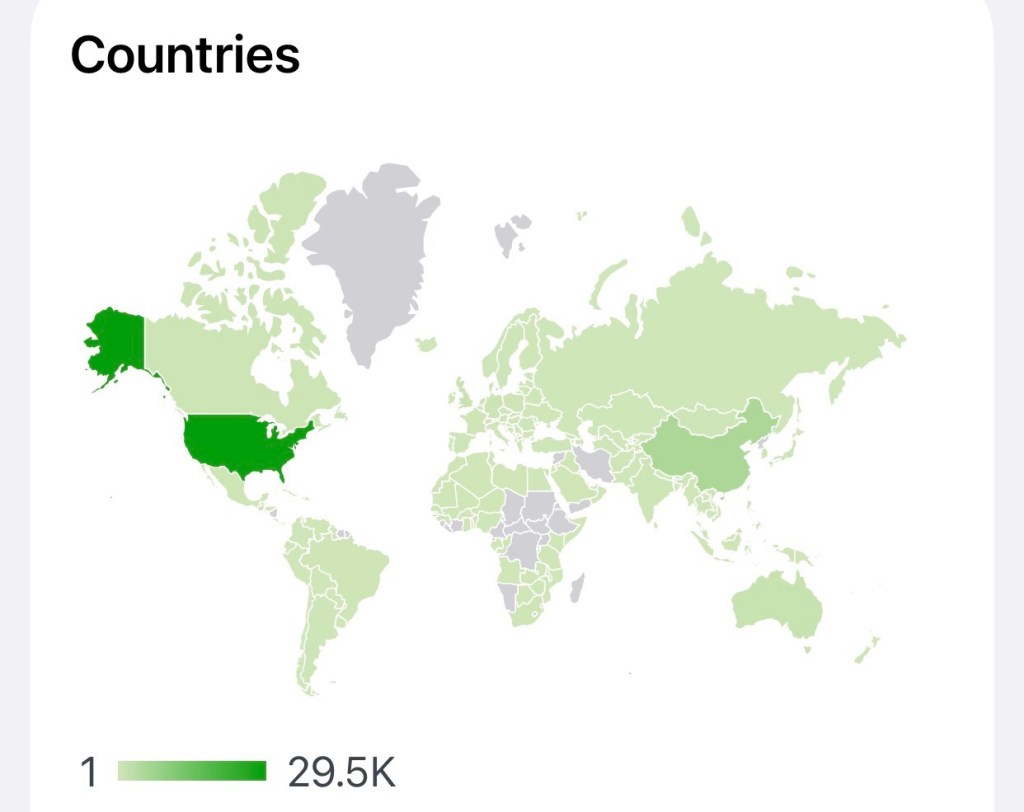
- United States
- China
- Australia
- United Kingdom
- Germany
- Canada
- India
- Japan
- Mexico
- Philippines
- Djibouti
- Malaysia
- Mongolia
- Austria
- Argentina
- Sweden
- Thailand
- Spain
- Brazil
- New Zealand
Below is a list of 2025’s top 20 posts and pages. I have ranked them by the number of the views they received and included the year of publication.
- Tips for Authenticating Louis Vuitton Multicolore (2020)
- Foreign Service Housing (2019)
- How I Lost 100 Pounds in 2021 (2022)
- About the Author (2014)
- I Love a Sunburnt Country (Wide Brown Land) (2019)
- My Top Tips for Long-Distance Solo U.S. Road Trips (2023)
- Foreign Service Housing, Part III (2023)
- A Sad Day For Diplomacy (2025)
- Foreign Service Promotions: 10 Things I’ve Learned (2022)
- My Foreign Service Timeline (2014)
- September is National Suicide Awareness Month: What Everyone Should Know (2022)
- Becoming an FSO Part II: The QEP (2014)
- Fifth Tour Bidding: The Early Assignments Cycle (2023)
- Flag Day Announcement… III (2018)
- Sixth Tour Bidding: Ready or Not (2025)
- Packout, Check (2025)
- Spanish (LBQ100): Week 15 Language Immersion in Ecuador, Part I (2019)
- Consular Officers Have the Best Stories, Part I (2023)
- If I Must: Learning Burmese, Weeks 36-37 (2025)
- Wrong Lane (2025)
Conclusions:
- The top-visited posts and pages this year were an “old and new” mix of posts on the Foreign Service, travel, language learning, and lifestyle-related topics.
- The 2020 post about my Louis Vuitton Multicolore purses from the 2003–2015 LV x Murakami collection continues to drive massive traffic to the site. I’m thrilled that people still find it interesting and helpful, especially since it was such a one-off post and a bit out of character for this blog. In many ways, the post is now also incomplete, as Louis Vuitton reintroduced new pieces from the formerly discontinued Multicolore collection in both 2025 and 2026. I may write about fashion again, although in the intervening years my handbag collection has expanded in many different directions — all of which I now document and create content about on Instagram rather than here on the blog. (Details below if the topic interests you.)
- As 2025 brought a shift from a domestic assignment and language training to service overseas, 2026 will be the year we finish our tour in Rangoon and make it back stateside. I will begin studying Bosnian in preparation for our 2027 transition to Sarajevo. And the PCS transition back to Virginia will happen before we know it, just as our transition to Burma did.
Thank you as always to readers for enjoying the Collecting Postcards Blog and I apologize for the inevitable emails I haven’t answered. Hope 2026 — now nearly half over — has brought a lot of happiness so far.
Contact me!
Email: askcollectingpostcards@gmail.com
Facebook: @collectingpostcardsblog
Instagram: @life_in_multicolore (purse-related; just for fun!)


1 comment for “Year in Review: 2025 Blog Stats and Recap”