
During week six, I started to realize that I’ve reached the point I’ve encountered in past language programs where I’m no longer going to fully absorb the material simply by attending class and doing the homework. To truly understand Bosnian grammar, in particular, I’ll need to study it more intentionally on my own and be open to discovering what works best for me. Lately, when I don’t understand something in class that we’ve touched on at least once before, my first reaction is to think either that it wasn’t really taught or that I didn’t really learn it. I think it’s reasonable to need multiple exposures to something new before it truly sinks in. I also think some of my prior frustrations with FSI language programs are valid. Sometimes it feels like the approach is, “Here’s a grammar book. Know it and love it!” And for someone like me who doesn’t even understand English grammar, that can be a real deficiency in the learning process.
At the same time, I think it’s reasonable to expect students to take ownership of their learning by assessing their own needs and finding ways to fill gaps in their knowledge, whether that means seeking out additional materials, resources, or explanations. I can point to a program and say it isn’t giving me what I need, and I might be right. But ultimately, I’m still responsible for recognizing what I’m missing and taking every step I can to address it. It isn’t the program that’s going to fail an End of Training test: it’s me. Everyone learns differently, and no one understands my learning needs better than I do. So I’ve been asking myself, Am I doing all I can do?
Weeks Six and Seven in Class
Week six began after the three-day Columbus Day weekend, when V and I took a brief trip out of town to celebrate the more important holiday of my birthday, which I’ll write about separately.
My two classmates and I had spent weeks 1–2 with our instructor D1 and weeks 3–4 with our instructor D2, alternating between the two in two-week blocks. We were therefore supposed to return to D1 for weeks 5–6. Instead, at the beginning of week six, we learned that D1 had been reassigned to help revamp our program’s curriculum. She would take the place of H, a third instructor who we hadn’t worked with yet, on the curriculum team, and H would take over as our instructor. As a result, rather than finishing the end of her second two-week block with us, D1 was replaced by H toward the end of the week.
As an experienced instructor, H quickly assessed where we were. But just as we settled into a routine with her, she unexpectedly had to take several days of leave, so we spent all of week seven with D2. I’m not sure if that means we’re halfway through a block with D2 now, or if she was just considered to be subbing for H. But I really think that schedule is far more important to the teachers and our language training supervisor than it is to us. As students, we arrive in the morning and the instructors’ offices (which double as classrooms) are side-by-side. All the instructors are nice and good at their jobs. Hearing different voices and working with different people is part of the flexibility and readiness you need for successful language study. They let us know what we need to do, and we go along with it.
I can imagine that a fixed schedule is helpful for instructors who need to plan their time. Fortunately, our lesson plans are already set, and we have a booklet of exercises for each week. With a little coordination, hopefully the materials make it easy for instructors to step in and pick up where we left off. We did miss one day of language instruction during weeks six and seven respectively due to the holiday and our second session of Western Balkans Area Studies (ASEUR205).
How lucky to have so many Bosnian instructors!
When I started Burmese in 2024, we had two instructors and four students, as I probably wrote quite a lot about at the time. We spent a couple of hours each day in a class of two with one instructor, then switched instructors and classrooms halfway through the day while keeping the same student pairs. Unfortunately, after a few months, we lost one of our contract teachers due to budget cuts and had to spend the entire day together as a class of four with the remaining instructor, a direct hire.
I really disliked this arrangement because two of the students were significantly more advanced than I was, and I felt I was no longer getting much out of class. During that period, I found it exceedingly difficult to do everything I could to keep up with the constant influx of vocabulary and new grammatical constructions. If I’m being honest, the effort I put in varied considerably from day to day and week to week, particularly when it felt like the return on my investment was low, even when I was genuinely trying.
I haven’t hit a wall like that yet in Bosnian (and hopefully won’t), but I wonder whether, given the Bosnian program’s larger pool of instructors, our class might be restructured further at some point so that students can have more individualized attention. The program certainly has more flexibility to do so than smaller, more specialized programs like Burmese. It feels like a lucky situation and I’m grateful for it.
What a difference two years makes…
Lately, I’ve been thinking about how differently my FSI experiences learning Burmese (2024-2025) and Bosnian are turning out to be. It’s probably natural to compare the two, given that they were nearly back-to-back 44-week courses, separated in the middle only by my year-long tour in Rangoon. Burmese sometimes feels like it just happened. I think there are several reasons it feels different, including my own motivation, program structure, classroom dynamics, and shifts in FSI culture.
First and foremost, I have a personal interest in learning Bosnian. Not only am I thrilled to serve in the Balkans, a place where I previously lived as a Peace Corps Volunteer, my spouse and his family are from the Balkans. I have almost 25 years of experience with Balkan culture and languages. I know two similar languages (Macedonian and Russian) that make it much easier for me to guess Bosnian words and meanings than someone with no Slavic language background. I plan to speak this language for the rest of my life, inside and outside of work. Class feels fun, and I relatively easily pick up new words and constructions. A friend noted the other day that I seemed a lot less stressed about the language learning experience compared to when I was in Burmese. That made sense to me. It hasn’t felt hard up until now to do “all I can do” without tearing my hair out.
My only motivation for learning Burmese, honestly, was that it was required for my job in Rangoon, a job I was excited about taking on but in a region I knew relatively little about. Burmese was also my first—and only—Asian tonal language, which presented a learning challenge I hadn’t encountered before. I think I generally tried to maintain a positive attitude and put forth my best effort, and I was enthusiastic about the challenge when I started. But my experience learning Burmese doesn’t compare to how I feel about studying Bosnian now. Learning Bosnian brings me a sense of happiness and enjoyment that I didn’t experience with Burmese, with no fault towards my prior teachers or classmates. Frankly, I kind of sucked at Burmese and that was demoralizing to face every day. Why not focus our tremendous professional energy and effort towards things we’re good at and actually want to do? In fairness, I bid on Burma, I knew there was a language requirement, and I wanted the job. I just didn’t know exactly what I was signing up for.
I find a certain logic in Bosnian that makes it much easier for me to understand and retain what I’m learning. There’s also something liberating about not having to transliterate an unfamiliar writing system into text that I then struggle to connect with actual words. With Burmese, I often felt caught between learning the language itself and trying to make sense of its writing system through transliteration. This never happened to me with Macedonian or Russian: I easily read and wrote the Cyrillic alphabet. My Russian instructor used to laugh that I wrote Cyrillic in all caps. “Like an inmate,” he observed. And while Bosnian primarily uses the Latin alphabet, it’s simple for me to read it or write in Cyrillic too when needed. Burmese script was different somehow. Even once I could read it, it wasn’t an effective use of time to write it.
I think any of my colleagues could relate to the feeling of being more excited to learn certain languages than others. Although I didn’t speak much Burmese even while I was in Burma, I am still grateful I had a chance to study it. Going to post with no language skills would have been tough.
Being at FSI just feels like a different experience now
These days, FSI feels a bit different too. The administration has restructured and consolidated language instruction into the morning. Language training in the past occupied most of the business day, with another two to three hours of homework and self-study expected each evening.
When I began studying Russian in 2014, for example, there were so many students that we had to share classrooms across two shifts, A and B. The A shift started at 07:40 and went to lunch and lab for two hours beginning at 10:40, when the B shift—which I was on—arrived. Parking was a real challenge in those days because we basically arrived “last” on campus. B shift students had two hours of morning study, followed by two hours of lunch and lab (during which the A shift reoccupied classrooms), then three more hours of class, while the A shift students were long gone by then. As time went on, we had Admin Wednesdays once or twice a month where we got out around lunchtime.
When Spanish began in 2019, the day started closer to 08:00 and consisted of five hours of classroom instruction, with a one- to two-hour break in the middle. I don’t remember a lot now about how it was organized, except that the program was very large and we very frequently switched teachers and reconfigured classroom groups. During that period immediately before the pandemic, campus was so full that language students in some programs ended up at an annex in Rosslyn — they weren’t even at FSI. Luckily the bigger language programs like Spanish didn’t have to move.
Later, in 2024, the Burmese timetable was similar, although I believe the annex had been discontinued by then and all language students were back at FSI. For some reason, our Burmese classroom had to move repeatedly and at short notice, and I feel like we held class in at least a half dozen different rooms in the F and K buildings over those 44 weeks.
Now, we arrive at Bosnian class at 08:20 and finish at 13:00, with a 10-minute bio break after the first and third hours and a 20-minute break in between. As far as I know, all the languages are on a similar schedule with only minor variations (e.g. an A-100 classmate said his class starts at 08:00 and they get done at 12:30). At first, I thought we were getting only four hours of instruction instead of the five we used to have. But a Bosnian classmate pointed out that, thanks to the more efficient schedule, we’re still getting 240 minutes of daily instruction, compared with 250 minutes under the old, less efficient schedule. For only missing 10 minutes, I think we’re getting a lot of value from this tightened schedule.
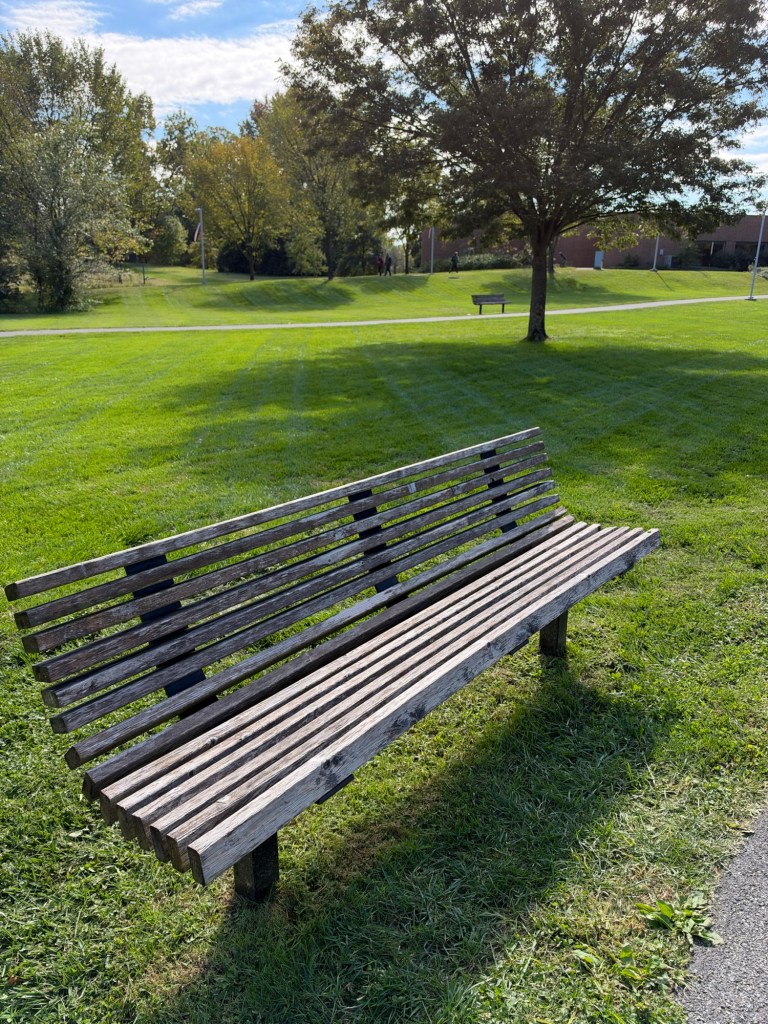
I really enjoy having class time consolidated to one block and being free from 13:00 on. It’s great for making doctor’s appointments, attending happy hours, and running errands.
But I’ve noticed how quiet the campus has become. In the past, the cafeteria and campus buzzed with activity over lunchtime as colleagues networked, caught up, and organically ran into people they served with on past tours. I used to spend the majority of my lunch and lab time outside, preferring to study in the evenings or the following mornings before class, and enjoying outdoor daytime walking and photographing the campus nature. I’ve done very little of that in Bosnian because once classes end and there’s no requirement to stick around, I’d rather not pay for an overpriced FSI lunch and just head home instead.
In other words, even though I come to campus every day, I don’t feel like I’m really there. I spend 95% of my time in the classroom or quickly walking to get a snack, rather than burning time before afternoon classes exploring the campus or hanging out with friends like I used to. Networking, like studying, has shifted to something more intentional, where I contact individual colleagues on Teams, WhatsApp, or Signal, and ask them to meet for lunch or coffee, often off-campus. A few people have lamented to me that they feel like they never see anyone anymore, particularly people who live alone. We have to arrange things intentionally now, rather than relying on serendipity, I commented.
Outside of work
During weeks 6–7, I also continued my new routine of attending physical therapy after language class. I went three afternoons during week six and twice during week seven. I noticed that the exercises I did with the therapist varied quite a bit and almost always left me wanting a nap afterward.
I’ve been surprised by how difficult it can be to do things that seem relatively simple, like stretching in a particular way or lifting my leg while wearing ankle weights. I haven’t refused to do anything the therapists have asked of me, but there have been times when I’ve probably completed the exercises much more slowly than they expected.
I also noticed that it takes me about 11 minutes to walk from my apartment to physical therapy, but nearly half an hour to make the return trip! Part of the difference is that the route there is mostly downhill, but exhaustion is clearly a factor, too. I’m thinking that in the future, I will do my appointments later in the day before dinner, preserving those precious couple of hours home alone after class to study and do assignments.
Also during this period, I had two other medical appointments, met up with a friend from my fourth tour in Washington for a belated birthday dinner, and had brunch with a couple we’ve been close with for 20 years. Trying to make the most of free time to take care of our health and be social with people we don’t always get to see is also an important part of the language learning experience.
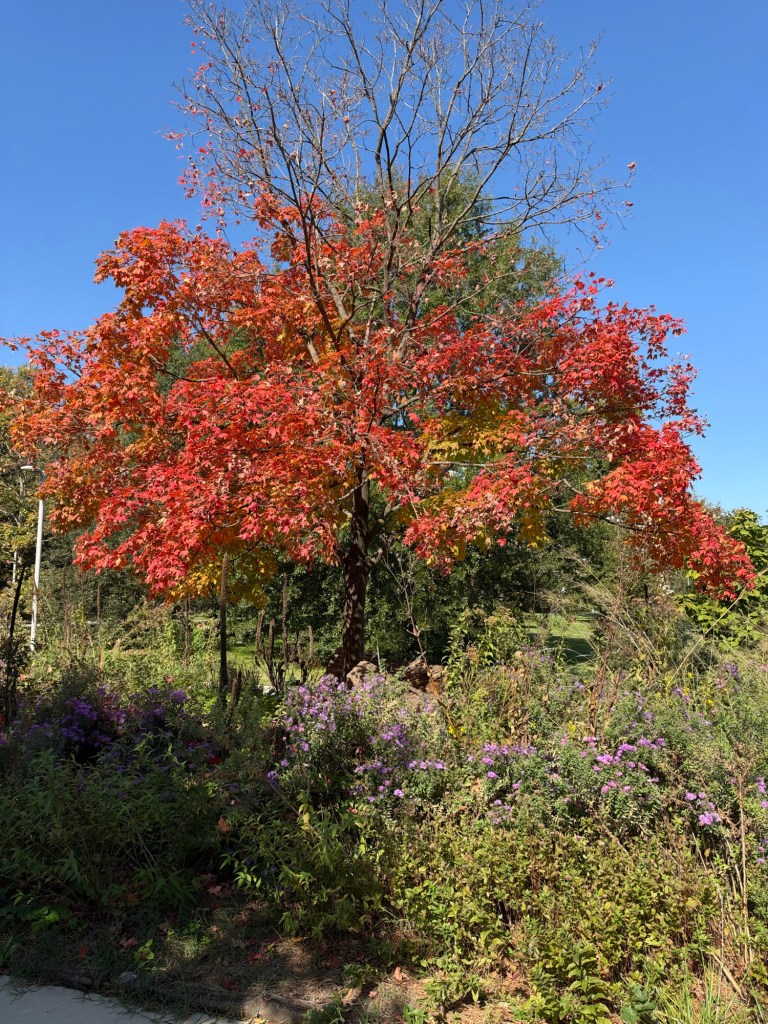
Autumn is beautiful in Virginia, and I’m trying to enjoy it all I can before winter comes.

