
Two weeks ago, the day after the Labor Day holiday, more than 600 language students arrived at the Foreign Service Institute (FSI) for orientation ahead of language training for their upcoming assignments.
I arrived early with a big grin on my face. I was nothing short of elated to be there. After 12 years in the Foreign Service, five tours, and three periods of long-term language study at NFATC—28 weeks of Russian in 2014–2015, 24 weeks of Spanish in 2019–2020, and 44 weeks of Burmese in 2024–2025—I was finally embarking on another 44 weeks of study in what would likely become my favorite language of all.
Since 2025, FSI has more commonly been referred to by its full formal name, the National Foreign Affairs Training Center (NFATC), pronounced most often like “en-FAT-see.”
Having already learned three languages at NFATC as an FSO, I was not particularly interested in returning for another stint after the rigors and angst of Burmese—unless it was a language I was personally interested in learning. This objective shaped my sixth-tour bidding in fall 2025, when I targeted assignments with either a Slavic-language requirement or no language requirement at all. I was also pleased to learn that earning a passing score of 3 in some of these languages would qualify me for a Language Incentive Pay (LIP) bump. Not bad during a three-year tour in the EUR bureau.
Because I served as a Peace Corps Volunteer in Macedonia (now North Macedonia) from 2002 to 2004 and my partner of almost 20 years was born there, I have always wanted to be able to speak the mother tongue of many who grew up in the former Yugoslavia. I have been exposed to what used to be called Serbo-Croatian for nearly 25 years: through social and professional interactions, film and music, history and books. My brother-in-law and his children live throughout Serbia and Macedonia. My mother-in-law was born in southern Serbia and is a native Serbian speaker.
Over the roughly 35 years since the Balkan wars and the dissolution of Yugoslavia, Serbian, Croatian, Montenegrin, and Bosnian have undergone increasing differentiation in their standardized forms, with each developing its own norms for grammar, vocabulary, pronunciation, and usage.
At the same time, the languages remain highly mutually intelligible, reflecting their common linguistic heritage and the closely related dialects on which the modern standards are based. The question of whether they are best understood as separate languages or as varieties of a single language is, in part, a linguistic question and, in part, one shaped by history, ethnic and national identity, and political considerations.
For language learners, the practical takeaway is straightforward: a strong command of any one of these varieties provides a substantial foundation for understanding the others. With some attention to differences in vocabulary, grammar, pronunciation, and usage, learners can generally adapt to the other varieties with considerably less difficulty than they would encounter when learning an unrelated language.
Having already studied Russian and Macedonian, I came to Bosnian with a significant head start. Macedonian, as another South Slavic language, gives me an intuitive feel for much of Bosnian’s vocabulary, sound system, and sentence structure, while my Russian provides a useful foundation in areas such as grammatical cases, verb aspect, and Slavic word formation. In some ways, the two languages complement each other nicely: Macedonian gives me a feel for the South Slavic linguistic environment, while Russian makes Bosnian’s more complicated inflectional system feel familiar rather than entirely new.
Perhaps the biggest advantage, however, is simply having learned Slavic languages before. At least in theory, I already know what to look for in a new Slavic language—the cognates, the prefixes and suffixes, the aspectual pairs, the grammatical patterns—and I have a much better sense of which similarities I can rely on and which apparent similarities are likely to be false friends.
Bosnian is certainly a new language for me, but it doesn’t feel like I’m starting from scratch. My listening comprehension is the strongest yet in any language I’ve studied. In a sense, Russian and Macedonian have given me two different sets of tools for approaching Bosnian, and I’m hoping the combination will make the journey considerably easier despite some expected confusion and interference.
My experience during the first two weeks has been overwhelmingly positive. We have two instructors who rotate teaching duties every other week – I’ll call them D1 and D2. There are only three students, including me, rather than the five I heard we were expecting. My classmates A and J are smart, funny, and really nice.
In much of my previous language study at NFATC, students spent three hours in class, followed by a one-hour lunch break and sometimes an additional hour of self-study, before returning for another two hours of class. The schedule essentially occupied the entire workday, leaving few, if any, windows during business hours to attend to other responsibilities. On top of that, we were generally expected to spend another two to three hours on homework and self-study after class.
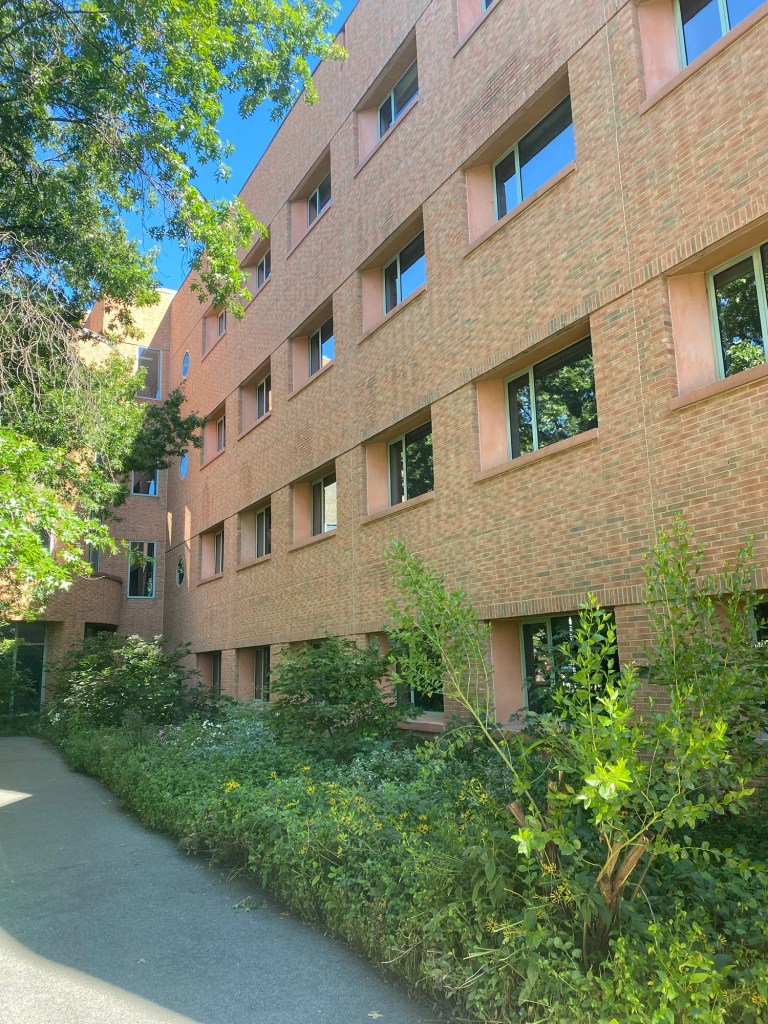
This time around, our schedule is really different. We come to class for four hours straight, with a 20-minute break in the middle and a 10-minute break after both the first and third hours. By 1:00 p.m., we’re free for the rest of the day.
Although this schedule doesn’t provide a natural opportunity to meet up with colleagues for lunch or take the walks around campus that I enjoyed so much during Burmese — with hundreds of campus nature photos to prove it — I’m appreciating the ability to knock out class in one consolidated block without having two hours to kill at NFATC. Leaving the suburban area where campus is located only to have to come back and re-park and re-focus isn’t logical or easy.
Of course, we are still expected in put in a full workday each day including 2-3 hours for homework and self-study. But at least the new schedule arrangement gives students larger blocks of time for independent study in the afternoon, along with the freedom to run errands, schedule appointments, or dedicate energy to hobbies. After two weeks, I still haven’t entirely figured out the schedule and routine that work best for me, but a balance between study, homework, errands, meal prep, exercise, and spending time with others is something I’m continuing to feel out as I go.

And I have been proactive and intentional so far about reconnecting with friends and colleagues, which I think is important for not getting lost in the difficulties of language study, maintaining your professional and social networks, and protecting your mental health. To that end, I met up twice outside of work with a colleague from my first tour (in Tashkent), once on campus and once at a Biergarten; went to visit my Burmese teachers during their lunch period; and had dinner with both a colleague from my fourth tour (in Children’s Issues) and one of my Burmese LE staff who happened to come to NFATC for immigrant visa training. V and I also had dinner the weekend before class started with friends from our second tour (in Canberra).
For now, our Bosnian class has already learned a startling amount in only two weeks. We can introduce ourselves, talk about where we’ve lived and worked in the past, describe what we like to do in our free time, ask a variety of questions, and read simple dialogues. We have a long way to go: 42 more weeks. But I’m feeling wildly optimistic about it at this point.
And once it’s over, the reward of serving three years in a beautiful country like Bosnia and Herzegovina awaits.

