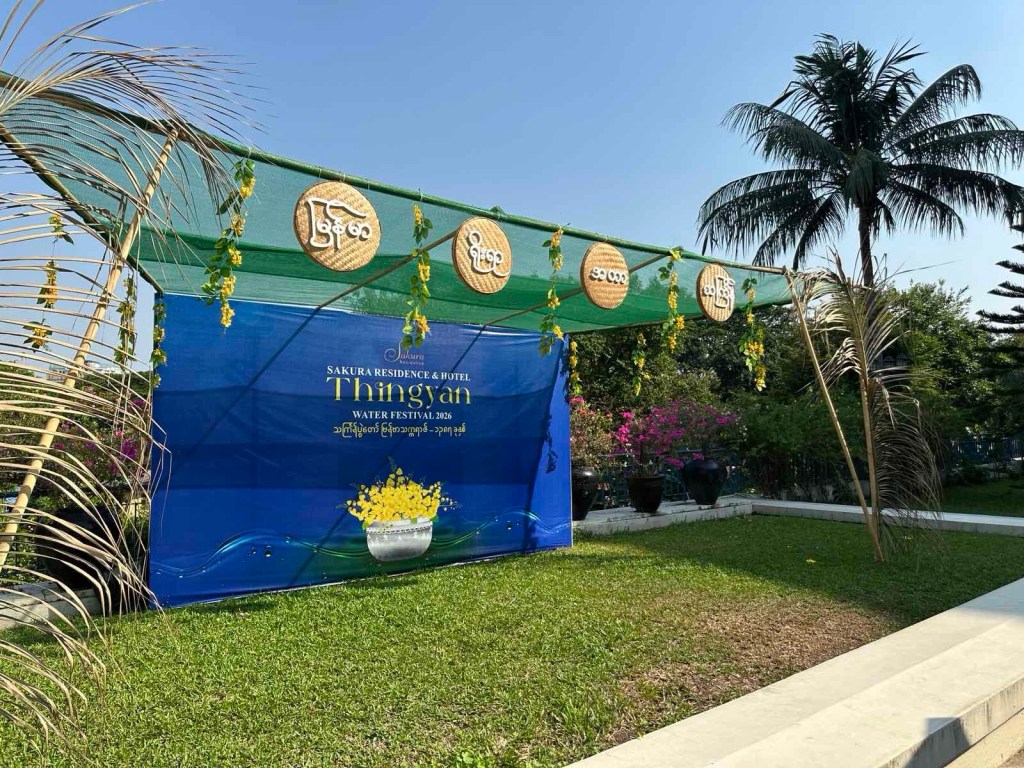
Thingyan is one of Myanmar’s most important holidays and marks the traditional Burmese New Year. Celebrated over several days each April, it is a time of renewal, reflection, and community.
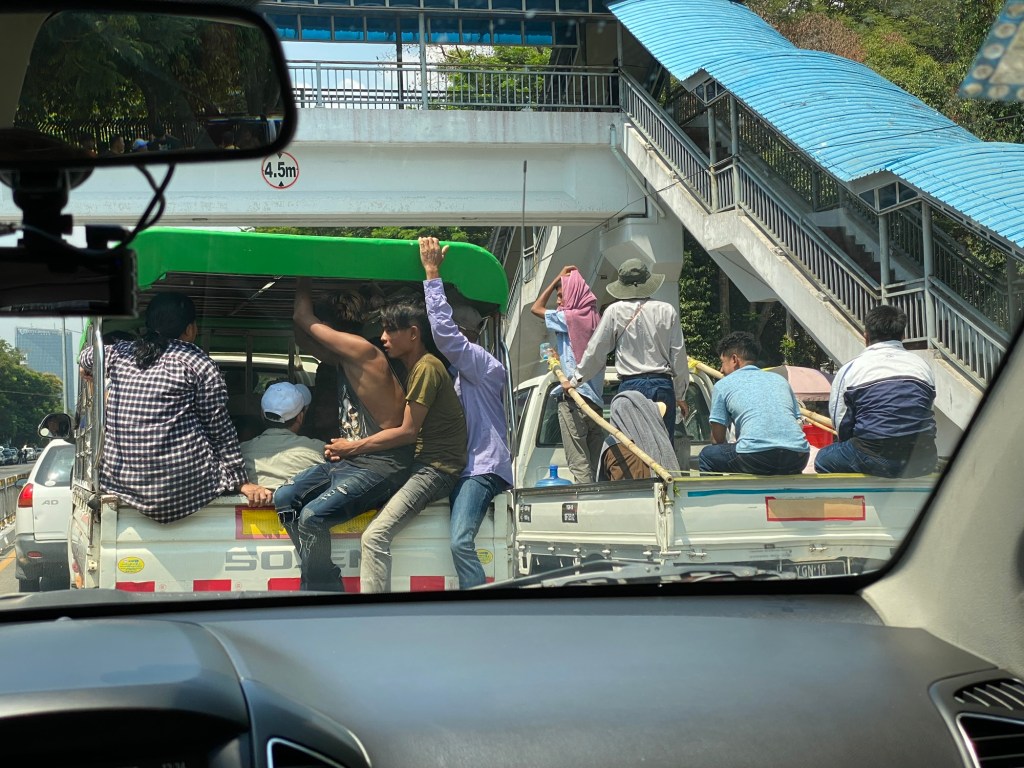
The festival is best known for its joyful water-throwing traditions, in which people splash each another with water as a symbolic act of washing away the misfortunes and impurities of the past year. In real life, this looks like a street festival in which everyone is happy to be thoroughly drenched. Beyond the festivities, many Burmese people observe Thingyan through acts of merit-making, including visits to pagodas, donations to monasteries and charitable causes, and time spent with family. Traditional music, dance, and foods are also central to the celebration. Combining both exuberant public festivities and deeply rooted spiritual practices, Thingyan reflects values of generosity, reconciliation, and hopes for a prosperous and peaceful year ahead.
In the days preceding our April R&R to the United States, we welcomed the celebration of Thingyan, also known as Burmese New Year or water holidays. I can’t think of any other local holiday during my Foreign Service career that has closed the embassy for four consecutive days. I also couldn’t think of anything better than water blessings to wash away the misfortunes I’d suffered over the preceding months. V and I were excited to participate.
A similar holiday (Songkran) is celebrated in Thailand. Both Thingyan and Songkran festivals mark the sun’s transition into a new zodiac position and the beginning of the traditional New Year. Both holidays also share a common origin and many core traditions, but each has its own distinct cultural expression.
For example, Thagyamin, a celestial king in Burmese Buddhist cosmology and folklore, is believed to descend from heaven to observe the conduct of humankind during the Burmese New Year festival. Songkran received international recognition in 2023, when UNESCO recognized the cultural importance of the traditional Thai New Year festival by adding it to the Representative List of the Intangible Cultural Heritage of Humanity.
I remember watching YouTube videos of Thingyan in my language class and was excited long before I came here at the prospect of water gun parties in the streets. People had their phones in waterproof plastic bags, and expected to get wet out in public, whether they were carrying a water gun or not. It looked like madness, although our language teacher cautioned the videos were pre-COVID. The events of 2020 and 2021 in this country scaled down or eliminated many of the celebrations, to be sure.
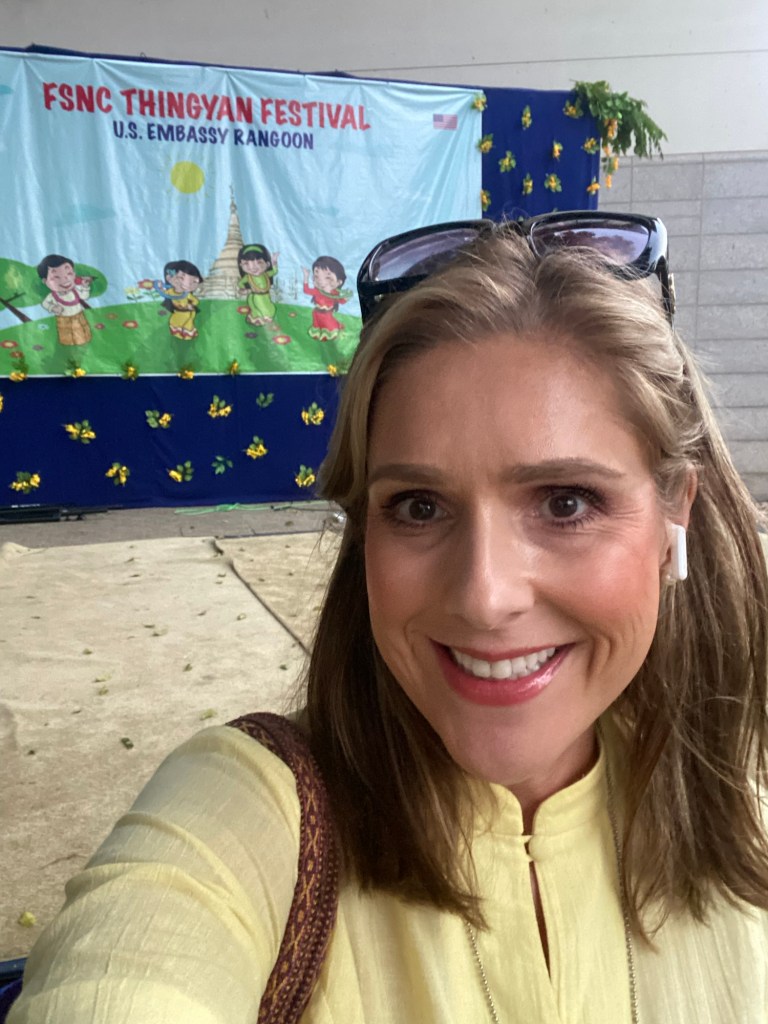
The main Thingyan celebration I attended this year was at the embassy, on a workday. I was wearing my traditional Burmese yellow blouse and skirt with yellow flowers; I have been told yellow is the perfect color for Thingyan. The padauk flower in Myanmar blooms around Thingyan. Many people, especially women, traditionally wear fresh yellow padauk blossoms in their hair during the celebrations. The flower is so closely linked to the holiday that it’s often called the “Thingyan flower.”
The embassy’s celebration included food, music, and traditional dancing. Many members of the American community donned traditional attire from different regions of the country and performed songs and dances on stage, much to the delight of our Burmese colleagues. Local staff members’ children ran around completely drenched, dousing each other with water. V and I had purchased a couple of Super Soaker-type neon plastic water guns. They had arrived through DPO mail in time and lurked, still unopened in a corner of my office, awaiting the festivities.
But when it came down to it, I decided to lend my water gun to a colleague more willing to get into the rambunctiousness of it all. I have to admit that — a bit different than the excitement and restoration I had imagined — the water aspect of the holiday made me uncomfortable in a couple of ways I hadn’t anticipated.
First and foremost, I can acknowledge—without apology—that I’m a relatively high-maintenance woman. I like to present myself in public looking neat and put together. That doesn’t mean I’m unwilling to let go of a carefully managed appearance when it makes sense to me. I wouldn’t, for example, dress up to go camping or wear full makeup to the gym. My makeup isn’t a mask, and I don’t need to look the same every day. I have no problem being seen without it. I certainly don’t feel obligated to present a “perfect” image for anyone else’s benefit.
In the right circumstances, I might even enjoy a street water fight. The videos I had seen of Thingyan looked genuinely fun. At the same time, in the ordinary rhythm of my life, I wouldn’t particularly enjoy being at work soaked and disheveled because of someone else’s actions—especially if I had no opportunity to opt out.
Which brings me to a second, more complicated point.
I’ve often wondered whether, if my accident had never happened, my reservations about Thingyan would have been fairly superficial—something along the lines of, “Please don’t ruin my makeup.” Instead, I was surprised by how intensely uncomfortable I felt about the prospect of being splashed with water after the accident.
I didn’t want to offend anyone or reject the spirit of the celebration, so I simply tried to stay on the periphery of most of the water throwing. Thingyan is a deeply rooted communal festival, and for many people, throwing water is an expression of joy, goodwill, and blessing. I understood that intellectually. No one was trying to frighten or threaten me.
Emotionally, though, I found myself reacting very differently.
I couldn’t fully explain it at the time. From my perspective—still recovering from a serious accident—the experience felt unexpectedly invasive. That reaction seemed both reasonable and unreasonable at once. Somehow, the idea of a stranger suddenly running up to me, altering how I looked and felt without my consent, and then disappearing again became entangled with the accident itself. It echoed the unsettling realization that another person’s actions could abruptly change my physical reality, leaving me to cope with the aftermath.
I also still didn’t feel entirely steady on my feet. I didn’t want to feel as though I needed to brace myself against unexpected physical contact or defend my personal space. Instead of experiencing the water as a blessing, I suspected I would respond with irritation or even anger if someone sprayed me. I knew that reaction wasn’t really about the festival, and I recognized that it wasn’t entirely fair to the people participating. Even so, it was real. I tried to set the feeling aside, but eventually I had to acknowledge it because it became almost physical in its intensity.
Instead of experiencing other people’s actions as joyful expressions of celebration, I found myself perceiving them as intrusive, even aggressive—an emotional response that surprised me because I knew it wasn’t how they were intended. Rather than feeling included in the communal spirit of the festival, I felt like I was standing just outside it, a stranger in a strange land. Realizing that I could no longer participate with the same ease or enjoyment felt like one more quiet loss—another small thing the accident had taken from me.
Myanmar is a society that generally places a high value on social harmony and collective participation, and during Thingyan the expectation of joining the celebration can feel especially strong. My discomfort wasn’t at odds with the intentions behind the festival, but it did leave me feeling that the communal nature of the celebration could easily override my own need for physical and emotional safety. In the end, I participated from the edges for a while before returning to my office. There was no other way to set a boundary, and trying to explain how I felt didn’t make sense given the context or the setting.
One of the moments I remember most warmly came when a local staff member approached me quietly and gently poured a small cup of water over my shoulder. That gesture captured the meaning of the holiday in a way I could receive. It felt unmistakably like a blessing rather than an intrusion.
Later that day, as I walked home, children leaned out of the rolled-down windows of passing cars, gleefully aiming their squirt guns at pedestrians. A few streams hit my shirt sleeve. As I approached our residence—and the site of my November 2025 accident—a security guard from a neighboring house stood with a hose, sending broad arcs of water into the air while children darted in and out beneath the spray. When he noticed me, he lowered the hose and turned the stream away, as if to avoid soaking me.
I smiled, gestured for him to keep going. His eyes were mischievous but friendly. I hurried beneath the gentle shower. As the water fell lightly over me and dampened my clothes, I laughed out loud.


Aww, everything you said makes so much sense, and it sounds like the people who know you found the perfect way to include you in festivities 🙂 I also really resonated with this post – although I haven’t had any traumatic experiences like your accident, I’ve always been really squeamish about getting “hurt” by others. I remember crying when someone pinched me on St. Patty’s Day in middle school! I don’t think this would’ve been the right festival for me either
LikeLiked by 1 person