For the past six months, I have been cooperating with the reckless driving case against the truck driver who hit and severely injured me last November. While as a victim I have appreciated having an opportunity to be heard, the process has — perhaps unsurprisingly — required me to repeatedly present my trauma for examination, documentation, and validation, often with unclear results.
Given the demands of recovery, work, daily life, and the broader challenges in this environment, I expected that pursuing closure could be complicated. I have spent a lot of time considering what closure might look like. What does restorative justice mean in this cultural context? Who am I to seek justice when so many others cannot? And at what point, if any, would participating in the process cost me more than it could provide in return?
I don’t have the answers to these questions. And I obviously won’t discuss details of the case or any of the surrounding circumstances here.
But on balance, I chose to pursue the criminal aspect of this matter because I hoped that resolving it might offer me some measure of closure. It wasn’t something I could just walk away from and pretend never happened. I feel strongly that the seriousness of the consequences to me personally, professionally, and financially requires some level of response from me.
What I did not expect was to be chastised on Facebook after writing a post about my recovery by someone I’ve barely talked to in years, cast as an agent of exploitation rather than as someone moving through a process I neither designed nor controlled. Even with my privilege in mind, his criticism placed me in a position of agency that bore little resemblance to my actual experience.
Participating in the criminal case has required me to repeatedly revisit the emotional aftermath of the crash, even while I was still dependent on a wheelchair and walker. In addition to giving my statement to local traffic police and meeting with the forensic doctor responsible for preparing injury reports for the court, in March, at the request of the court, I also underwent a comprehensive physical examination at the local public hospital.
Back when I was first injured, the embassy arranged my treatment at private hospitals, including in Thailand, in accordance with my employer’s policies for injured diplomats overseas. However, to submit medical evidence in a court proceeding in Burma, the documentation had to come from an official government hospital. Records from my private treatment in Bangkok—or even from the private hospital in Rangoon on the night of the accident—could not be submitted as evidence except insofar as they helped corroborate injuries later documented by physicians in the public system.
This wasn’t something we knew or understood earlier in this journey, nor would it have changed the course of my treatment. By the time I found out in February, the external signs of injury had mostly healed.
Undergoing the examination at the public hospital felt more stressful and intimidating than even my visit to the forensic doctor’s office at the morgue, where more than half a dozen deceased persons sadly arrived for autopsy during the short time I was there.
The difference was that the hospital required me to expose my own vulnerability without any clear medical necessity or benefit. I was not seeking treatment. None of the scans or surveillance I underwent were medically indicated. Yet, without my submitting to them, the defendant couldn’t be held to any account. It was as though the burden was on me to prove the accident caused by his behavior even happened, and that the injuries it caused me were real.
I was shown kindness and professionalism by many of the hospital staff. I was not charged anything for the assessment I received, or for the report the facility generated.
But I was photographed by other patients without my consent, exposed to extra radiation, and subjected to a level of public scrutiny that would have been unthinkable in the United States or private hospitals where I have previously received care.
Strangers viewed my medical records, listened in to my consultations with physicians, and moved freely through spaces where privacy was largely nonexistent. I also got bitten dozens of times by mosquitos. Perhaps taking photos that day was, in part, a defensive reaction on my part, alongside an honest desire to capture and convey something of the experience to friends and colleagues.
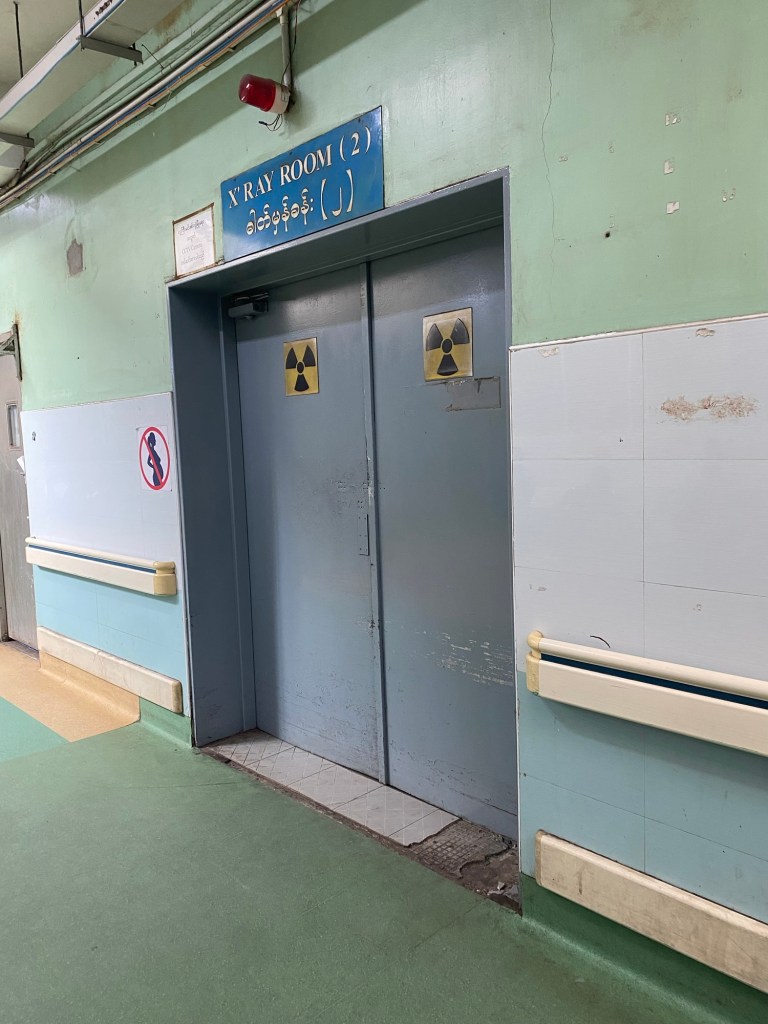
Another dimension of my hospital visit was the public health context. Burma is a high-burden tuberculosis (TB) country, with annual incidence rates measured in the hundreds of cases per 100,000 people, compared with roughly three cases per 100,000 in the United States. A public hospital here is therefore a very different infectious-disease environment from what most Americans would expect.
Because I am immunocompromised, spending hours in a crowded and under-resourced public hospital carried a level of concern that would not have existed in a typical U.S. medical setting, where TB is far less common and infection-control measures are generally more robust. Exposure does not mean infection, but the combination of my health status, the prolonged time spent in the facility, and the broader public health context made the experience feel more consequential than simply completing a required set of examinations.
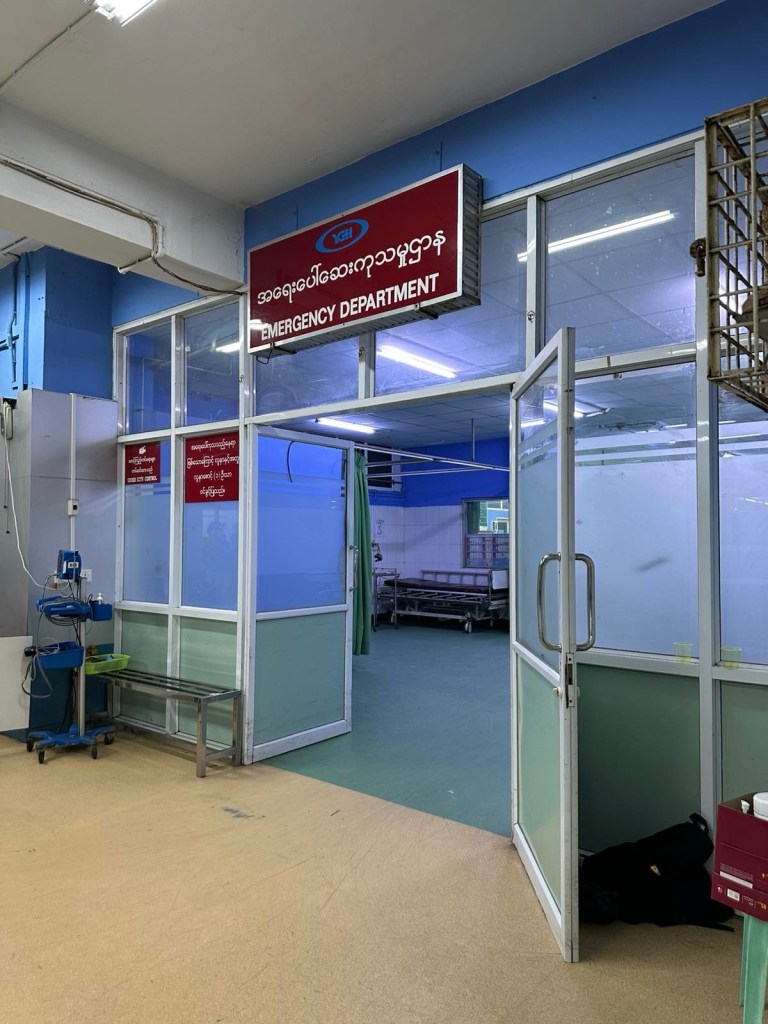
The visit took hours longer than expected, consuming not only my workday but also the time of two local staff members and our driver, who accompanied me throughout the process. By the end, I was physically exhausted and eager to get home, shower, and put the experience behind me before returning to the office.
The next day, I made a Facebook post about my hospital visit, explaining why I had been there, what I observed, and why undergoing the experience mattered to me. I included several photos of me at the facility. Some of the photos showed other patients in the background, with their faces turned away, or out of focus.
The following morning, I woke up to a disturbing comment from a Facebook friend who had tagged me on my own post. It read:
“(My name), glad you’re healing, but this post is remarkably tone-deaf, especially for a Peace Corps volunteer. Secretly photographing unconsenting patients on hospital beds to show your Facebook friends how shocking it was to sit among ordinary Burmese people? Their suffering isn’t your content.”
When I read it, I was stunned. This was someone I had known for nearly 24 years. Why would he assume I was using local patients’ hardship for social media attention? And why post such a harsh comment all my network could see instead of raising his concerns with me privately? Did he not think I counted “ordinary Burmese people” among my close, respected friends and colleagues, with whom I spend all day, every day, and there’s nothing remotely shocking about it?
Over the years, I have tried to respond thoughtfully in difficult situations rather than simply react. Sometimes I have succeeded; other times I have not. I have also learned that right and wrong are often less clear-cut than they first appear. Two people can be wrong at the same time.
My friend—whom I’ll call N—may have been wrong in how he delivered his criticism, while I may have shown too little discernment in the photos I shared and should have been more careful to blur faces (in my defense, people were only visible from the side or back and no one was identifiable). After rereading his comment, I removed a couple of photos that showed but a sliver of someone’s face. The rest of the photos did not contain people, but showed the facilities, and I left those up.
I was able to acknowledge that I had been at least slightly in the wrong about my photo judgment. The more I thought about N’s comment, though, the angrier I became. In the end, I removed him from my Facebook friends. I didn’t feel the friendship was strong enough to warrant a direct conversation; the depth of his misunderstanding made me question how well he knew me at all. Nor did I feel compelled to justify my actions to him.
Yet as I continued reflecting on his words, I became increasingly interested in a different question: Why had his criticism affected me so deeply? Exploring that question felt worth writing about here.
Erasure
“Their suffering isn’t your content.”
N’s comment assigned a motive to my post that I did not recognize in myself. To begin with, I don’t think of anything on my Facebook account as “content.” It is a scrapbook of my daily life, maintained for more than 19 years and shared with a community that has gradually grown to over 1,000 friends and family members.
My Facebook page is not this WordPress blog, which I write carefully for a public audience, nor is it my purse-focused Instagram account, where I intentionally create and curate fashion-related posts, even though I do not monetize them. Simply put, my Facebook is the most authentic social media I have. Two decades of posts back that up.
More importantly, I had not gone to the hospital looking for “material.” I was required by the court system to return to a public hospital to have injuries from a life-threatening accident documented. N’s accusation felt like an erasure of what had actually happened. I wasn’t engaging in ugly poverty tourism or looking for an opportunity to make a point about Burma. I was complying with a legal requirement after becoming the victim of a crime.
I was an injured person navigating a strained public system and trying to explain what that experience revealed—not inviting an audience to pity the people around me. Photographs from a firsthand experience can communicate realities in a way words cannot.
The accident initially made me feel alienated from this country I was just getting to know. On reflection it was also proof that I had become immersed enough in local life that I was no longer moving through it as an outsider.
In some ways, the accident happened because I was living here not as a visitor looking in, but as someone participating in daily life as it is actually lived. I crossed streets the way people here cross them, moved through the city the way people here move through it, and accepted risks that become ordinary when they are part of everyday life. The accident was not something that happened while I was standing apart from Burma; it happened because I was embedded within it.
That realization became important in the aftermath. In the weeks after I was injured, I struggled with feelings of rejection and estrangement from a place I had worked hard to understand, including during my 10 months of language study before I even arrived.
Yet I ultimately concluded that the accident itself was evidence of a different truth. It happened precisely because I was on the inside rather than the outside. I had ceased to experience the city as a protected observer and was instead navigating it under the same assumptions and routines that shape daily life for the people around me.
The privileged bubble around me was undeniable. I was but a temporary resident in this exotic land.
But I smelled the burning trash, experienced the blackouts, got the food poisoning, just like everyone else. I truly saw the people: their elegance, their dignity, and their struggles that most of the world doesn’t even know about. I celebrated their holidays, witnessed their religious and cultural practices. Was there some way to show this humanity, in all its complexity?
There is little comfort in the accident itself, but there is some comfort in what it represents. The circumstances that led to my injuries were, paradoxically, also evidence of a degree of integration and acceptance that I had not always felt. The accident was a consequence of participating in life here rather than remaining separate from it, and recognizing that helped soften the sense that I had somehow been rejected by the place. It reminded me that, however imperfectly, I had become part of the rhythms and realities of the community around me. I felt a powerful sense of respect and reverence towards the beautiful people here that even the accident couldn’t completely ruin.
What particularly troubled me about N’s comment, then, was the way he framed the intentions behind my post. His comment positioned me as the person with power: the detached observer exercising agency over vulnerable Burmese patients. But that was not how I experienced the day at all. I was not standing outside the system looking in. I was inside it, subject to its demands. I was there because a legal process required me to prove that another person’s criminal actions had permanently altered the functioning of my own body.
That reality does not eliminate legitimate concerns about privacy or consent in photographs. It does, however, complicate the moral picture. N’s interpretation reduced the experience to a familiar narrative: a privileged foreigner observes suffering locals and turns their hardship into a story.
In doing so, it flattened the fact that I, too, was there in a position of vulnerability. I was out of my element, confused, and the subject of intense attention and curiosity. I am again not trying to deny that I possessed certain privileges in that situation. But the circumstances were not of my making. The hospital was not a backdrop for my observations; it was a place I was compelled to enter, navigate, and endure, with a level of pain and discomfort apparently evident only to me. It is my experience to interpret, process, and share.
Just as my Instagram account documents a curated version of my life with my interest in handbags superimposed over the top, centering the bags like the gnome visiting exotic destinations in the film Amelie, my Facebook account documents my life through the lens of wherever I happen to be living. My hope is simply that people who know me might see those glimpses and gain a small measure of understanding about what daily life is like where I am—and not just for me.
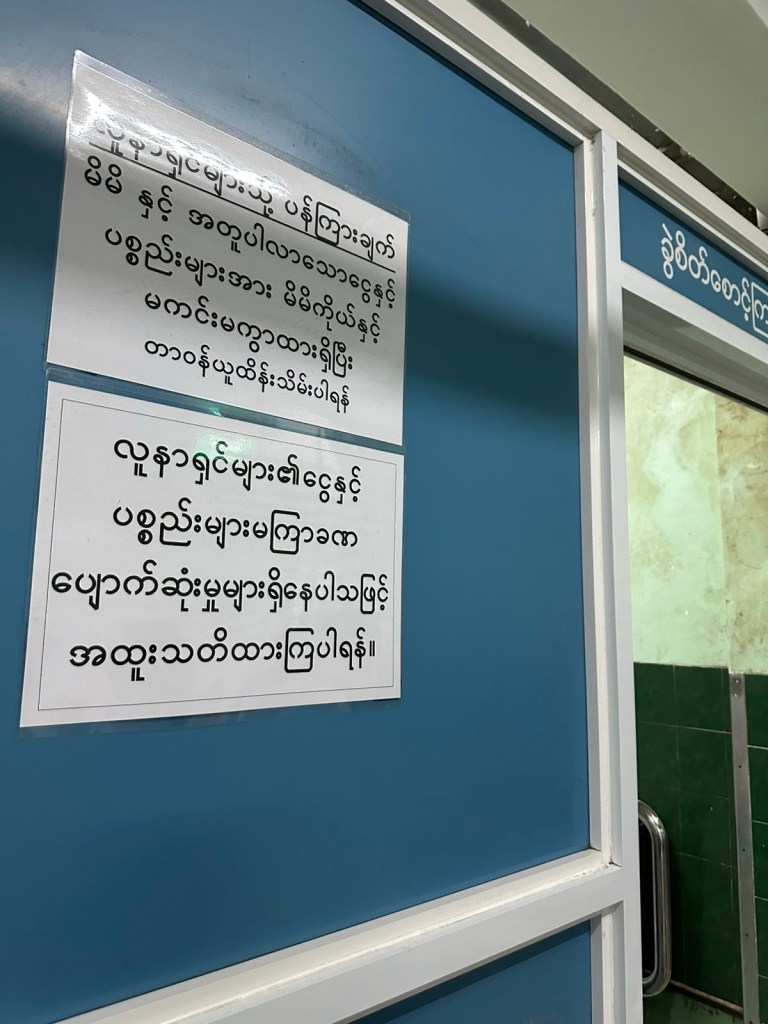
Collapsing “documenting a system” and “judging people.”
N also interpreted my attempt to show—without explicitly condemning it—what ordinary people endure when seeking medical care in a severely constrained system as a message of, “Look at these poor people.” That interpretation was especially painful because it ran counter to values I have tried to uphold throughout my years abroad.
I have always tried to portray life in every country where I have lived—including in my own and developed countries like Australia—with nuance and respect. Simplistic “good country” or “bad country” narratives have never interested me. My experiences are necessarily filtered through my own perspective, and others may experience the same places very differently. My goal has never been to pass judgment on a country or its people, but to document the reality I personally encounter within it.
Because my connection to N originated through my Peace Corps service, his criticism landed squarely on values I have long tried to embody. The phrase “especially for a Peace Corps volunteer” felt less like a concern about privacy and more like a personal indictment. Being accused of participating in a colonial or voyeuristic dynamic felt like something far larger than a critique of a few photographs.
Had he said, “I’m concerned about the privacy implications of these images,” I would have heard a specific criticism of my actions. Instead, the message was, “You should know better.” It was a judgment not only of what I posted, but of who I was. By invoking my Peace Corps service, he appealed to an entire ethical framework—humility, service, and respect for host communities—and suggested that I had violated it.
To be fair, N’s concern did not emerge from nowhere. There is a long history of outsiders photographing suffering in ways that are exploitative, dehumanizing, or self-serving. Like many criticisms that contain a kernel of truth, this one stung.
What troubled me, however, was how quickly that framework was applied by a keyboard warrior without regard for the specific circumstances. It assumed a simple dynamic: outsider with camera, local person without agency.
But the reality was more complicated. I was not observing a system from a position of detachment; as I have explained, I was moving through it as an injured participant. And the norms surrounding privacy and consent were not distributed evenly. In many places, including here, expectations around privacy in public institutions differ significantly from what someone from the United States might expect.
None of this means that ethical concerns disappear or that “anything goes.” It does mean that documenting a system is not the same thing as judging the people within it, and that the moral landscape is more complex than a binary distinction between observer and observed.
Grief and trauma
I went through a traumatic accident, a foreign legal process, and a medical ordeal that is still far from over. Much of my writing and sharing about the experience has been driven not only by the fact that I survived, but also by a desire to understand what it revealed about the place where I live and the people around me. Writing has been part of how I make sense of what happened.
N’s comment suggested that this effort to process and share the experience was itself morally suspect. Frankly, he doesn’t know me well enough to assess this. He also was not among the several hundred people who reached out to me on social media following my accident to convey support and sympathy. But his words were still painful to read. After months of vulnerability, uncertainty, and recovery, it felt less like a critique of a Facebook post and more like a condemnation of how I had chosen to navigate the aftermath of a life-altering event.
The criticism overlooked the vulnerability I had experienced throughout the process. The months of pain, suffering, expense, and loss of agency. My medical records, my injuries, my personally identifiable information in court documents, my body, and my trauma all became things I was repeatedly required to hold up for inspection and validation, even as the person who caused the harm is free and I continue to live with the physical consequences of his decisions every day.
The public hospital visit itself was another exercise in surrendering privacy. I accepted much of this with the restraint expected of a diplomat and because I understood that I was operating within a system whose norms differed from my own.
To then be publicly accused of treating other people’s suffering as content felt like a complete inversion of the story. The criticism focused on the possibility that I had violated someone else’s privacy while largely ignoring the ways my own privacy and dignity had been exposed throughout the same experience.
That does not mean concerns about consent are unimportant. They are. But when someone lectures you about consent while overlooking the circumstances that placed you in a similarly vulnerable position, it feels like the moral standard is only being applied in one direction. What angered me was not simply the criticism itself. My own humanity—and the reality of what I had been through—had disappeared from the frame.
Part of getting older and wiser is focusing your energy better. Sometimes that means determining which friendships deserve maintenance and repair because you and the other person truly see one another, versus which friendships were important for a season in life and have now run their course.
It is not my intention to defend myself or to give too much oxygen to a comment that contained more heat than light. I do not believe the relationship itself warrants this level of engagement with the criticism. I do, however, think the underlying subject does.
What happened raises broader questions about how we interpret images, assign intent, and draw moral conclusions from incomplete context—especially in situations involving vulnerability, unequal power, and incomplete information. Those questions feel worth sitting with, even when the immediate trigger does not.
 Collecting Postcards
Just curious, were you required to waive P&I for the court case? I had a similar situation in South Africa, but the juice wasn’t worth the squeeze.
LikeLike
I did not.
LikeLiked by 1 person