Last weekend marked Burma’s sacred holiday of the Full Moon of Thadingyut (pronounced like tha-TIN-jut). The date of Thadingyut varies each year because it follows the traditional Burmese lunar calendar, which is based on moon cycles. Usually Thadingyut falls in October, but it can also occur in late September.
We had a three-day weekend in honor of the occasion. While most local people celebrated by visiting family around Burma and observing Buddhist traditions of thanksgiving, I took the opportunity to relax. I had a nail appointment, spent several hours swimming, and caught up with friends throughout the weekend — a Friday evening out at a new American-style 1950s diner; fabric shopping on Saturday afternoon with colleagues to commission a Burmese dress set, followed by an embassy Oktoberfest gathering that evening; and a Monday afternoon luncheon hosted by our neighbors next door. But the most special part of the weekend for me and V was finally visiting Shwedagon Pagoda, Rangoon’s golden temple, on Sunday evening.
Shwedagon Pagoda hosted a lighting ceremony for Thadingyut, as major pagodas in Burma do. The Thadingyut Festival has been celebrated for over 2,500 years, and Shwedagon itself is about that old. Thadingyut is one of the most significant and beloved holidays in Burma, holding religious, cultural, and social significance. I wouldn’t have missed the ceremony, as this annual holiday won’t happen again during our tour.
History and Celebration
Thadingyut marks the end of Buddhist Lent (Vassa) — a three-month period during the rainy season when monks remain in their monasteries to study and meditate. It also signals the conclusion of the monsoon season that begins during the Waso full moon, usually in July. During these three months, monks traditionally avoid traveling to focus on spiritual practice — not to mention the impracticalities of traveling in many areas of Burma during the rains.
According to Buddhist belief, the Buddha spent the Lent period in the celestial realm of Tavatimsa. He was teaching the Abhidhamma (Buddhist philosophy) to his mother, who had died and was reborn there seven days after giving birth to him. On the full moon day of Thadingyut, the Buddha descended back to earth, accompanied by celestial beings who illuminated his path — hence the festival’s lights and lanterns.
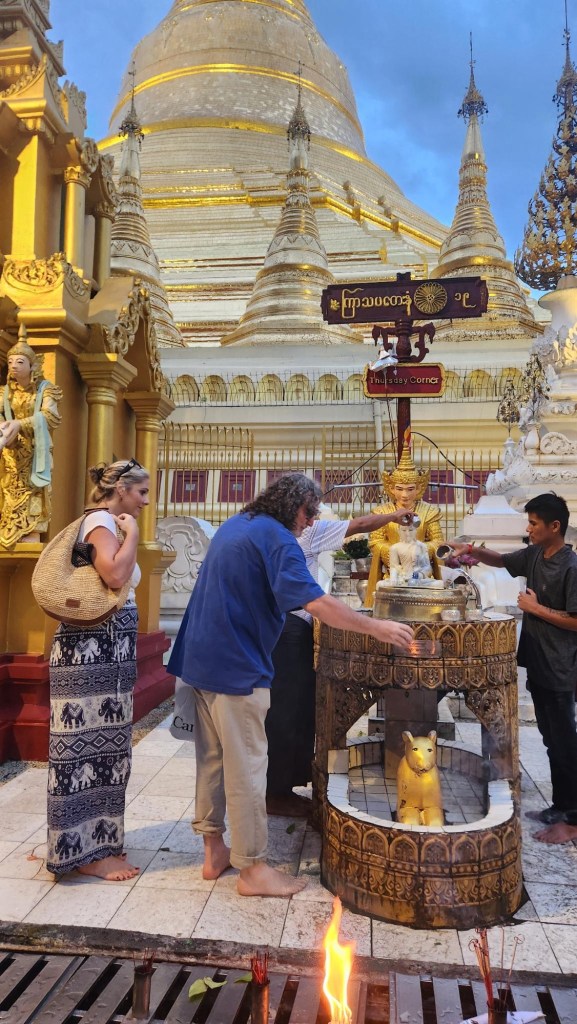
During Thadingyut, homes, pagodas, and streets are decorated with colorful lights, candles, and paper lanterns to symbolize the heavenly lights that guided the Buddha’s descent. The festival is marked by family reunions, music, food stalls, and street fairs. Major pagodas hold special lighting ceremonies and are crowded with devotees offering candles, incense, and flowers.
In rural areas, it’s also a time of joy and community gathering after the agricultural lull of the rainy season. Businesses and government offices often close for three days, and travel surges as people return home to celebrate with family.
Young people pay respect to their parents, teachers, and elders by kneeling and offering gifts or symbolic offerings (like fruit or candles). In return, elders give blessings — and often small sums of money — to the younger generation.
A festive atmosphere fills the air, reminiscent of Christmas — of course, absent the attendant cold weather Americans and Europeans would expect. People of different ethnic groups dress in beautiful traditional outfits and go out to celebrate.
Meaning
Similar to the Macedonian holiday of Prochka (Прошка), which marks the beginning of Lent on the Orthodox Christian calendar, Thadingyut is a time to seek forgiveness for any wrongdoings committed over the past year.
Though these two traditions arise from different faiths and lands, they share a profound common thread: the belief that forgiveness renews the spirit and that light, whether divine or human, can illuminate the way forward. Both holidays center on the moral act of forgiveness — cleansing relationships, acknowledging human imperfection, and renewing harmony within families and communities.
Both also combine religious observance with social warmth — visits, gifts, and shared food — marking key transitions in the spiritual year.
Ultimately, Thadingyut represents light overcoming darkness, gratitude, and reconciliation: themes that resonate deeply in Myanmar’s Buddhist culture. It is a reminder to reflect on one’s actions and mend relationships, express gratitude to those who have guided you, and renew your own commitment to spiritual and moral conduct. This is especially important to understand in the context of a civil war that has been raging here for over four years already.

Shwedagon Pagoda
The pagoda was built around 588 BC, when Gautama Buddha attained enlightenment, making it one of the oldest Buddhist pagodas in the world. King Okkalapa reportedly received eight strands of the Buddha’s hair as a blessing and enshrined them inside Shwedagon, along with the relics of three previous Buddhas. (Buddhists believe there will be one future Buddha during our present era for a total of five; however, Buddhism teaches that “world-cycles” are endless, and that each era can produce multiple Buddhas.)
Shwedagon is visible from almost everywhere in Rangoon, rising nearly 100 meters atop Singuttara Hill and dominating the city’s skyline — a true spiritual and physical landmark.

The pagoda is built in the classic bell-shaped Burmese stupa style, representing the Buddha’s path to enlightenment. Its layered tiers symbolize the Five Elements — earth, water, fire, air, and space. In deeper detail, the pagoda features mouldings, octagonal ridges, inverted lotus designs, and just above the girdle, a festooned, inverted alms bowl.
Its surface is covered in real gold leaf and plates — not just gold paint. Over the centuries, Burmese monarchs and the faithful donated gold leaf and jewelry to maintain its splendor. Today, the stupa is plated with an estimated 27 metric tons of gold. The gold is periodically replaced or refreshed with new leaf donated by the public — a tradition that continues to this day.
At the top of the stupa is the hti, or umbrella-shaped crown. The hti is an elaborate, sacred finial encrusted with jewels and precious metals, including 5,448 diamonds and 2,317 rubies, sapphires, and other gems. The hti also features over 1,000 golden bells that chime softly in the wind. At its very pinnacle sits the pagoda’s crowning jewel: a 76-carat diamond. You can view it up-close via an observation station.
It’s truly unbelievable.

In terms of territory, the terrace sits on 14 acres, but the broader property comprises 114 acres.
The main pagoda’s base circumference is 1,421 feet around, or nearly 433 meters. The main stupa is surrounded by 64 smaller stupas and four primary entrances, each guarded by massive mythical lions called chinthe.
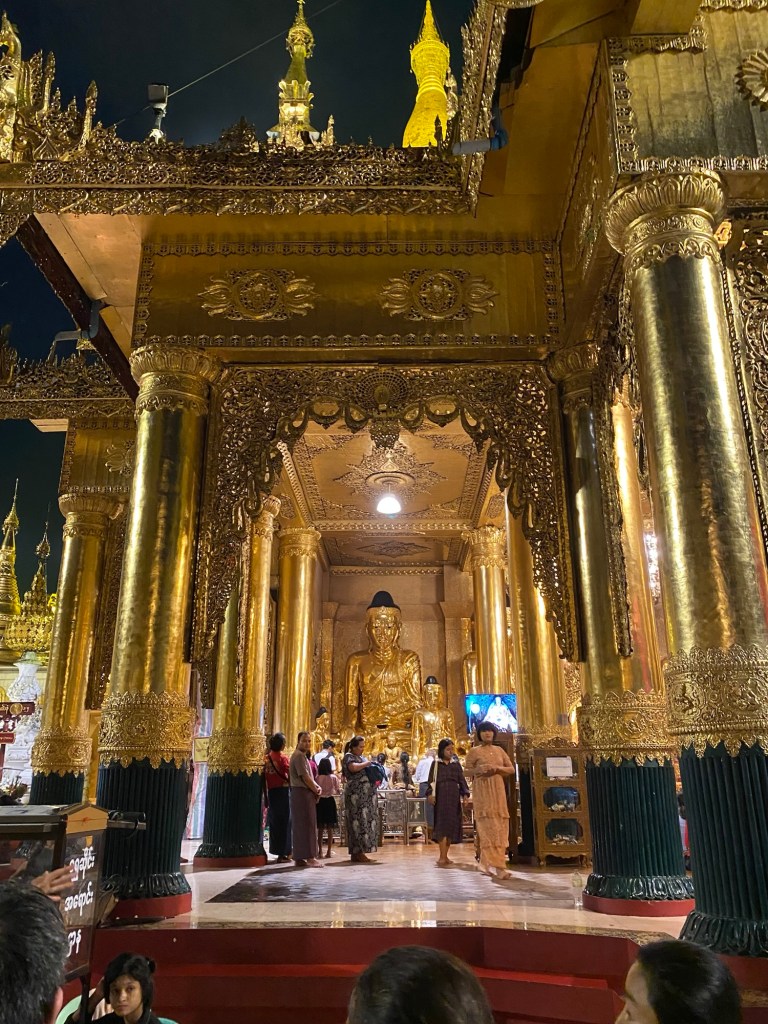
Around the main platform are dozens of shrines, prayer halls, and pavilions, many donated or maintained by former Burmese kings, ethnic groups, or modern devotees. The tourist map we received marks 18 different depictions of the Buddha throughout the compound.
Despite centuries of change, the pagoda’s core brick structure has endured since antiquity. The pagoda has been damaged and restored multiple times, including after earthquakes.

Our Visit
The embassy’s generous and kind Community Liaison Office, or CLO, and our embassy Burmese teacher organized and facilitated this memorable trip for any embassy colleagues who wanted to join.
Attendance cost for foreign visitors is hovering between $11 and $12 USD each (45,000 kyat). Burmese currency is fluctuating ahead of national elections expected later this year; a month ago, the cost for this ticket would have been closer to $10.80. Regardless, it was well worth the price.

The pagoda itself glows in gold leaf and sunlight by day, the intensity shifting gently as the sun sets. It then startlingly appears solid gold under floodlights by night. It’s almost impossible not to gasp when you first see it.

When we arrived, it was gently raining. No shoes may be worn on the property, and attire must cover shoulders and knees.
We had to remove our sandals and carry them inside the plastic bags we’d tucked inside of our totes and backpacks. An attendant affixed a sticker to each of our shirts indicating we’d paid our fees, and we were then gifted a bottle of drinking water. Grasping our umbrellas and smartphones, we walked barefoot through security and climbed a long set of indoor-outdoor stairs lined with vendors.
Even among the holiday crowds, the atmosphere felt serene and peaceful. We heard the soft rhythm of chanting, the clinking of bells, and the quiet sweep of barefoot pilgrims circling the stupa. The smell of incense filled the air. A man blew into a conch, which made a horn-like sound as a sort of parade procession began.
We quietly circled the stupa clockwise, intended to be an act of reverence and mindfulness. I wore a long, modest Thai elephant skirt, which I’d bought outside the Grand Palace in Bangkok in 2016 when I went to pay my respects to the recently deceased Thai king. The hem barely touched the wet white tiles, but the fabric quickly soaked up water like a paper towel. At first I tried to gather and lift it, but later gave up as the rain continued to fall. I surrendered to being too impressed by my surroundings to care about personal comfort.
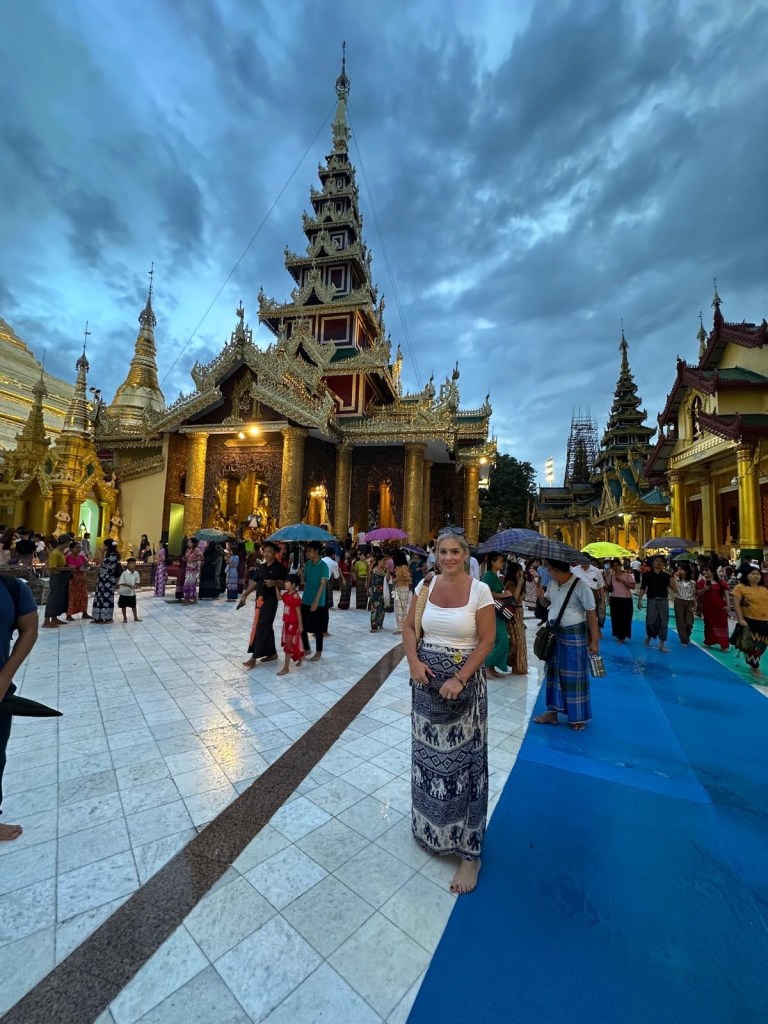
In my opinion, sunset hour is the most beautiful time to visit Shwedagon. The stupa deepens from gold to amber to rose as the light changes. Once darkness falls, the thousands of ceremonial candles flickered, and the pagoda gleamed like a crown over the city. I’ve seen Shwedagon lit up on regular nights from afar, but this was my first time to see it up close. No photos could do justice to the actual experience of standing in front of it, especially with all the extra holiday accoutrements.
The glowing pagoda mirrors the spirit of Thadingyut — light overcoming darkness. We circled it more than once, but the amount of detail and intricacy to gaze upon left me feeling pleasantly dazed and never at a loss for something new to glimpse.

Just as the Buddha’s descent is celebrated with lanterns and forgiveness, the pagoda itself seems to embody renewal — a reminder that even in stillness, there is warmth and connection. Standing beneath its gleaming spire, I felt both an outsider and somehow part of the rhythm — a guest in a place where light and devotion quietly touch everything.
Disclaimer: Please note that I am not an expert on Burma or Buddhism. Any mistakes in this text are the unintentional mistake of the author. I wrote this post to share my well-wishes and reflections about this beautiful and little-known place.
If you’re interested in seeing the video I took at Shwedagon, you can watch the reel on my public-facing Instagram @life_in_multicolore.
 Collecting Postcards
wow beautiful & amazing. Thank you for sharing!
LikeLiked by 1 person
Stunning pictures!
LikeLiked by 1 person