
When I count up the past two weeks of Bosnian class, we really only had six full days of language instruction. There was one federal holiday and one Area Studies day. Of the remaining eight class days, two were devoted primarily to our small cohort’s first progress assessments, for which we were aiming to achieve a language score between 1 and 1+. With three students and two teachers, both of whom participate in each assessment (one serving as the examiner and the other as the tester), we took turns completing our assessments individually over Thursday and Friday of week 11. While one student was being assessed, the other two studied independently.
Although the number of in-language classes we have each week will continue to be affected by holidays and our Area Studies course through January, the power of showing up and participating continues to pay off.
The power of showing up
Most days, I feel enthusiastic about going to class and genuinely glad to be there. But as anyone who loves their job knows, even the things we love and feel so lucky to be able to spend time on can occasionally feel like a chore. There are truly days when the only thing anyone really wants to do is snuggle into our blankies and stay there.
Even when it’s raining, I’m tired, I’m scrambling to finish homework, I don’t feel particularly prepared for class, or I’m just generally not in the mood to engage with the world, I’ve made a point of getting up, showering, getting dressed, and going to FSI anyway, no matter what (except on two days when I was legitimately sick).
And I’ve come to realize that, on some days, that is most of the battle right there. There’s something to be said for simply showing up, especially when you don’t particularly feel like it. Once I’m there, settled in, and engaged, any inertia is long gone, and the day becomes something that in retrospect I’m very glad I didn’t miss. Just as with going to the gym or any number of other things people tend to avoid, the daily choice—and the discipline—to keep showing up trumps motivation every time.
First progress assessment in the books
The good news, right up front, is that I passed my first progress assessment Thursday with a score of 1+. I spent multiple days preparing over weeks 10 and 11. I reviewed all our prior units, did grammar drills, practiced formulating questions, played vocabulary flashcard and Wordwall games, and came up with talking points for all the topics I expected could be covered — such as my biography, free time and hobbies, educational and professional accomplishments, life and work overseas, vacations, public transportation, education, and some simple news topics.
In the post-assessment feedback session, my instructors told me I was ahead of schedule, as students were expected to reach somewhere in the range of 1 at this stage of our program. Obviously, I still have significant work ahead of me to reach the score of 3 required for my language-designated position so I can go to post. Nevertheless, this was an encouraging result, and I worked hard to earn it.
The art and science of language scores
Progress assessment scores are the most quantifiable measure of our meeting required program benchmarks. Language courses as long as ours (44 weeks) typically include three or four informal progress assessments at predetermined intervals, culminating in an End-of-Training (EOT) test at the conclusion of study. The EOT determines our official final language score and whether we are cleared to PCS. Although our progress assessment scores are not official, they provide useful reassurance—or an early warning—about how we’re tracking toward that final goal.
It seems to me that NFATC has been exploring different testing methodologies for some time. The assessment and testing processes have shifted several times since I first studied Russian in 2014. Among the most notable changes I can recall are the elimination of the formal reading test requirement while I was studying Burmese in late 2024 and an announcement earlier this fall that a less formal, teacher-led Testing by Observation (TBO) approach may be on the horizon for future cohorts.
I support both of these decisions: placing greater emphasis on speaking proficiency and potentially replacing the high-stress, performative EOT process with a system in which the teachers who know us best determine whether we have met our training objectives. I see both as positive developments. The former should help us become more fluid and effective in using the language to carry out our work, while the latter would allow for a more holistic assessment of what we have learned, rather than reducing our progress to a single, pressure-filled test performance.
The NFATC (National Foreign Affairs Training Center) language proficiency system uses the Interagency Language Roundtable (ILR) scale, which runs from 0 to 5, with plus ratings (such as 3+) indicating performance between two number levels. ILR ratings aren’t simply a measure of grammatical accuracy or vocabulary size. They’re meant to measure what someone can actually accomplish with the language across four dimensions: functional ability, linguistic accuracy, meaningful content, and contextual appropriateness.
A 1 to 1+ on the ILR scale represents elementary proficiency. It’s the stage where someone moves beyond memorized phrases and begins to independently communicate in the language, but is still operating within a fairly narrow range of situations. For someone learning a language at FSI, this is an important developmental stage: the transition from knowing vocabulary and grammar to actually being able to use the language spontaneously.
The difference between a 1 and a 1+ can most simply be described as moving from “I can communicate basic information,” up to “I can have simple conversations.”
I’m ostensibly at the level where I can expand beyond basic biographical exchanges. While I can often sustain a conversation, I may struggle when asked to explain why something happened, defend an opinion, or discuss an unfamiliar subject.
Other characterists of a 1+ include good control of much of the high-frequency vocabulary; inconsistent control of basic grammatical relationships; more ability to organize thoughts, but limited cohesion in longer statements; errors with references to people, places, and time; difficulty maintaining accuracy as sentences become more complex; and some ability to use cultural references and socially appropriate expressions. I think the latter part is especially relevant to me since I have been listening to this language for over 20 years and already have a level of cultural competency I haven’t experienced during past FSI language study.

Other cool things that happened during weeks 10 and 11:
- Our friend T who was also our social sponsor, interagency colleague, and next-door neighbor from Rangoon — with whom we spent a lot of fun and happy times during our recent Burma tour — came to DC for a brief visit. We got to see him for a short lunch and it was so, so good to reunite and see one another in a different context. T, V, and our housekeeper P had bid us farewell in August in our driveway as we had prepared to take our final trip to Rangoon’s airport and begin our long journey back to the United States. He told us that since we had departed, he and his own awesome spouse named V were able to confirm their extension in Rangoon until roughly 2029, which means he will continue being the life of the party there for years to come.
- Another of my Rangoon colleagues from the consular section, M, came to FSI for training, and we had a chance to catch up on the cafeteria patio on an uncharacteristically sunny autumn day. M had been one of my three Burmese language classmates. Of the other two, one has since retired and the other has moved on to her next assignment. Of the four of us, M is the only one who had a two-year tour and is therefore still in Burma. The last time we had seen each other was in August, when our section posed for a photo in front of the embassy. Afterward, I crossed the embassy grounds alone and departed for the last time, with only a few hours remaining before V and I were to PCS. It was nice to reconnect here under such different circumstances, especially knowing M was able to attend the training. It had been my recommendation, as his supervisor, that he be given the opportunity, and he deserved it. With only a quarter of his own tour remaining, he can finally see the finish line and begin looking ahead to his second assignment.
- Both V and I continued our own healthcare journeys with doctor’s appointments, PT, blood tests, and other treatments we need to do after returning from Burma.
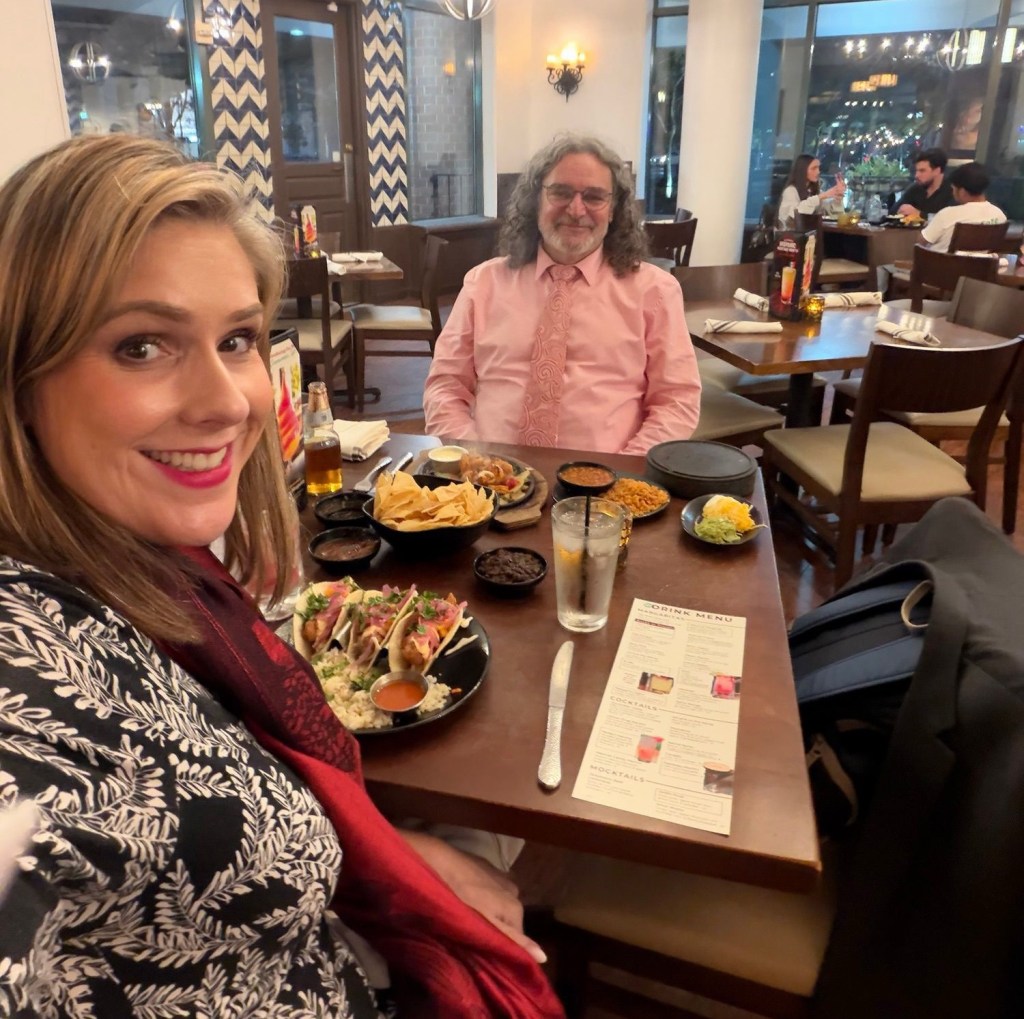
- V and I tried a new-to-us Mexican restaurant, went to see the latest Hunger Games movie, and supported my younger stepdaughter from afar as she underwent her long-anticipated shoulder surgery in Tennessee. We also continued enjoying photos of my older stepdaughter’s first baby in North Carolina and marveled at the proliferation of food-delivery robots throughout the more urban parts of Arlington.

