
My accident—the day I was hit by a truck and my life took a hard right turn—was just over three weeks ago. It feels like a lifetime has passed, yet it’s also difficult to believe I’ve already lost so much time. During a one-year tour, each week makes up 1.9% of the assignment. By that math, I’ve already lost 5.8% of my time in Burma (along with post allowances like danger and hardship pay), and the count keeps climbing because of this accident.
Over the 20 days I’ve now spent hospitalized in Thailand, the overall ordeal has felt a bit like Groundhog Day, even as the details of my daily lived experience have shifted subtly over time.
For example, initially, I received daily abdominal injections of clexane and wore pneumatic compression cuffs on my legs to prevent deep vein thrombosis. Now I only take an oral medication to prevent blood clots from forming and have regular ultrasounds for surveillance.
When I first came, I was on intravenous antibiotics and fluids. Eventually my canula was removed and the IV was swapped for oral medication and then discontinued altogether.
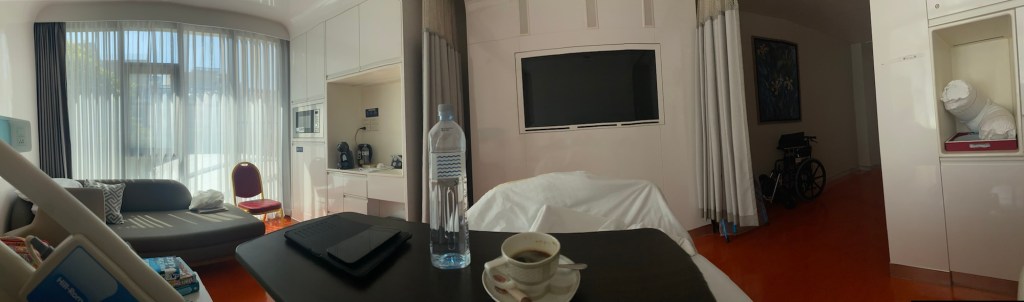
At the beginning of my stay, the hospital wouldn’t let me take a shower or even use the toilet. But for a couple of weeks now, I’ve been allowed to do both on my own, as long as I call a nurse to take me there and back, and as long as I sit in a safety chair while showering.
Over time, the nurses have become slightly more relaxed about letting me handle small things myself—for example, they no longer try to move my legs for me, and they don’t always grab me by the back of my pants as if I’m about to fall.
But they still won’t let me get out of bed on my own, not even to take 10 unsupervised steps with my walker to my coffeemaker. I know that’s more hospital policy than it is a pessimistic assessment of my capabilities. I also know they are trying to prevent further injury to me. All the same, the grinding lack of autonomy often frustrates me.
My days tend to follow a typical pattern: Get woken up around 5:30 a.m. for vitals and morning meds. Wake up again around 6:30 a.m. and hit the call button to be brought to the bathroom. Brush teeth, take a shower on my shower chair, put on clean hospital top and bottom, blow dry my hair. Pull the cord for a nurse to bring me back to my bed and see they have changed the sheets and everything is fresh and clean. At 8:00 a.m. eat breakfast, and by 9:00 a.m. do morning PT.
Free time until noon: watch the news, work on my work laptop, watch a movie, read a book, work on bidding, work on my blog, talk to my family on the west coast before they go to sleep. If I need an x-ray, ultrasound, or some other scan, it’s likely to happen before lunch.
Around 2:00 p.m. the physical therapist comes back and pushes me in my wheelchair down to the rehab gym. Have a couple hours’ break before they bring me dinner at 5:00 p.m. Video call with my husband in Europe. Read, work on my blog, or watch a documentary before being taken to the bathroom to brush my teeth and wash my face. Sometimes if I’m in pain I close my eyes for a while. Sometimes I ask to be wheeled to the patient lounge so the ladies who work in there will make me a cappuccino.
All day long: doctors and nurses and pharmacists and hospital guest services staff coming in and out of my room. I’m happy to see each of them, and greet them in the most open and friendly possible way. They are the ones who have been here every day to support me through this injury, whether my day was bad or good.
The pelvis is a ring, and injuries like left sacral alar, left superior pubic ramus, and left inferior pubic ramus fractures often occur together because when one part breaks, stress transfers elsewhere. Even “simple” fractures cause massive inflammation and stress to the body. The sacral alar in particular is close to the sacroiliac (SI) joint, which bears a huge amount of body weight and stabilizes walking. Even tiny shifts (a few millimeters) can cause long-term pain if not protected.
Most stable fractures heal without surgery in eight to 12 weeks, though full recovery of strength and stamina can take several months.
The first four weeks after a pelvic injury is considered the acute phase. The main goals are pain control, blood clot prevention, and protecting the fractures. Even if your fractures are stable, as mine are, complete non-weight bearing is recommended until you reach the subacute phase in week five. The idea is to avoid subtle displacement, SI joint widening, rotational deformity, and future chronic lower back and pelvic pain—and to promote early bone bridging and pain reduction when you do begin to load the joint.
This means whenever I’m out of my hospital bed, I’m either sitting in a chair, walking on crutches with my right foot while my left foot stays up, or leaning heavily on my walker as I hop on my right foot. These movements are made all the more painful and difficult for me by my bruised lung and cracked ribs.
And I was surprised over this past weekend to learn that my three pelvic fractures are not just hairline cracks; the bones are broken all the way through. I don’t know why that wasn’t explained to me more clearly before this, or why everyone has repeatedly referred to the breaks as “fractures.”
According to the latest x-rays from a day ago, it’s too soon for the bones to have started fusing back together, but at least there isn’t any displacement (movement of the bones that would require surgery).
I’m looking forward to the second, subacute phase that should begin a week from now where I can focus more on mobility, strengthening, and starting to put some weight on the injury, as well as the healing and restorative phase beyond that— to rebuild function, restore symmetry, and reduce limping.
I understand that in the long term, six months out, I may still experience stiffness in the lower back, occasional groin or buttock pain, reduced tolerance for sitting or long walking, fatigue, and a “deep ache” at the end of the day. This sounds miserable to me on top of dealing with an already complex autoimmune situation and chronic pain, but fortunately I have a high pain tolerance and have heard these symptoms usually improve steadily over time.
What many patients aren’t told is that pelvic fractures often cause emotional distress (feeling trapped in your body), insomnia, fear of being struck/falling again, and frustration with slow progress. Pelvic injuries also often weaken deep core muscles.
And rib fractures and lung contusion matter a lot for pacing, healing, energy, and pain control. At three weeks after trauma, rib fractures cause pain with deep breathing, lifting, or twisting. Healing usually takes six to eight weeks, but tenderness can last over three months. Rib pain makes crutch use harder and can slow mobility progression. Lung contusions also take three to six weeks to fully clear. Patients can have chest tightness, reduced stamina, shortness of breath on exertion, and a “need to rest” more than expected.
I have found myself tiring much faster than usual during PT sessions, and needing more breaks to avoid hyperventilating. Walking feels like cardio, I get winded easily, and I need breaks more often than seems reasonable to me. I stubbornly push through as much as I can without complaining. It worries me because as I see increased strength and progress from just after the accident, I also know the muscle loss of weeks in bed is going to be a huge fight to build back. Before my accident, I worked on my protein intake daily, and consistently checked my body composition to ensure I wasn’t losing muscle. Now I’m going to have to start the race from farther back, but I’m pretty sure I can still go the distance.
In surviving a serious accident like this, I think it’s normal to feel anger, grief, impatience, concern about reinjuring myself, hypervigilance, insomnia, and intrusive memories of the moments just before impact. My brain and nervous system were traumatized along with my body.
A high-force trauma like being hit by a truck triggers a survival reflex—fight, flight, or freeze—along with massive muscular bracing, surges of adrenaline, disrupted proprioception, emotional shock, and a sudden loss of freedom of movement. Walking has always been one of my main ways to regulate my nervous system, so losing that tool makes all the built-up energy feel trapped.
A couple of weeks ago, I was still in the shock-and-freeze phase: numbness, disbelief, my brain protecting me from overload, and memories of the impact that felt unreal. Now I’ve shifted into the anger-and-claustrophobia phase. This includes intense anger, pacing urges I’m not allowed to satisfy, the feeling of being trapped in my own body, energy I can’t discharge, irritability, and longing for my old body back. This reaction isn’t a flaw; it’s my survival system trying to move energy that currently has nowhere to go.
Even though I’m deeply grateful to be in a safe place now, I know I’ll need to find somatic modalities in the coming weeks and months to help me process all of this in a healthy way. I’m fortunate to have good people and strong resources around me, so working my way out of this sense of claustrophobia is something I can realistically move toward.
 Collecting Postcards
I’m so sorry for what you’ve experienced. Your writing in beautiful, deep, and clear. Sending strength and hugs from a post on the other side of the world.
LikeLiked by 1 person