Coming home from the embassy that Sunday morning after my accident ushered in not only new levels of physical pain, but a lingering stretch of complicated, disorienting emotional terrain.
The physical discomfort alone was bad enough. It was exacerbated by the post-accident reality that I could no longer do most things independently. After being discharged from the emergency room and sleeping the prior night in the embassy’s health unit, I was brought in a wheelchair out the front door of the chancery and down the ramp to an embassy van.
I then had to stand up and find a way to lift each leg high enough to boost myself onto the seat. I turned forwards and backwards and sideways, looking for an angle that would work. One of my legs seemed to barely function. The other I couldn’t lift at all. In the already hot morning light, I gained a sobering new appreciation for how hurt I really was.
The driver helpfully wanted to lift my leg before I was ready, garnering a yelp from me. Somehow, I summoned enough energy to lift myself. I powered through the pain of moving my legs and was seatbelted in with a grimace. I felt as though someone had kicked me over and over about the hips with a steel-toed boot. Something inside hurt deeply that couldn’t be explained by muscle soreness alone.
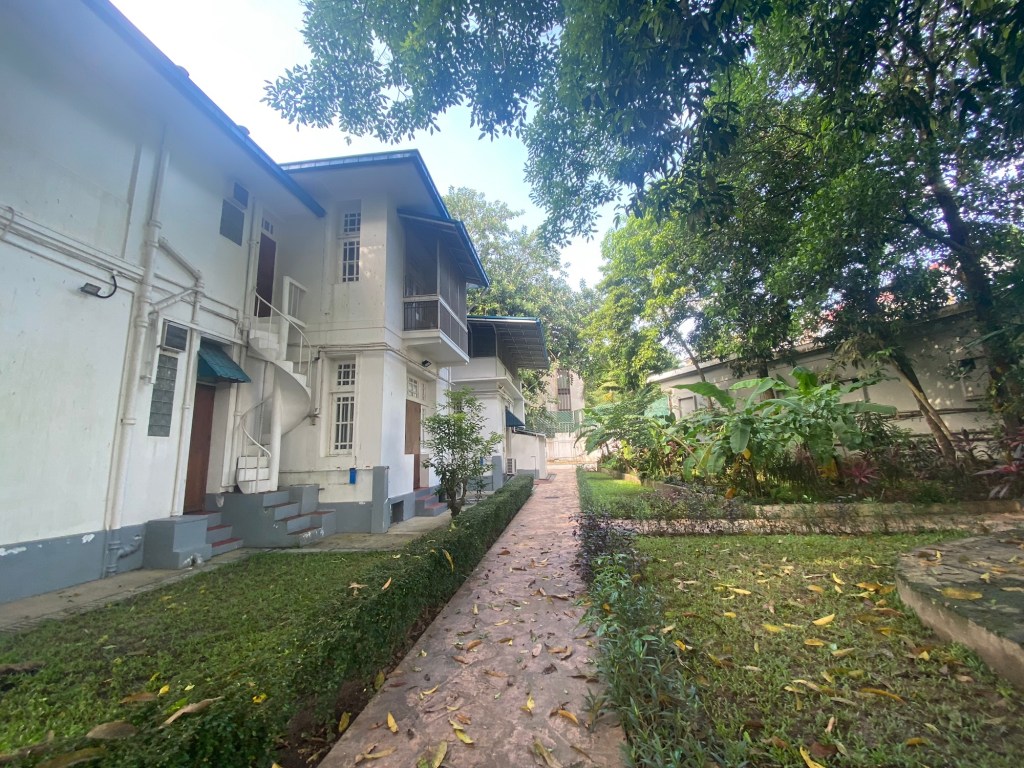
When we drove through the gate at our residence, the guard clearly expected us, emerging from the booth quickly as if important visitors had arrived. Our housekeeper, usually not around on the weekends, also stood in the driveway looking pensive. I saw her worried face and felt a stab of sympathy and affection.
Once I lowered myself out of the van, I tried to walk up the three easy, wide front steps to our double front door. There was no possible way. My right foot was glued to the ground and I couldn’t lift it. Other than doing a hokie-pokie pivot move from my elementary school square-dancing days where my heel wiggled and my toes stayed pressed to the ground, I was out of moves. And I couldn’t hardly bear weight on my left leg. I was placed back in the wheelchair. I closed my eyes and crossed my arms over my chest as I was carried by four or five people up and inside the foyer.
Since there was no possible way I could walk up to to the second floor, either, the downstairs bedroom with one twin bed was made up for me. I don’t remember washing my face or brushing my teeth in the attached bathroom, but I must have. Much of Sunday and Monday I passed sleeping, exhausted and trying to manage medication. Every time I realized I was in that little bed and could not go upstairs or even roll onto my side, I felt despair.
On Monday I had more scans, confirmatory of pelvic fractures. This necessitated another wheelchair carry up and down our front steps, another embassy van ride, another Burmese hospital. I sat in the embassy’s loaner wheelchair, wearing a wraparound housedress, bare-faced, hair unwashed. It was the first time in many years that I’ve left the house without makeup on. It would have never been my choice.
My husband and I commented to each other quietly about different aspects of the facility. I could feel dozens of pairs of eyes upon me as I was wheeled through the hallways. What’s wrong with the blonde foreigner? people doubtless wondered. I didn’t see any other western patients. I felt pressure on the left side of my chest and every time I sneezed or coughed, I’d let out a winded shout. I knew something was wrong. It crossed my mind more than once that I was probably also surrounded by people with active tuberculosis; I am a person who uses immunosuppressants weekly to manage autoimmune disease. Great, let’s add TB onto my tab.
Yes, the physical pain was grinding. The lack of mobility was both inconvenient and frightening. But I wasn’t prepared for the dark mood that settled over the house on Sunday and Monday—like a fog, like something with its own gravity. V and I were half caught in an endless loop of comparing notes about what each of us had seen happen, and half swallowed by foreboding thoughts about how this injury might harm me in the long-term. V was the only one who had witnessed the accident, and I had a million questions. But my questions were upsetting, and the answers often left both of us with more questions.
What was the scope of my injuries? Was I going to get better? How long would that take? Had the driver been intoxicated? Arrested? Sorry? As I tried to piece together the chronology of the evening and the facts of my accident, there were still lots of unknowns. I had nightmares about the truck zooming towards me and would wake up in a cold sweat. It would have been easy to dismiss it all as a bad dream, except the guest bedroom and the crushing feeling on the left side of my chest and the pelvic fractures made it impossible to deny.
I should have been at my nail appointment on Sunday, then swimming in the afternoon for my spine health. Instead, because of someone else’s choices, I lay broken— the force of his decision driven literally through my body until it cracked my bones. I couldn’t even get myself to my own bathroom, let alone anywhere else.
Meanwhile, my husband was tormented by the image of me flying through the air and striking my head on the street, then lying there unconscious and unresponsive, my eyes rolled back.
We were back in our own safe, comfortable home surrounded by our things. Our black cat sunned his fur on one of the sunporch’s stuffed armchairs. My husband brought me a steaming cup of my own Starbucks brew and a bowl of oatmeal with sliced bananas in the morning when I was hungry.
But home wasn’t the same place anymore. Outside, the sun shone brightly; inside, we were in a dark cave. The banana trees in the front yard and the expanse of lawn visible through the windows looked suffocating, ominous. Something conflicted and tangled had settled over our familiar, peaceful surroundings, warping and distorting everything that had once felt normal.
The first two days after the accident felt like living in a split reality—one part of me stunned that I was still alive, still breathing, still able to speak and move at all, and another part reeling from the fact that I couldn’t walk. Gratitude and disbelief kept colliding: Thank God I wasn’t killed, running directly alongside, How could this be my life now?
People kept saying to me —while acknowledging my injuries were serious— that it could have been so much worse. They were right and I agreed, and I was still angry and resentful as hell. My baseline was not me dead in the road; it was me on Saturday morning before the accident, living my life the way I wanted to. The way I’ve built for myself. “At least I’m not dead” wasn’t good enough, not by a long shot.
Everything felt surreal, like my mind hadn’t caught up to the fact that my body had been hit, injured, changed. The world around me looked the same, but somehow it felt drained of its usual texture, its usual sense of safety. I kept revisiting the what-ifs—what if I had taken one step slower, what if the driver had looked up sooner, what if we had stayed in for dinner, or walked somewhere not requiring us to cross. My brain played those loops nonstop, as if replaying the moment might undo it, or at least make it make sense. The dismay kept hitting me in waves as I went through it all again and again.
My suffering underlined the risk FSOs take while serving on overseas orders in developing countries with limited trauma-system infrastructure, resource limitations on hospitals, lack of trained specialists and pain management options, and variable standards of care. In fact, in the last blog post before my accident, published only days before I was hit, I’d mentioned the danger of crossing traffic on our street and spelled out our awareness that proper trauma care, should we need it, might not be available. These are risks we knowingly assumed to have the opportunity to serve in Burma.
And now the feeling of relative safety we’d cherished in our expat bubble had finally burst. In its aftermath, the reality of pervasive fear, misfortune, and lack of ability to control one’s own life had reached in and grabbed us tightly. I felt like my very life had been divided in two halves: before getting hit by a truck, and after.
I didn’t know what the “after” would look like. I knew I had to be in a wheelchair temporarily. I couldn’t think far enough ahead to even ask myself how long that would be. Life had become an hour-to-hour and sometimes even a minute-to-minute exercise to endure.
From the outside, one could surmise I was very much still in the bubble. I had a wheelchair and a walker that the embassy loaned me. I had American doctors monitoring my condition. I was secure in my air-conditioned house with my husband looking after me and a guard posted outside. This is much more than a local person in the same situation would have likely been able to access.
And somehow, all the inconveniences of our suddenly-deconstructed life came home to roost at once.
My husband’s work schedule, signing on remotely during core Washington hours, was destroyed by the chaos of injury and caretaking. All four showers in the house had two stairs leading up to a tub you had to lift your leg over to enter, and were therefore inaccessible. Three of those showers were also on the second floor, up a three-tiered staircase where I couldn’t navigate even the bottom step. There was nowhere to plug in a hairdryer downstairs without blowing a fuse.
The one time I showered my husband was beside himself with worry about what a bad idea it was, and I cursed having to blow dry my hair in the dining room afterwards with no mirror. Every time I went to the downstairs bathroom I saw tiny ants I’d never seen there before, and faintly smelled sewage. I’m tired of this Mickey Mouse shit, I said to no one in particular.
There was anger—hot, sharp, insistent—at the sheer wrongness of it all. Anger that I had followed The Rules, generally Kept My Shit All the Way Together, lived my life the way Any Normal Person does, and still ended up here. Anger that someone else’s recklessness and disregard for others had cracked open my sense of normalcy. But threaded through that anger was grief: grief for my mobility, my independence, the parts of my daily life that were suddenly out of reach.
Simple things—climbing stairs, sleeping comfortably, getting into my familiar bed, having to cede my shortly-upcoming work trip to Mandalay— became symbols of what had been taken from me. Coming home made it all feel both real and unreal at the same time. The house was familiar; we simply were not entering it as the same people who had left it.
There was darkness to those days, a kind of emotional dimness where everything felt heavier, colder. We talked about whether there was a way to not let this color the whole way we felt about our tour, and sadly, we weren’t sure. The uncertainty made it worse—the not knowing the true extent of my injuries, the gaps in understanding what had happened, why it had happened, how long it would take before I felt like myself again.
Loneliness threaded through each activity or chore. It wasn’t the loneliness of being abandoned—our wonderful neighbor came right over, our medical officer frequently checked in, and I was deluged by texts and check-ins from family and colleagues. It was the loneliness and trauma of V and I having experienced something violent and disorienting together that no one else around had lived through. It was the loneliness of slowly and painfully moving through a house that no longer fit my body, of not being able to walk anymore, of not being able to go to work, of feeling like a visitor in my own life. The loneliness of a large life shrunken down, a nautilus shell retracted to the smallest chamber. The loneliness of feeling like we had to accept whatever scraps of happiness this accident had left us with.
I didn’t even call in sick Monday or Tuesday. What was there to say? The entire embassy knew I’d been hit by a truck.
It was a dark, surreal stretch of time where gratitude, fear, anger, grief, and disbelief all coexisted. I survived, and I knew I should be thankful—but surviving didn’t erase the weight of what had happened, or the ambiguity about what was next.
As it turns out, what was next was coming fast. I should have anticipated it, and yet somehow I didn’t. On Monday afternoon, our medical officer called and told me he was planning to medically evacuate me the following morning to Bangkok, Thailand. He laid out his case logically: we couldn’t get clear, complete scans of my injuries in Rangoon. My injuries were serious and needed to be treated in a trauma hospital. In Bangkok, we would be able to manage all of this. It made total sense.
My response? I didn’t know what to say or do. I was overwhelmed and didn’t want to leave my house. I simply could not imagine showering, dressing, packing, and taking an international flight. I could not even imagine walking down three steps outside of my house! It all seemed like one more thing I’d become incapable of doing. How would it work, in practical terms?
Fortunately, I did not have to do all of it by myself. A nurse attendant would accompany me on the flight. Someone else would make the logistical and administrative and financial arrangements. I would be wheeled through the airport and even onto the plane. And I would be picked up in Bangkok by an ambulance.
I accepted the medevac needed to happen and the more I thought about it, the more I could visualize how it would work. V and the medical officer and I talked it through, and I realized no obstacle was too large to remove. Being sent to Bangkok was the Department taking care of me. V also went online and bought a ticket.
It was settled. We would leave in the morning. As V did laundry and made arrangements with our neighbors and housekeeper for our cat, I sat and made a packing list on my phone. I adapted quickly. Starting to look forward to the medevac, it occurred to me ruefully that a patient with a double head injury probably shouldn’t be the person in charge of complex decision-making predicated upon his or her own best interest.
V went upstairs, we got on a video call, and together we retrieved items from my bathroom, dresser, and closet. A handful of trips back and forth and zipping up a suitcase is all it took. And no, I didn’t have any regular clothes, I wasn’t wearing earrings or makeup, and I didn’t even bring pajamas. We were up late, and it was stressful, but for the first time we had a plan.
In the morning we rose early, and I took a terrifying and probably unsafe shower to wash the blood out of my hair. There was no way I was taking an international flight not having showered for three days after scraping the street with my entire body and visiting two hospitals. Using my athleticism and strength, I made it work. I put on a sundress, and was already exhausted.
When we were picked up, it struck me how strange it was: I was about to take an international flight with no real clothes, a mostly empty suitcase I hadn’t packed, no jewelry except my wedding ring, and not a trace of makeup. And yet it was completely okay, because the only thing that mattered was getting me somewhere that offered a way forward.
 Collecting Postcards
My heart aches for you and everything you’re going through. Been reading your blog for, I don’t know, a decade? Your writing is so captivating and descriptive. Sending all the positive energy I can to you guys.
LikeLiked by 1 person
Thank you very much! I am an overwriter but I think it can help people feel sucked into the story. I am a fan of the blog readers just like they might be fans of the blog. I am appreciative of you reading and thank you for your support. I will update folks on my hospitalization and recovery soon!
LikeLiked by 1 person
I can’t imagine what you’ve been through. Actually I can because you’ve done such an amazing job writing about it. I hope that process was equally as healing.
LikeLiked by 1 person
I’m so so incredibly sorry that this happened. This is just awful.
LikeLiked by 1 person
I am so horrified that this happened to you! I don’t even know what to say other than I’m so glad you’re well enough to write about it, and I look forward to reading about how you come back from this stronger than ever.
LikeLiked by 1 person