
Burmese is the third language I’ve studied at FSI, and it’s also the longest formal language program I’ve undertaken. Last week, I completed week 29 of Burmese, surpassing the time I’d previously spent in Spanish (24 weeks)* and Russian (28 weeks).
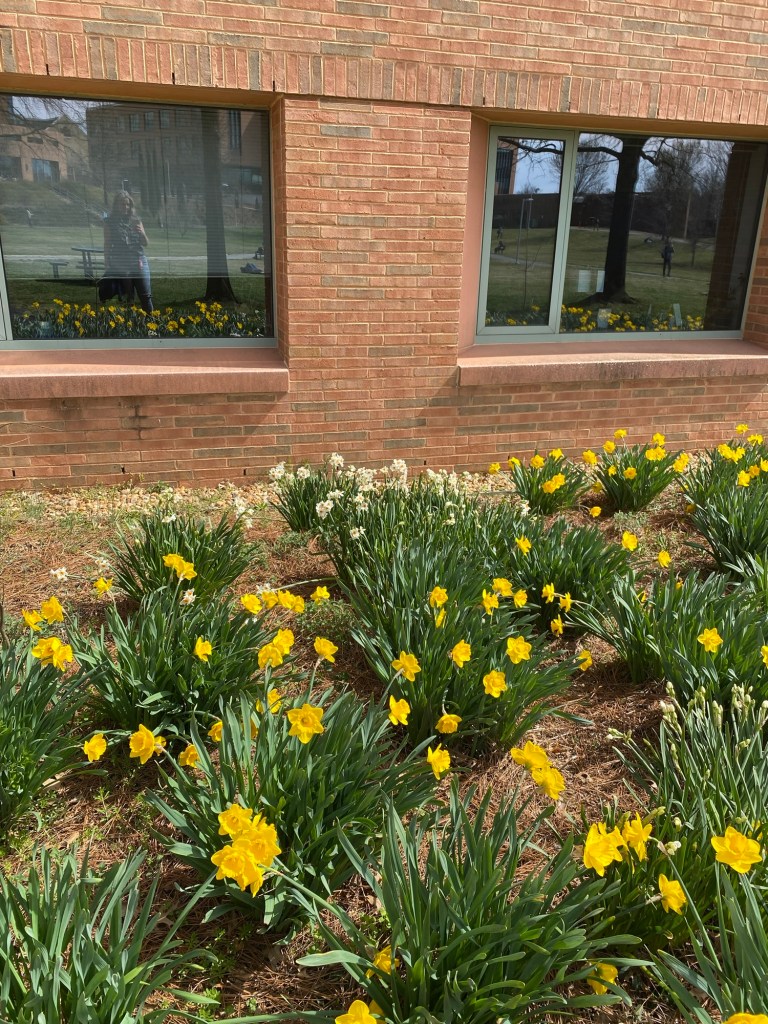
As I ventured into the great beyond, spring arrived on campus—fittingly—and offered clear proof that we’ve endured the long winter and a new season is just ahead.
*(Note: Since I completed Spanish in 2020, FSI has extended its Spanish program from 24 to 30 weeks. This is partly due to the high no-pass rate on the Spanish End of Training test and a desire to help students avoid language training extensions that delay arrival to Post.)
Feedback Loop
Last week I had the opportunity to meet with my language training supervisor (LTS) about my week 27 progress evaluation. She told me I was on-track and doing well, and we discussed the fourth and final progress evaluation scheduled several weeks out. She also made some helpful suggestions for challenges I still face in the areas of listening and generating speech.

One of those language learning tips was about using AI.
I have to confess that in the past, as someone on the cusp of Gen X and what some would call an elder Millennial, I’ve vaguely dismissed AI applicability as something between cheating and pure laziness. Especially at work. After all, when I was in grad school 20 years ago, I didn’t need it and it likely would have been frowned upon to write papers or explore topics using something called artificial intelligence vs. using your brain.
But while I don’t see myself relying on AI or digital assistants for all my personal tasks (which could be a completely separate blog post at some point), I’ve also learned ignoring its useful features would be a mistake that leaves us stuck in less productive ways of doing things.
The State Department, in my view, has began using AI safely over the past year or two to automate and streamline workflow processes. This has resulted in gained efficiencies, improved customer service, and enhanced employee well-being. (No, AI did not write this!) AI has particular potential for consular officers, whose largely public-facing jobs span a labyrinth of systems, complex legal requirements, and operational procedures.
Of course, this leverage of robot brains is a step in the right direction. When our former Secretary of State Antony Blinken asked employees last summer to “just get started” using AI, it relieved me of my desire to understand something perfectly before leaping. I gave AI a chance, and while I’m very much a novice, my mind was still blown imagining all the time I could have saved already by utilizing it for some basic tasks like drafting routine emails or managing bidding.
Yet when my LTS suggested I initiate a topical conversation with ChatGPT in answer to my concern that sometimes I don’t have much to say on a given theme even in English, let alone in Burmese, I was still surprised.
ChatGPT — evidently — knows Burmese better than I do (ha ha) and can also suggest interview questions, break down sentence structure, and delineate the differences between colloquial and literary Burmese that I often miss.
PCS Prep, Begrudgingly
I spent most of the month of February glued to the news as colleagues and friends lost their jobs. I have been so afraid I would be next.
It’s a strange pivot to whipsaw between those fears and active preparation to take our house and lives in the U.S. apart and move overseas — at massive inconvenience to us — in service of the administration that may decide to pink slip us. But with about four months to go from now until our planned PCS, time is beginning to grow short. It seems like two seconds ago it was Christmas and already daffodils and hydrangeas are starting to bloom in our front yard.
And as much as I hate to admit it, many of my weekends and weeknights will soon be occupied either by personal admin, or procrastination of said personal admin. So I’ve tried to start early in the hopes I can avoid getting very stressed out and exhausted by the end.
First up, I’ve been getting organized. I scheduled some medical appointments. I checked into the process for pre-departure vaccinations and put a reminder on our calendars to get them done.
I’ve been giving away and selling unneeded items. I’ve started small – clothes, shoes, craft supplies, books. But it won’t be long before we have to deal with disposing of larger items, like furniture, and our second car, that require more discussion and planning. I also went through a ton of accumulated documents as part of my ongoing attempt to scan and shred any stray papers in our lives.
Additionally, V scheduled our cat’s annual veterinary visit where we’ll plan out the necessary next steps to get his pre-departure vaccinations and paperwork. He’s also working hard on how to keep his job and bring it with us to Rangoon while working remotely.
Also high on my priority list, I need to complete and circulate my TMTWO (request for orders). Other than successfully enrolling myself and V in the Foreign Affairs Counter Threat (FACT) training—which we need to retake in July after multiple COVID-related extensions following our canceled March 2020 session—I’ve been dragging my feet on this.
But an approved TMTWO generates a TMFOUR, or “orders.” Having overseas orders allows you to start the foreign visa process, renew a diplomatic passport, break leases or contracts without penalty, use government funds to purchase plane tickets to Post, schedule your packout, and more. So that’s as important as it sounds.
The list of things to manage certainly far exceeds what I’ve done or even scoped to date. But one way or another, we will manage… while working full-time and dealing with all the other unexpected problems that are bound to arise.
I feel as though spring’s arrival marks the end of the golden glow we’ve been living in for three years now since we settled into our house in Alexandria. We always knew the days of everything being “easy” and just-so would conclude eventually, but that doesn’t make it easier.
As the days slowly get longer and warmer, I want to pause for a lengthy moment and remember every room of our clean, organized house — where there is a place for everything and everything is in its place — just as it is right now. I will try to accept that a period of profound disorder is on the horizon, with planned moves in both July 2025 and July 2026 and God only knows what after that.
Because once we start moving things around and dismantling this life, we will also be venturing again into the great beyond, ready or not.
 Collecting Postcards
I’m curious, have they also lengthened the Russian training? It seems odd to me that Spanish requires 30 weeks but Russian only 28? I know I’m missing a lot of context, though.
LikeLiked by 1 person
This is a good question – I should have been more clear. Spanish is 30 weeks to get to the 3 level; when I was in 28 weeks of Russian it was to get to the 2 level. I don’t remember how long my colleagues who needed a 3 stayed on after.
LikeLiked by 1 person