
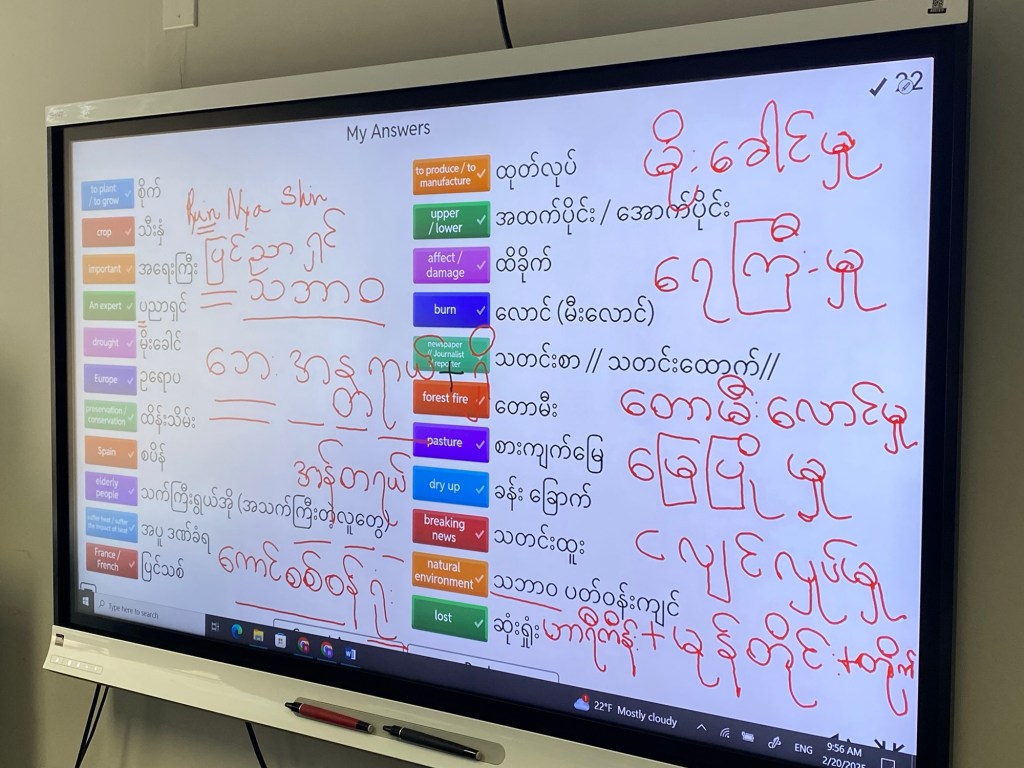
Last Friday marked the end of week 26 of my Burmese program. Now 59% complete, we’ve shifted from everyday topics like our biographies, weather, and travel to work-related themes such as peace and security, bilateral relations, human rights, natural disasters, and the global economy.
Just weeks ago, my biggest challenges—less individual instruction time after our class merger last November and preparation for our upcoming PCS move to Burma this summer—felt significant.
Those concerns still feel valid on their merits, but have now paled in comparison to my more recent fears of losing my job, income, pension, and health insurance. (See: Open-source news from the American Conservative, Politico, and the New York Times.)
In its nearly 11 years in publication, this blog has never been the place to comment on Washington intrigue or express personal political opinions. I don’t really do that anyway, even on my private social media. And I don’t plan to.
More broadly, I think it’s important civil servants maintain demonstrable political neutrality in the course of their work. I’d like to talk a little about how the United States adopted a non-partisan career federal workforce and what it means to me.
During my Peace Corps Volunteer service in the early 2000s, I worked at an environmental NGO in Macedonia (now North Macedonia). I vividly recall going with my counterpart to my site’s local elementary school for a meeting with school officials. On the agenda was a discussions about our ongoing plan to form an after-school biology club.
We’d been to the school before, on multiple occasions to work on similar initiatives. The school was located only a five-minute walk from the NGO office. We set out on foot.
On the way, my counterpart briefed me that we’d be meeting with a new principal and science teacher, and noted we’d have to re-explain the project from the beginning. I asked her what happened to the staff we’d been working with, and she explained they’d all gone: changed over in the recent national election.

I looked at her blankly. “What do you mean? Why?”
“They’re all members of [x political party], and that party is out now, so…” she attempted to clarify for me. I wasn’t clear.
“The teachers? All of them?” I asked. She smiled uncomfortably.
“I mean, all the school employees?”
“Yes.”
I paused, thinking of my landlord. “Where are they now?”
She shrugged. “At home, I guess?”
My series of shocked follow-up questions revealed I didn’t understand the connection between elementary school teachers and political party. I questioned the automatic assumption people who ostensibly voted for someone else (although I’m not sure how anyone would know, or why it would be anyone’s business to ask) couldn’t continue doing their jobs.
The implications of teachers losing their jobs (and, as I soon realized, municipal workers, factory laborers, and other jobs in town) due to a national election led me to a key realization: in my Peace Corps host country, at that time at least, people were hired based on connections and political affiliation. Even for jobs that seem totally unrelated to politics.
Thanks, Captain Obvious, says anyone who’s spent time in the Balkans. But I didn’t see it coming. What I did understand was that the ensuing disruptions of such policies harmed individuals, institutions, and society.
By contrast, as a federal employee and member of the executive branch for approaching 20 years this summer, I’m acutely aware of my oath to the U.S. Constitution. I have an obligation to support whichever administration is elected to office, and their political appointees. I take this seriously and have done so faithfully through five presidential administrations. In fact, as a career employee I worked as a special assistant to political appointees both during the Bush and Obama years.
In my 20 years, I have not seen any federal employees substitute their personal opinions for official U.S. policy. I have also not seen any career officials let personal disagreement with any policies or appointees negatively impact their ability to carry out their work responsibilities, even at times when that disagreement could be very strong.
For example, when consular officers adjudicate visas, they follow U.S. immigration law as it is and not how they think it should be. When political or economic officers deliver demarche points, they are letting their foreign interlocutor know what the U.S. position is on an issue. Our personal opinions are not relevant.
In the Foreign Service, we are hired for our expertise and expected to provide our best input before decisions are made. Once a decision is final, we accept it. If we strongly disagree and can justify our position, we may formally dissent through official channels.
And if we can’t carry out our duties on behalf of an administration, it is our duty to resign. I absolutely understand this and I’m certain my colleagues do too.
I’m proud to sit behind the placard of the United States, representing my country as a lawyer would represent a client. The patriotic desire to do that — and the obvious societal benefits — are stronger than any prospective partisan “benefits” in my view. Not to mention, not every American is a member of a political party or even a voter.
I couldn’t have articulated the implications of the problem I noticed in Macedonia clearly back then. I was young, and more concerned about individual people I knew losing their jobs. And I don’t mean to make any slight towards Macedonia: of course it’s always possible I misunderstood the situation, and/or that things have improved in the interim.
Macedonia’s transition from the socialist state of Yugoslavia to a parliamentary democracy didn’t quite resemble the democracy I’d grown up in. In reality, under the surface, society functioned very differently in ways that were obvious to my host country colleagues but nearly invisible to me as a foreigner. This was a major part of navigating my Peace Corps experience and confronting all its attendant culture shock moments.
Here in the United States, things have worked differently for almost 200 years.
Most Americans have probably never heard of the Pendleton Act (also known as the Pendleton Civil Service Reform Act of 1883). But the Pendleton Act is one of the reasons why the U.S. government today draws a distinction between career employees and political appointees. The latter group tends to change as presidents come and go, while career folks are the worker bees who stay in place.
This allows the government (and in turn, the taxpayers) to benefit from both people well-positioned to lead on the president’s agenda, and the deep subject matter knowledge and expertise of apolitical career public servants. The latter are best-positioned on how to provide the services Americans expect and deserve from their government.
But it might surprise you to know that from our nation’s inception up until the 1880s, the United States had a “spoils” system rife with corruption and short on transparency. In other words, people were chosen to work in government positions for reasons that prioritized political affiliation and campaign contributions over knowledge and substantive job qualifications.
The Pendleton Act sought instead to award jobs based on merit rather than political patronage and the resultant conflicts that caused.
“The Pendleton Act provided that federal government jobs be awarded on the basis of merit and that government employees be selected through competitive exams. The act also made it unlawful to fire or demote for political reasons employees who were covered by the law. The law further forbade requiring employees to give political service or contributions.”
How did the Pendleton Act come about? By the 1820s, the “spoils system” President Washington had tried to avoid had become entrenched and expansive. Government workers were more concerned with political fundraising and power struggles than with their daily duties. Angling to control political appointments diverted workers’ precious attention away from policy formulation and serving the public.
Ultimately, a disgruntled would-be federal employee was passed over for a job. In response, he assassinated President Garfield in 1881. (The President was shot in July, and died two-and-a-half months later of his injuries.) Widespread corruption, political patronage, and the president’s assassination spurred Congress to pass the reformatory Pendleton Act.
After the Pendleton Act became law, government service became professionalized. Over the years, the scope of the Act expanded to cover more parts of government, making federal employment largely apolitical and based on qualifications rather than political favoritism.
Essentially, this helped our government become more impartial, accountable, and efficient. It better guaranteed the best-qualified workers were hired, reduced opacity, provided greater job stability, and paved the way for the merit-based system we have today.
By contrast, a partisan civil service—where government employees are hired and fired based on political loyalty rather than merit—can harm a country in several ways.
- Corruption and Cronyism – Jobs may be given to unqualified individuals based on political favoritism, leading to inefficiency and potential misuse of public funds.
- Inefficiency and Poor Governance – When key positions are filled by political loyalists instead of skilled professionals, government agencies may struggle to function effectively.
- Lack of Continuity – Frequent turnover after elections can disrupt long-term projects and policies, preventing stability in governance.
- Erosion of Public Trust – Citizens may lose confidence in the government if they perceive it as serving a party’s interests rather than the public good.
- Political Instability – A partisan civil service can deepen divisions, as each administration purges opponents and rewards supporters, leading to cycles of retribution.
- Weakened Rule of Law – Civil servants may feel pressured to act in the interests of a political party rather than uphold laws impartially.
Today, the foundational Pendleton Act is still relevant.
As has been widely reported in the press, many federal employees — including American veterans who have written the ultimate blank check to our great nation — work and live in a climate of fear. Fear of being laid off or fired. Fear of loss of income and suddenly being unable to support their families. Fear of losing part of their identities through the dignity and purpose of national service work. Fear of losing their health and life insurance benefits. Fear of losing the pensions they’ve worked hard for and may be so close to earning. And perhaps fear of losing services themselves as constituents.
It is surely a difficult environment in which to concentrate on Burmese language acquisition. And yet my classmates and I continue getting up every day, going to class, and trying to progress with our language skills. Difficult circumstances should not, cannot derail us from the mission.
In my next post, I’ll talk about the breakthroughs I’ve experienced thus far during week 27.
 Collecting Postcards
Thanks for sharing this and for dedicating so much of yourself to the American people, no matter the administration ❤
LikeLiked by 1 person