
I’m continuing to catch up with blog posts from a few months ago to bring us to the present day. September 2022 marked one year since the death of my longtime friend T who I met in 1998 and who was my boyfriend off and on for a few years while I was in college. It hardly seemed possible a year had elapsed, since I’d only learned in April that he’d already been gone for seven months. It still felt new and unfathomable to me. In an attempt to find answers and process his passing, I’d gone to California in May and visited his grave, worked on a memorial plaque, and found lots of books and podcasts about suicide and grief.
In honor of T’s life and September being National Suicide Prevention Awareness Month, I tried some volunteer activities I’d hoped would help me feel like I was doing something that mattered. I couldn’t help the one person I really wanted to try and help, so maybe I could help someone else. But I slowly began to understand I couldn’t “action” away my grief with memorial or suicide prevention activities, nor did “grief brain” allow me the ability to take on a lot of new information or tasks. As time passed and my shock wore off, I actually felt worse as people were expecting me to start feeling better. I saw I needed to take a step back to process. Because grief is an individual journey and everything you feel when grieving is normal and OK, even if it doesn’t meet others’ expectations or even your own.
As I talked about in my post September is National Suicide Prevention Awareness Month: What Everyone Should Know, there were almost 46,000 U.S. suicides in 2020, the most recent data year at the time. We now know the suicide rate in 2021 rose by four percent to 47,646. That’s an enormous amount of people who have each left behind several others who are hurting and grieving their absence.
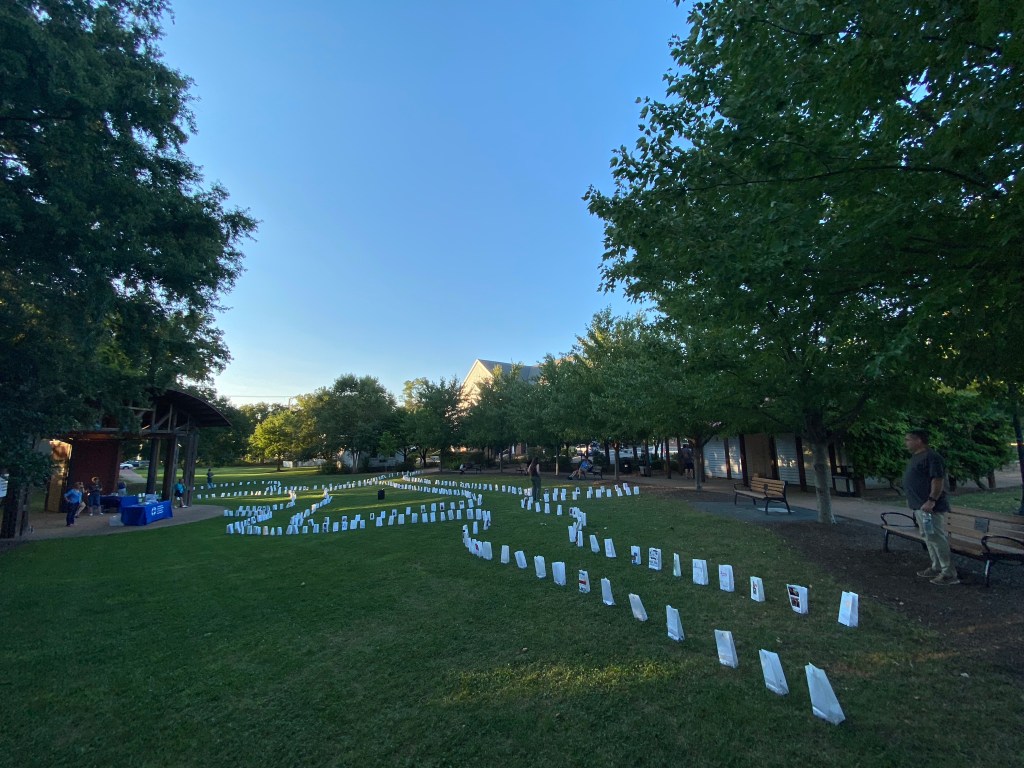
National Suicide Prevention Week
Vienna Town Green, VA
September 2022
During National Suicide Prevention Week in September, the local chapter of the American Foundation for Suicide Prevention (AFSP) held a luminaria event. If you’d lost someone to suicide, the idea was to decorate a white paper bag in their honor and add it to a large lawn display in the town square. At night, battery-operated candles placed inside each bag illuminated the decorations in memory of the person lost.
My husband V and I met after work in Vienna, another northern Virginia town about a half hour from where we live, and decorated bags for T. It felt awkward at first, coloring on lunch bags at a folding table with strangers. But it was actually great. I brought a picture of T that his former partner provided for the memorial plaque we worked on together because in the photo, he was having fun and he looked so happy. As we waited for darkness, V and I wandered around looking at the bags other people made for their loved ones. You can see what it looked like at dusk in the photo above. It was really hard not to cry seeing the heartbreaking messages of loss and all the smiling photos of people on the bags when you knew they all had later come to a point of ending their own lives.
As T’s friend, it had been really hard for me to stumble across news of his death online and not really understand what had happened, when, or why. I felt a lot of regret especially as his friend that I hadn’t noticed when he had stopped reading my messages, and that I hadn’t been more in touch. I felt intense sadness to have misinterpreted signs he was struggling, to not have been in a position to talk to him about things while he was still here, and to not have known about his death earlier. I felt terrible for his family. And almost immediately, I had a million questions and came up against the uncomfortable realization that none of them felt appropriate to ask. It took some months to find my way through all of that, to the extent I even have – the unanswerable question of “why” despite all the answers I have received could truly only be answered by him.
Scientists and experts agree the expression of feelings and externalization of mourning through milestones like memorials and funerals after a death allows people to start to process loss and integrate it. Missing his burial hit me very hard, and I looked at the pictures his sister sent me from that day hundreds of times.
Without considering timing much, less than three months after learning of T’s death, I’d impulsively signed up to train as a volunteer on a suicide crisis line for a local northern Virginia community-based non-profit. The organization provides behavioral health, crisis intervention, and suicide prevention services, and volunteers answer suicide and crisis prevention hotline calls, chats, and texts.
I figured talking to suicidal people wouldn’t be overly hard for me. I’ve done it before, informally, with friends. I already work with families in crisis in my day job dealing with international parental child abductions. I did my undergraduate work in psychology because in high school I’d wanted to become a psychologist. Looking back I got some of my highest marks in the courses on drugs and behavior, and death and bereavement. After finishing college I’d worked for a while in a residential psychiatric treatment center. I’ve worked with people who have developmental disabilities, substance abuse disorders, mental illness, and behavioral issues. I’m not inexperienced in the human condition, nor do I find it unpleasant.
However, I failed to understand it was too soon for me to be in the trenches helping potentially suicidal people on a crisis line. At the three-month mark, I was still in a very acute stage of grief. My executive function was very low. I was still trying to put together the narrative of what happened. I’ve struggled with what to tell myself about T’s actions and motivations. I have a lot of work to do to process and grieve my friend’s death before it would be appropriate and helpful for me to work on a crisis line. The timeframe for coping with suicide loss is often years, not weeks or months. And grief is something you carry, not something you “fix” or “get over,” something I will talk more about another time. So I put the crisis line volunteer idea on hold, for now, to focus on my own health. But that didn’t mean I couldn’t still support suicide prevention activities in a more low-key way.

In October, AFSP held its national Out of the Darkness Walk for suicide prevention in Washington, DC. I didn’t create a fundraising team or walk, but I did volunteer at one of the tents passing out honor bead necklaces to walkers before the event. Honor beads are optional and can be worn in different colors to represent lost loved ones or to show solidarity in struggles with mental health. In helping people decide which color of honor beads to wear, I was able to connect with a lot of different people on an individual level.

Some people came up wearing sunglasses, grabbed their beads, and took off. I understood those people, totally. Other people seemed shy, or upset. Some people were smiling and brave. Some people didn’t know what the walk was about and wanted to know if they could still have beads, or to learn more about what we were doing. The people who chose white beads for the loss of a child and wanted to talk about their child especially broke my heart, but I listened to everything that everyone told me. A few people noticed the memorial tattoo for T on my arm and asked me about it. Quite a few people showed me their own memorial tattoos.
One lady came up and said she was on vacation from California where she worked as a social worker with drug-addicted youth and then burst into tears. Another girl came up and after a long hesitation picked up green beads for a suicide attempt and said, “Well, I’m just going to call myself out.” I replied, “You might see some other people wearing green beads you can go talk to. There’s no judgment here.” Some people told me after intense conversations it was wonderful to talk to someone who understood the kaleidoscope of sadness, shame, blame, regret, and anger they felt about their losses. It was so great to be able to talk to people who didn’t look at you and say, “Oh,” and then change the subject when you brought up suicide loss grief. I realized that is what it felt like to be in community.

Sources + further reading:
https://tadsaw.org/22-suicides-a-day/
and
https://en.m.wikipedia.org/wiki/United_States_military_veteran_suicide#Background_information
But there is also something difficult for me about the suicide prevention space that I have not figured out yet how to reconcile. Prevention efforts are excellent and we need them, and I want more people to be conversant with layperson intervention skills. It’s actually critical we break the myth that talking about suicide is going to give a sad person “the idea” to take their own life.
Yet at the same time, when people who have lost someone to suicide hear about “suicide prevention,” I think it’s normal to feel like maybe we failed to prevent our loved one’s suicide. If only we would have done more right, had better tools, seen the signs, would our person still be here? The conflicting narratives of someone “living on their own terms” and someone “succumbing to depression and mental illness” have been extremely challenging for me. Almost everyone who comes to this work comes because of deeply personal loss or struggle. It can be very fraught. And I honestly don’t believe every suicide can be prevented, as much as I wish that weren’t true. But it doesn’t mean we shouldn’t try as individual people to turn this tide. I would argue we’re obligated to do so.

Another lady I saw walked up to grab beads wearing a shirt that read: “MENTAL HEALTH IS HEALTH.” I couldn’t stop thinking about it all day. I haven’t stopped thinking about it since.
Yes.
Mental health is health. It’s just health. A broken arm is a health matter. A heart attack is a health matter. Depression is a health matter. A root canal is a health matter. Some of these things are more stigmatized and receive more judgment than others. Some of these things are more likely to receive health interventions than others.
That’s what I’d like to see. A world where mental health is just health. And where people could just ask for help without being afraid of being judged as broken for not being able to “think” their way out of a chemical imbalance. The same way you can’t “think” your way out of a cavity or a broken bone or a tumor.
As heartened as I am about the growing awareness around mental health and self-care, too much stigma still prevents necessary conversations. And while not every suicide death is related to a mental health issue, according to the CDC, 90% of people who die by suicide had a diagnosable mental health condition at the time of their death.
We want to tell ourselves suicide isn’t a “real” option for people who are unwell or becoming hopeless. Except it is. It’s on the table. People who think freely can and will consider it, including children. Look at the statistics. As of 2020, it was the third-leading cause of death for young people 10-19. Third. There are 130 suicides on average in the United States daily, 365 days a year. Earlier this month the CDC released fall 2021 data from its biannual Youth Risk Behavior Survey that showed more than 40% of high school students said feelings of sadness or hopelessness kept them from engaging in their regular activities for at least two weeks of the year. More than one in five LGBT+ high school students had reportedly attempted suicide in the last year.
Most teen girls (57%) felt persistently sad or hopeless in 2021, double the rate for teen boys (29%). Nearly one in three teen girls seriously considered attempting suicide. Both rates “increased dramatically” over the past decade, according to the CDC.
Centers for Disease Control, February 2023
These statistics are heartbreaking. And as I’ve talked about in the past, those who have lost someone to suicide are more likely to ideate or take their own lives than those who haven’t. Mental health is health. I’ll wear that T-shirt.


People forget the brain is susceptible to illness too!
LikeLiked by 1 person