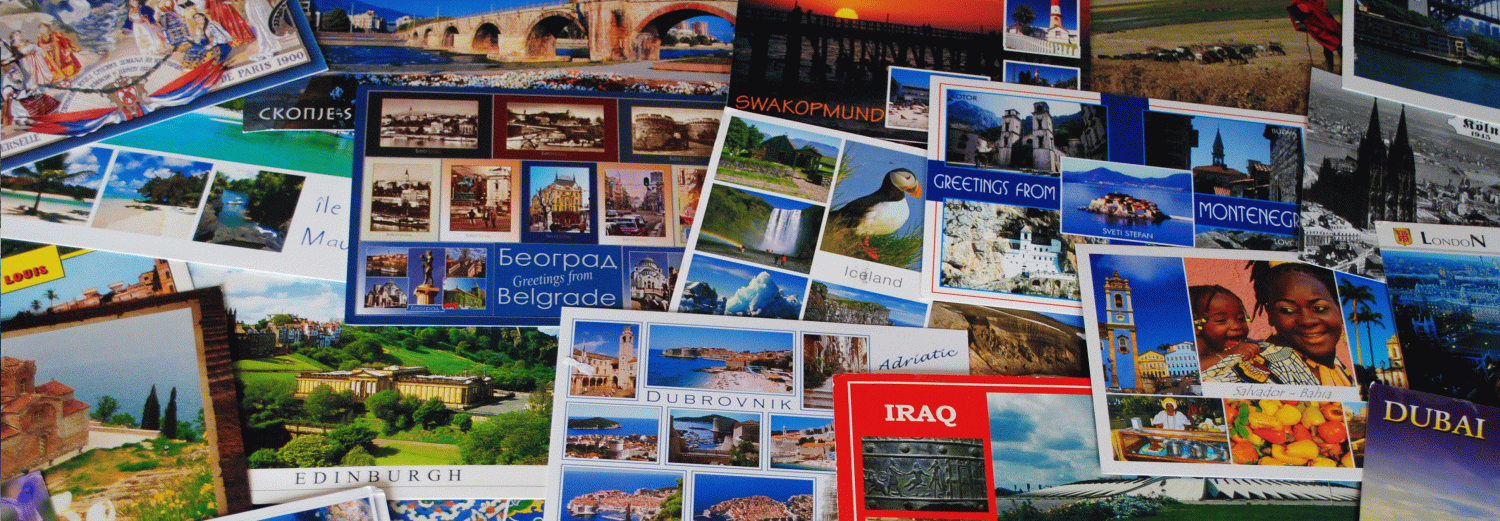
It has been six months since the last edition of Your Questions Answered, so in this post, I will share some questions recently asked and answered by the blog’s email box – as always, anonymously and without attribution. In this edition, we discuss the rewards of consular work, being single in the Foreign Service, what I know now that I wish I knew when I’d joined the Foreign Service, financial matters like savings and what expenses Foreign Service Officers should plan to budget for overseas, and the typical Foreign Service “car.” Enjoy!
Tag: Consular Work
…Vaccinated
This month brought us a tremendous gift: the opportunity to be vaccinated against COVID-19.
Year in Review: 2020 Blog Stats and Recap
As longtime readers of this blog know, since I launched in April 2014 I have never missed a month. Sure, there were a couple of times where I posted on the last day of the month, but I have never gone a month without posting something. And I was not going to start 2021 by messing that up! I don’t know why it matters to me; it is not as if missing a month means I can never come back. People who know me would not be surprised by me adhering to this all-or-nothing mentality though. I guess it’s just the way I am. Lest you think I need rules to govern me entirely, I actually do still very much enjoy writing for this blog; it’s just that the last two months have passed in a blur of work and one crisis after another that have left me simultaneously exhilarated and wiped out, which are stories for another day. So here I am at the eleventh hour with a short recap of 2020 and blog stats for the year.
Fingers (Cautiously) Crossed
As 2020 comes to an end at last this week, my husband V and I celebrate 14 years since our first date in Georgetown and reflect on hopes for next year.
Trying Not to Pick Things Up By the Lid
Since our terrific socially-distanced trip to New Mexico six weeks ago for my birthday, V and I have been settling in to life in Ciudad Juárez together. It has been both great, and tedious, and prolonged, kind of like 2020.
Your Questions Answered, Volume V
It has been almost five months since the last edition of Your Questions Answered, so I thought I’d share some recent Q&A from the blog’s inbox, edited for length and clarity. In this edition, I’ll address how embassies decide which officers get language training (and how much), length of service vs. number of tours, whether officers serving on the U.S.-Mexico border can live on the U.S. side, and what consular officers do as they advance in their careers.
And as always, please remember these are my unofficial answers derived from my own experiences. Your mileage may vary.
It’s Not Cinco de Mayo
Today is el Día de la Independencia de México, or Mexican Independence Day. A lot of Americans think Mexican Independence Day falls on the fifth of May, but they would be wrong. (Cinco de Mayo actually commemorates a battle victory in Mexico’s war with France during the 1860s.)
No, Mexican Independence Day is on September 16. It was on this day in 1810 that a famous priest in the town Delores, Mexico rang the church bell and issued a call to arms. His shout, “The Cry of Delores,” marked the beginning of Mexico’s war for independence from Spain. If it weren’t for the coronavirus pandemic, I could have had a chance to see the re-enactment; every year on the eve of the holiday, the president of Mexico delivers “el grito” (the shout) from the balcony of the National Palace in Mexico City. But unsurprisingly, the festivities for 2020 have been mostly cancelled or virtual.
Checking In to a New Post, Pandemic Style
Typically when a Foreign Service Officer (FSO) arrives at a new post, they spend much of their first two weeks “checking in.” Check-ins consist of a variety of consultations with people in your section, the leadership of other sections, security and HR briefings, and one-on-one meetings with any people you supervise. There are also the practical matters of getting your badge, receiving your unaccompanied air freight (if you’re lucky), navigating between your house and the consulate or embassy, and generally orienting yourself and finding your way around your new environment. But my first two weeks were spent mostly quarantined at home, in line with Post’s 14-day stay-at-home policy for all new arrivals.
So how does checking in work in the time of COVID-19?
Your Questions Answered, Volume IV
It has been about a year and a half since my last YQA post, so I decided to share a selection of repeat questions the blog has received since then for wider distribution, along with my answers. I have edited both questions and answers for clarity and privacy wherever necessary. In this edition, I tackle questions about candidate experience and qualifications, travel, dual-citizenship, and mail.
These are unofficial opinions and my personal advice, which are worth roughly what you pay for them. (Wink!) These posts remain popular through the years, so I will try to do them more often if the questions keep rolling in.
Go ahead, ask a diplomat! You can email the blog a question at askcollectingpostcards@gmail.com.
Six Years Later, the Answer is Still Yes
After waiting on the register for almost a year and five months, it was on this day in 2014 that I received “the call” to join the U.S. Foreign Service. In other words, I was invited to become a diplomat. It was my favorite Cinco de Mayo ever, and one of the most exciting days of my life. Accepting the offer marked the end of my three-year quest for the professional opportunity of a lifetime – my chance to be a part of the 178th Generalist A-100 Class at the Foreign Service Institute (FSI) in Arlington – and the beginning of a whole new career and lifestyle. Finally, my candidacy had been successful and I was in! The last six years haven’t been perfect, but given the chance, I’d do it all again.
Spanish (LQB100): Weeks 1-4
I just finished the fourth week of Spanish language training at the Foreign Service Institute (FSI) in Arlington, where the State Department sends its diplomats and staff for training ahead of overseas assignments, sometimes for months at a time. In my case, late next spring I will become Deputy American Citizen Services (ACS) Chief at our consulate in Cuidad Juárez, México, so I get six months (24 weeks) of Spanish. FSI teaches dozens of languages and tradecraft courses, so you’ll find employees from across the U.S. government studying there, too.
For me, the change of pace from a busy political section at our embassy in Australia – where the bilateral relationship is huge – to sitting in a small classroom for several hours per day has been nice, but challenging in its own way. It’s also crazy to think I am one-sixth done with Spanish already! My first progress evaluation is on Monday, so this is a good place to pause and reflect.
Postcard to Americans Abroad
Last week, I worked from our consulate in Sydney for two days and attended an American Citizen Services (ACS) training for consular officers posted to Sydney, Perth, and Melbourne. Ninety percent of the time, I work in the embassy in Canberra as a political officer, but every once in a while, my particular portfolio allows me to do some consular work too. This is especially important to me because I’m consular-coned, and I’m also the only consular officer in the embassy. From sharpening my skills on working death and arrest cases, to making citizenship determinations, to bonding with my consular colleagues and friends, my whirlwind 48 hour trip to Sydney after an interesting and busy week of political meetings and writing in Canberra was a morale boost and a chance to pivot my focus. How much do you know about ACS?
Postcard From Melbourne + One Year in Oz
A few weeks ago, I went on a work-related trip to Melbourne, Australia’s second most populous city. Nearly thirteen years had elapsed since my prior visit, but it was evident that Melbourne still has a spirit all its own – it is definitely not Sydney, or Brisbane, or Adelaide, or Perth. Melbourne is one of Australia’s most diverse cities; often called Australia’s “cultural capital,” one-third of Melbourne’s 4.9 million residents were born overseas. Visiting the melting pot that is Melbourne to attend the Strong Cities Network conference on preventing violent extremism, amidst this year’s confluence of global politics, the threat of terrorism, and the halfway point of my tour as a political officer in Canberra, made me reflect on the immigrant experience in Australia and Melbourne’s successes in social cohesion.
Farewell, Uzbekistan
On a hot, dry night in May 2015, I landed in Tashkent to begin my first diplomatic tour. My iPhone was shuffling through songs and settled on “The Heart of Rock and Roll” by Huey Lewis and the News just before the wheels hit the tarmac. My heart was excited and hopeful, and my mind was jumbled full of Russian and consular don’t-forgets. Over 105 weeks later, hours from flying away for good, I’m grateful for the best parts of being here, and even the tough parts. Five figure visa interviews. Eleven new countries…and one old. Road trips. Illnesses and injuries. New friends and colleagues. Probably way too many plates of plov cooked in sheep fat. And an inestimable amount of gratitude and hope for what comes next.
First Uzbek Wedding, Last Tashkent Ball
Next month will make two years that I’ve lived in Uzbekistan. In the course of my work here on immigrant and “green card lottery” cases, I’ve looked at literally hundreds of Uzbek wedding photos, submitted to bolster the bona fides of a relationship. I’ve seen the dresses, the festive and colorful tables, and the giant plates of plov. But literally every Uzbek I know is already married. In fact, my Uzbek colleagues who are the same age as I am have children who are now preparing for university. That is probably why I’ve never actually received an invitation to an Uzbek wedding. But a couple of weeks ago, one of my colleagues A., walked into my office and asked me what I was doing on April 14.
 Collecting Postcards