In week 11 we reached a milestone, completing the first quarter of our Burmese language course. The following week (week 12) marked a turning point of its own as our two classes merged into one for the first time.
Author: pennypostcard
First Quarter Achievement Unlocked: Learning Burmese, Weeks 10-11
The end of last week marked a significant milestone: we achieved 25% completion of our 44-week Burmese language course.
A Year Out From Sixth Tour Bidding: The Daydream
I’m not bidding in this current cycle. I already have my assignment to Burma that starts summer 2025 — hence my current long-term Burmese language training to prepare. But fellow FSO friends in the last year of their current posts are bidding for their onward assignments. Soon, their wait will be over.
Trail Quest, Part II: Collecting Pins
As I mentioned in the first post of my Trail Quest blog series, in 2020 I inadvertently started a bid to visit all of Virginia’s 43 (and counting) state parks with a pandemic isolation-era visit to Mason Neck State Park (MN). The site of friends’ kids’ birthday parties and impromptu weekend gatherings over the years, Mason Neck as our first state park was familiar, and probably – as the state park nearest our home – also the only Virginia state park we’d ever been to.
At that time, I was only peripherally aware of the state park system in Virginia. I didn’t realize how many parks existed, where they were, or how nice they were. We hiked outdoors in lots of places, but in retrospect they were northern Virginia’s abundant local parks or bigger-visit national parks. Occasionally I would see a sign for a state park off interstate 95 while we were on the way to somewhere else. But in 2023, I discovered Trail Quest.
First Progress Evaluation: Learning Burmese, Week 9
Last Friday marked a date I’d circled on the calendar during September’s first week of Burmese class: November 1st, our initial Burmese speaking and reading progress evaluation.
Connecting the Dots: Learning Burmese, Weeks 7-8
During weeks seven and eight in Burmese language class, we continued stringing sets of smaller ideas together to form larger ideas. Connecting these dots eventually got us from “I want to go to Burma and I like Burmese food,” to being able to express “I want to study Burmese language because I like Burmese food and in the future I’m going to work as a diplomat at the U.S. Embassy in Burma.”
Trail Quest, Part I: Get Outside
One of the best things about serving a domestic Foreign Service tour is proximity and access to all the wonderful aspects of life in the United States. In contrast to many overseas assignments challenged by air pollution, security restrictions, or lack of infrastructure, northern Virginia boasts a nearly endless array of activities with no such hindrances.
One of my favorite things lately about living in Virginia has been enjoying its beautiful nature.
Distance Vision, Part III
In early January, I had eye surgery to free myself from glasses and contact lenses. The procedure was called refractive lens exchange, or custom lens replacement (CLR, pronounced like the word “clear”). During CLR, an ophthalmologist removes the natural lens from behind each eye and replaces them with synthetic interocular lenses (IOLs). In my case, like cataract surgery without the cataracts.
IOLs can never develop cataracts and are free of the age-related hardening and clouding that begins in your 40s. This lens hardening causes presbyopia, which means you may need reading glasses, even if you’ve had LASIK in the past to correct astigmatism. CLR restores the eye’s original refractive ability by dealing with all of your vision problems on the back end. Usually, CLR patients no longer need any vision correction.
Although my first CLR corrected most of my astigmatism, it took three further surgeries to bring my vision up to its present point: clear at all distances. I would have been dumbfounded to know back at the beginning that it would ultimately take four procedures to permanently correct my vision. But fortunately it was all covered by the initial price I’d paid and today I have no regrets.
Pivoting As Needed: Learning Burmese, Weeks 5-6
Over the past two weeks of studying Burmese, I’ve made a deliberate effort to increase my study time. A slump in week five made me realize the importance of establishing a more consistent and intentional study routine.
Suggested Tips for Language Study at FSI
Last month, I attended a seminar on study tips offered to current language students by the Foreign Service Institute’s (FSI) School of Language Studies (SLS). At any given point, hundreds of Foreign Service Officers are engaged in long-term language training at FSI. Successfully reaching the required scores for our overseas language-designated onward assignments is “the why.”
I’ve aggregated here some of my favorite language study tips from SLS consultants, fellow students, and my own experience. I’ve categorized them into two groups: strategy (what you do) and mindset (how you approach what you do), though the division is probably subjective. If you have a favorite tip for succeeding in FSI language study, feel free to add it in the comments!
Hamster Wheel: Learning Burmese, Week 4
Last week, we finished week four of the Burmese language course. We’re just one-eleventh of the way through (ha!), but I’m already acutely aware of the hamster wheel I’m running on.
Building a Foundation: Learning Burmese, Weeks 2-3
Week three of my 44-week Burmese class is drawing to a close. In this short time, we’ve progressed from hand-drawing consonants to reading strings of script, sounding out words we don’t know like kindergarteners. We’ve even written some little paragraphs on easy topics.
Into a Bigger Bowl: Learning Burmese, Week 1
Last Tuesday – after the Labor Day holiday – over 650 shiny new students with language-designated onward positions arrived at the Foreign Service Institute to begin language training. I was one of them.
But Who’s Counting?
Last week marked the eighth consecutive week of summer tradecraft training that bridged the end of my tour in Children’s Issues to the start of Burmese language studies. It also marked the final week.
To Its Rightful Place
I believe that when someone passes away, especially at a young age, those who knew them have a responsibility to share their memories with the deceased’s family as much as possible. Once a person is gone, memories of them become incredibly precious. Whether something tangible like photos, letters, or mementos, or intangible like stories and reflections, every memory becomes part of a finite legacy—everything that remains is all there will ever be.
Every mourner experiences the loss of a relationship with the deceased that was theirs alone: irreplaceable, and deeply personal. Each person who loses someone loses a unique version of that person only they knew, and in some way, part of themselves along with it. Sharing memories, even if painful, forms part of the lasting echo of the individual. It helps to preserve their essence in the hearts of those left behind.
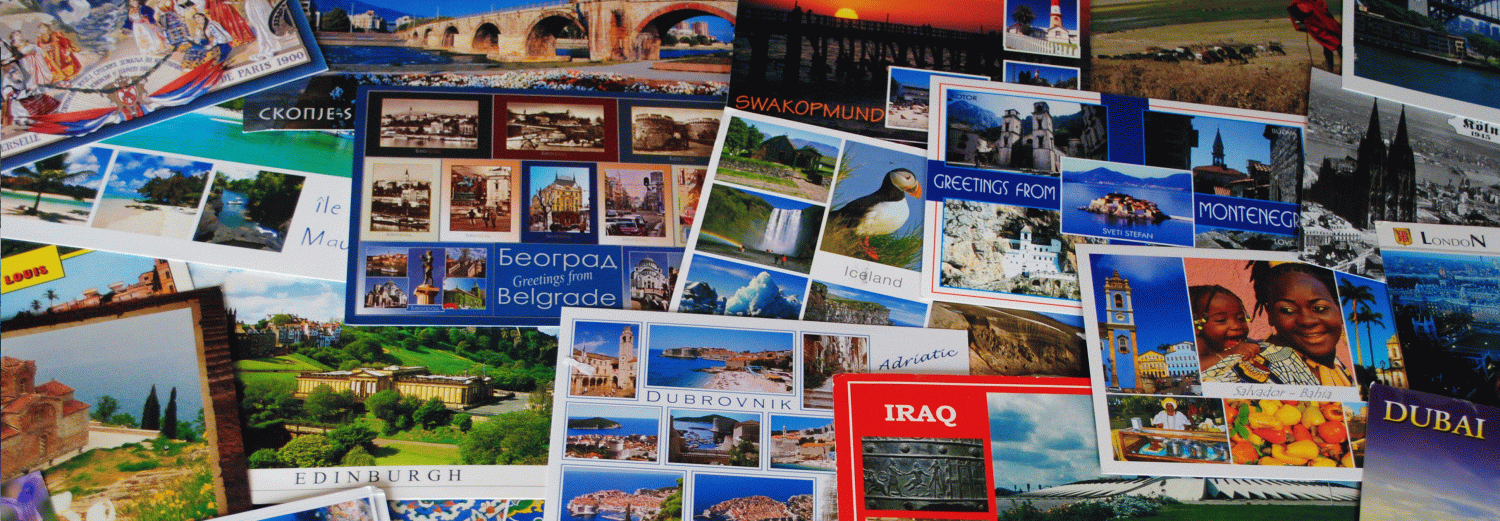
 Collecting Postcards