January found V and me on R&R in Vietnam, a country we had never visited before. Our first stop was Hanoi—the country’s vibrant capital. Its streets buzzed with the cacophony of commerce and the chaotic crush of cars and motorbikes. It felt so different from Rangoon—more optimistic, more productive, life moving in fast-forward motion. I had only been out of the hospital for a month after being hit by a truck eight weeks prior, and I was still using a walker. But I didn’t let that stop me from enjoying Hanoi as much as I could.
[This post is the second in a series. To read the post about the first half of the trip, please click on the link.]
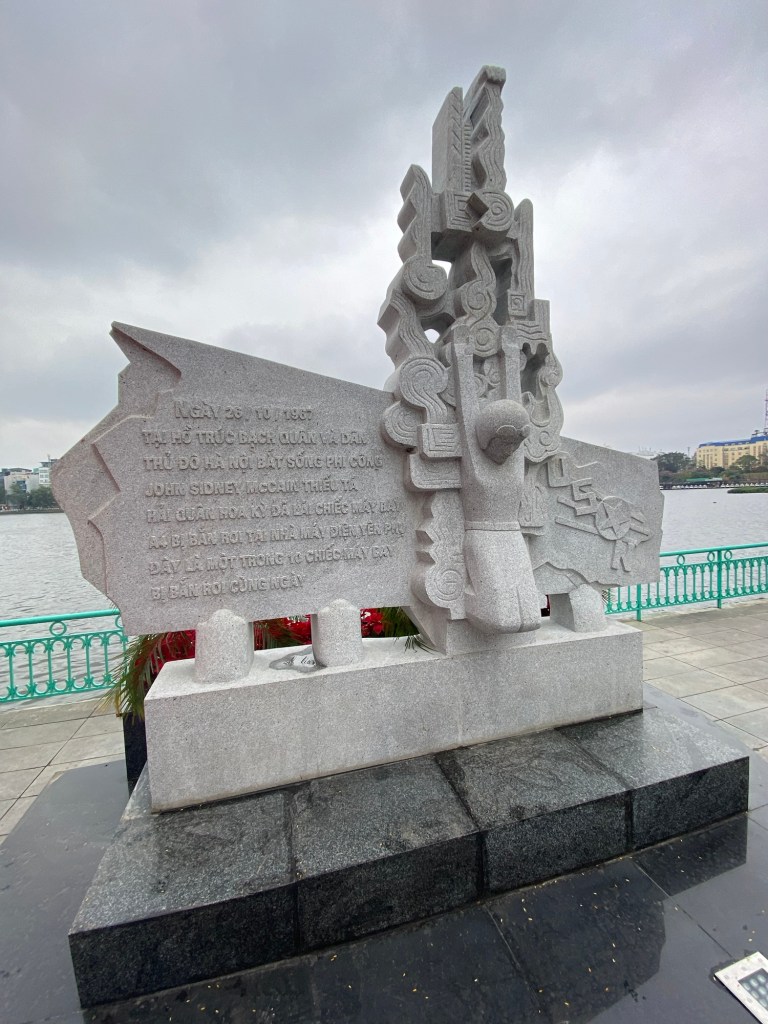
Hỏa Lò Prison in Hanoi—often sarcastically called the “Hanoi Hilton” by American POWs, was built by the French colonial government in the late 19th century to imprison and execute Vietnamese political dissidents seeking independence. During that period, detainees were subjected to harsh conditions, overcrowding, and frequent use of torture and capital punishment.
After Vietnam’s partition in 1954, the prison was repurposed by North Vietnam to hold U.S. military personnel captured during the Vietnam War, many of whom later reported systematic mistreatment, coercive interrogations, and violations of the Geneva Conventions.
Today, the site operates as a museum, so we thought we’d go and see it. It was hard to imagine as we walked through the buildings and grounds filled with tourists that once people there suffered so profoundly. Senator John McCain spent over five years of his life there.
In my opinion, the museum’s exhibits largely reflect the Vietnamese state narrative more than the experiences of either the Vietnamese anti-colonial prisoners or the American POWs who were later held there. However, they did a thorough job of explaining what the war was like for civilians in Hanoi under U.S. military bombardment. Despite these limitations, I still found the Hanoi Hilton important and well worth a visit.
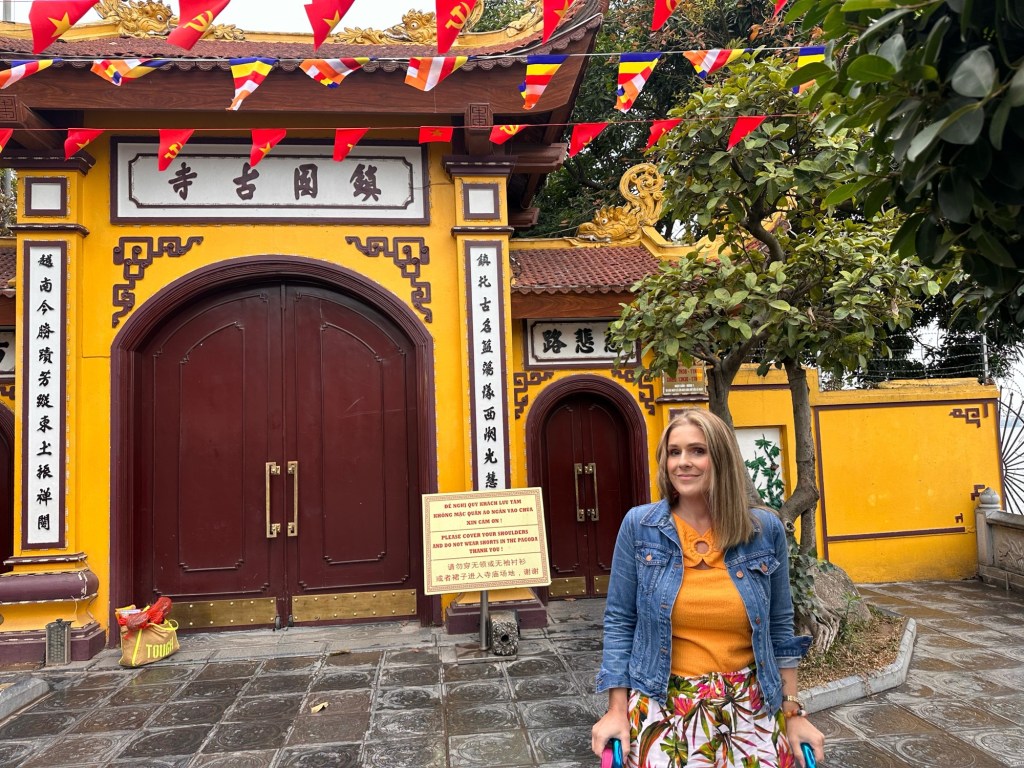
The beautiful Tran Quoc Pagoda is Hanoi’s oldest Buddhist temple, originally founded in the 6th century on what was once the shore of the Red River before the lake system shifted to form today’s West Lake. For more than 1,500 years it has been an active place of worship, closely connected to Vietnam’s imperial and spiritual history.
Its elegant red stupa, added in the 1990s, houses relics of past monks and reflects a revival of Buddhist practice after decades of war and political upheaval. Today the pagoda is both a working temple for local worshippers and one of the city’s most photographed cultural landmarks, especially at sunset.
Visiting the Ho Cho Minh Mausoleum might have been one of the strangest cross-cultural experiences I’ve ever had — on this trip or otherwise.
Visit Attempt #1: The first time we tried to visit, V was wearing shorts and I had on a skirt that fell just above the knee. We were told we couldn’t enter with bare legs, so we hastily bought cheap cover-ups from vendors lingering outside the front gate.
However, when we tried to go in again just minutes later, we were informed that the site was closing for the day. Bummer! I still thought the mausoleum would be worth seeing, so we made other plans and decided to return the following day.
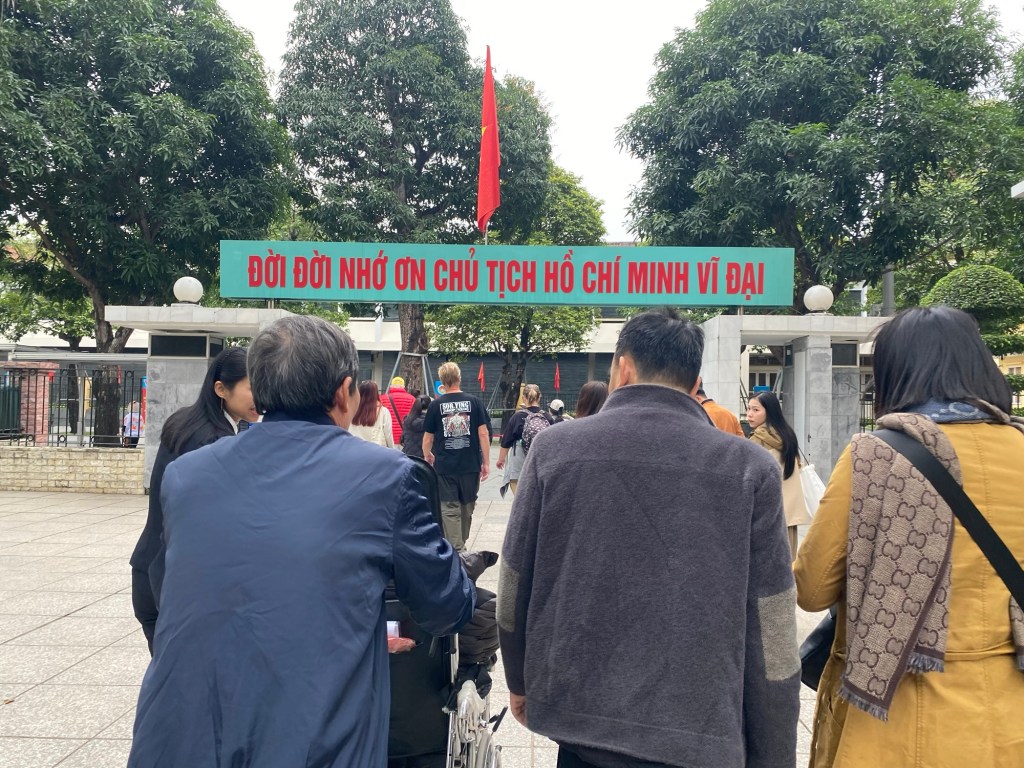
Visit Attempt #2: We arrived on time and properly dressed. Almost as soon as we joined the long line of visitors waiting to enter, a staff member noticed that I was using a walker. They pulled me out of line and offered me a courtesy wheelchair. I was capable of walking across the flat ground—just slowly—and I had already been walking much more than usual on this trip. My pelvis was aching, so I gratefully sat down in the wheelchair, resting my walker across my knees.
I assumed the wheelchair would simply help me move more quickly through the line and across the vast complex to the mausoleum building. Unfortunately, I soon realized that because I “needed” the wheelchair, staff would not allow me to keep my walker on my lap and required us to check it at a left-luggage counter.
A staff member and I communicated through a voice translation app. My blood pressure began to rise when I thought I understood her to say something about soldiers carrying me up some stairs so I could walk in to “see Uncle Ho,” as she referred to him, more easily. It seemed too absurd. Surely they weren’t going to carry me, I thought. I can walk with my walker—evidenced by the fact that I arrived here. And how was I supposed to stand and walk inside without it? It didn’t make sense that they would require me to sit in a wheelchair, yet then insist I could walk.
I asked to keep my walker with me. The staff member smiled, spoke into her phone again, and then showed me the screen. It read: “Perhaps the regulations must be respected!” All righty then.
Why I couldn’t use both my walker and the site’s wheelchair is beyond me. The rule meant I would be confined to the chair the entire time—including on the stairs—but I was too determined and curious about the mausoleum to decline the “help” and leave. When my mom and I visited Moscow in 2016, we missed seeing Vladimir Lenin’s remains because his mausoleum in Red Square was under construction. I didn’t want to miss this opportunity too.
At no point did anyone ask about my injuries, limitations, or what I needed for a safe visit. I would have said: Please wheel me close to the building, then I’ll use my walker. I can walk, but I’m only 50 percent weight-bearing on my left side and tire easily because of broken ribs. That conversation never happened.
The only other wheelchair user was a uniformed 98-year-old veteran with a placard listing his dates of service and military accomplishments. Surrounded by family, he seemed celebratory. We set off across the vast park with our minder, rolling past hundreds of visitors who had surrendered their bags and were queued beneath a covered walkway. As we approached the imposing building housing Ho Chi Minh’s remains, I felt a flicker of dread despite the obvious courtesy.
At the entrance, four or five wide, red-carpeted steps rose before us. Four soldiers lifted the elderly man’s wheelchair and carried him up as he smiled and waved. No, no, no, I thought, twisting around to tell our minder I didn’t want to be carried. But soldiers were already at my sides. Suddenly I was airborne, aware of the crowd staring and likely wondering what was wrong with me.
Inside, I was rolled down a hallway and briefly relaxed. That wasn’t so bad, I thought. Then we turned a corner and faced another long flight of red-carpeted stairs—at least 30 more!
Panic set in. Surely they didn’t intend to carry me the entire way, risking a fall? What was I supposed to do now, without my walker? The mausoleum is a place that demands decorum; it was not the moment to make a scene. Still, I was genuinely afraid of being dropped and ending up injured in a foreign hospital. Again.
We reached the top without incident. V hovered anxiously behind me. Inside the chamber, a soldier stood on either side of me, lifted me from the wheelchair, and guided me along the U-shaped walkway around the glass bier. Ho Chi Minh lay peacefully inside, 57 years after his death. I could barely focus on the historic gravity of the moment; I was limping, bracing myself each time I put weight on my left leg, concentrating only on taking one careful step at a time until I could sit again. Then came the return trip down the stairs—another surge of fear as I was carried.
In an unexpected way, the administrators transformed what could have been a safe, dignified experience—me walking steadily with my walker—into something that felt frightening and unsafe. The soldiers were strong and, in hindsight, unlikely to drop me. But carrying me up and down stairs was unnecessary. It wasn’t trauma-informed, and it wasn’t medically appropriate to remove the mobility aid that allowed me to walk safely. I understand that visitors are expected to stand when viewing the leader affectionately called “Uncle Ho,” and that they may have had security concerns about mobility aids like canes or walkers being used as weapons, but safety should come first.
The final frustration: our minder required us to return the wheelchair immediately rather than allowing us to see the nearby fish pond and grounds. On the way back to pick up my walker, our minder had pointed out the museum, which stayed open an hour later than the rest of the grounds but which also was located at the top of a large set of outdoor stairs, and suggested we not miss it. What?? By the time I retrieved my walker, the site was closing and we were ushered out. Then it began to pour. The whole episode felt like a comedy of cross-cultural miscommunication—one that took me several hours to fully process.
Since my accident, I’ve had much more to say about the ways people with temporary or permanent disabilities are perceived and treated. My experience at the mausoleum crystallized something I’ve encountered repeatedly: too often, disabled people are not asked what they can safely do or what accommodations would actually help them. Instead, decisions are made for them—swiftly, confidently, and sometimes kindly—but without consent or curiosity. The result can feel less like assistance and more like being handled as cargo.
At the mausoleum, no one asked about my specific injuries or limitations. No one inquired how far I could walk, how much weight I could bear, or what would make the visit safe. The assumption seemed to be that if I was in a wheelchair, I must be incapable of walking at all; and if I could stand briefly, I must not need my mobility aid. Those binary assumptions erase the nuanced reality of many injuries and disabilities.
Mobility exists on a spectrum. The fact that someone can take a few steps without a walker does not mean they don’t need it. A person may use a wheelchair not because they are fully incapacitated, but because they are protecting a healing fracture, conserving limited stamina, managing pain, or preventing further injury. Assistive devices are not theatrical props; they are tools that allow people to participate safely and with dignity in society.
What made the experience so unsettling was not malice. The staff were polite. The soldiers were careful. The intention was to show courtesy and respect. But good intentions cannot substitute for listening. When support is imposed rather than discussed, it can strip away autonomy and create risk rather than reduce it.
The simplest solution would have been the most humane: ask. “What do you need?” “How can we help?” “Are you comfortable with this?” Those questions acknowledge expertise—the disabled person’s expertise about their own body. Without them, even well-meaning assistance becomes disempowering and sometimes genuinely frightening.
There were several experiences like this throughout my January travels—in Singapore, Vietnam, and Indonesia—particularly in airports and other public spaces. I often felt eyes on me, people silently wondering what was “wrong” and questioning whether I really needed a wheelchair, given my otherwise athletic appearance. At the same time, others responded with infantilization, assuming I couldn’t (or shouldn’t) do anything for myself.
The broader lesson I keep encountering is this: disability is not a single, static condition. It is often dynamic, contextual, and invisible in its complexity. Respecting that reality requires more than ramps and wheelchairs; it requires communication, flexibility, and trust.
I’m aware that I’ve spilled a ton of digital ink on this one topic, and it is not reflective of our overall time in Hanoi. It is, however, something that I’d like others to be more aware of.
 Collecting Postcards
1 comment for “Holiday in Hanoi, Part II”