Before too much more time elapses, I decided to deviate briefly from the heaviness of the present-day story about my recent truck vs. pedestrian accident and highlight a trip V and I took in October to the ancient city of Bago, about two hours northeast of Rangoon.
I’ll give an update on my hospitalization in Thailand and recovery from the accident soon.
The Community Liaison Office (CLO) at the embassy sponsored the Bago day trip last month, arranging the transportation and designing the itinerary. The pickup time was around 8:00 a.m., the return drop-off well after dark. We signed up in advance, looking forward to a chance to see Bago.
But as I’ve come to realize—and this trip was no exception—CLO outings at some posts tend to squeeze too many people into a vehicle and cram the agenda so tightly that there’s no time to linger or appreciate any one destination for more than 20 minutes. The effect ranges from merely hurried and inconvenient to downright uncomfortable and miserable, depending on your point of view.
But it’s hard to be too negative about it. At the end of the day, if you want American travel standards, you might do better to stay in the United States. CLO trips are a good opportunity to visit a place you may not have seen otherwise, and a lot of care, intention, and local cultural insight goes into the organizing. Even when travels are exhausting, we don’t often wish we hadn’t gone.
But with that said, V and I agreed after this particular CLO trip that we might be better off in the future taking more initiative to either travel on our own or in smaller groups. That would help avoid some of the less fun things about group tours, like travel discomfort, the loss of autonomy, and feeling herded.
I knew from the first five minutes of the trip anyway that it was going to be rough for me. We were picked up towards the end of the pickup route, and the only remaining available two seats together were in the back row of a 14-passenger van. Every other row had an overhead vent; our row had none, and I suspect that was because the only thing the back of the van was actually meant to carry was luggage. Yet, we still packed in four more pickups after us.
As our driver bounced and weaved through Rangoon’s bumpy, traffic-filled streets on the way north out of town, the temperature outside had already exceeded 90 degrees. Humidity was right about 100%. I’d worn a lightweight cotton and linen blend sundress from Australia—the most comfortable possible option—and sandals, but it was going to be a scorcher.
The van’s air-conditioning was blasting, but although people in the front complained about being “freezing,” none of the air was reaching us. I had taken a Dramamine, but unfortunately for me, not sufficiently in advance. I spent the entire two-hour trip overheating and dealing with head-spinning, stomach-churning carsickness. I sat perfectly still, eyes closed, listening to music on my headphones and communicating with no one. I already deeply regretted having signed up for the trip but was determined to make the best of it. As it turns out, we got lots of great pictures which belie the true difficulty of the day.
Our first stop (aside from a roadside gas station bio break filled with stray dogs and unlikely snacks) was Kanbawzathadi Golden Palace. The palace, located in Bago, is a reconstruction of the magnificent 16th-century royal residence of King Bayinnaung of the Taungoo Dynasty. Built in 1566, it was destroyed by fire and looting in 1599 and not rebuilt until the early 1990s.
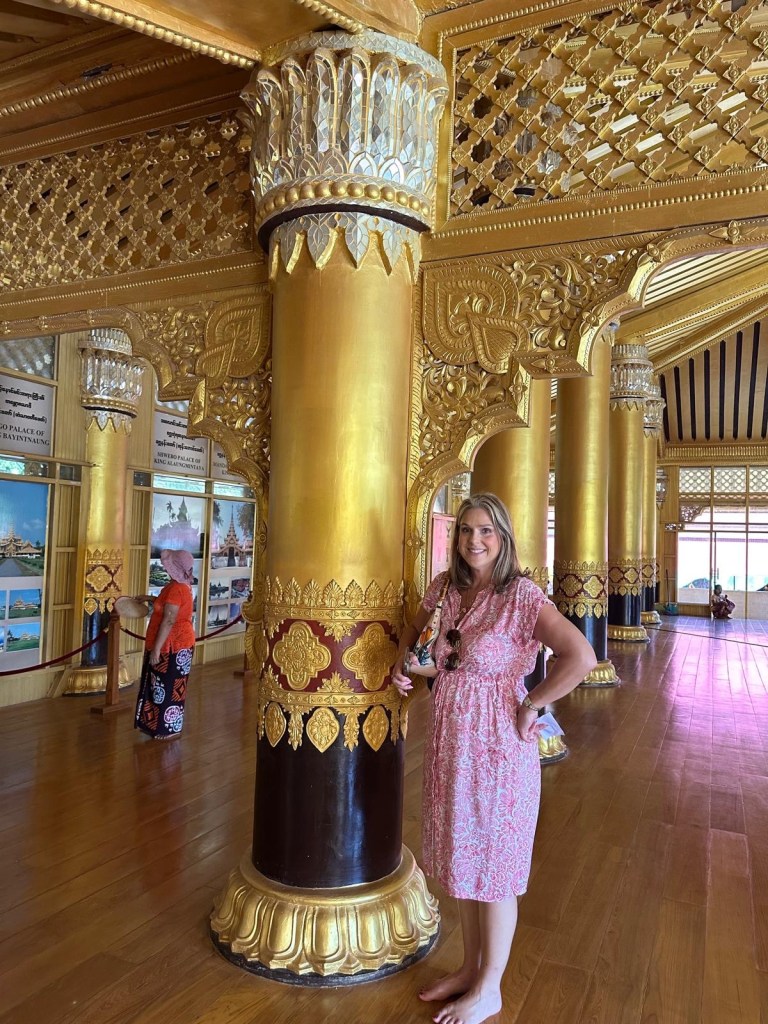
The present-day, replica complex gives a vivid sense of the scale and grandeur of the king’s court, with soaring teak halls, gilded ornamentation, and elaborately carved wooden interiors in the Great Audience Hall—where the king used to welcome visiting foreign dignitaries.
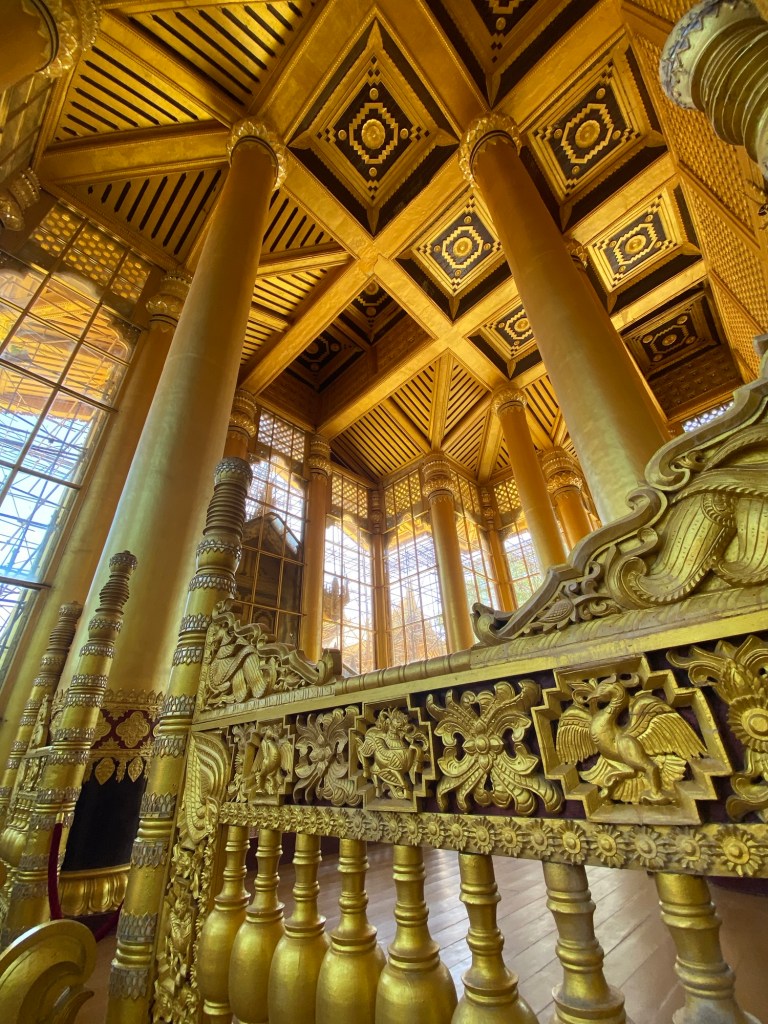
Excavations three decades ago uncovered foundations, the remains of elephant stables, and artifacts that guided the reconstruction. This includes more than 175 unearthed teak pillars inscribed in Mon and Myanmar, sent from various parts of the kingdom during the original construction to encourage unification. Today, the palace functions both as a historical museum and as a symbol of the cultural and political height of Bayinnaung’s empire.


After we left the palace, we stayed on the grounds, driving a short distance away to Bhammayarthana Throne Hall. Bhammayarthana previously served as King Bayinnaung’s royal bed chambers. Although they were located within an easy walking distance of less than 10 minutes, it was incredibly humid and we were being pushed along a little hurriedly by the CLO who had her eye on the schedule. So we climbed all the way back into the van, and two minutes later we climbed all the way back out again. The chambers looked incredible and full of gold…as I assume one would want one’s royal bed chambers to be.
Rebuilt on the original 16th-century foundations, the hall showcases the elegance of Taungoo-era court life—rich teakwork, elevated platforms, and gilded ornamentation that reflect the grandeur of Bayinnaung’s empire during its most powerful. Evidently the king sometimes also used this space for more intimate consultation with his most trusted advisors.

On the way to our next destination, the CLO suggested stopping at a local shopping mall to use the restroom. It quickly became clear that this was likely the only suitable public bathroom in town, so no one wanted to say no, even though there was no real tourist reason to enter the mall.
But everything about the place felt strange. The building was tall and narrow, forcing shoppers to wind their way up a tight stack of escalators. It seemed to be the local hangout—probably for the A/C—yet hardly anyone carried shopping bags. Each floor had men’s and women’s restrooms, but we couldn’t seem to get into any of them; they were in narrow hallways and so crowded that it was impossible to tell whether there was an actual line, or who was even in it.
Frustrated, myself and a few female colleagues banded together and made our way up a level where we entered a small, oddly-shaped bathroom with three stalls, mostly occupied. At least four young ladies were hanging out at the sinks, talking on the phone or fooling around in the mirror. The weirdest thing of all was that they were hanging out in the public bathroom of their own free will; the A/C didn’t extend to the bathroom. It was probably 90 degrees inside, and it stunk.
We did our business as quickly as possible so we could escape. We shared what little tissue we’d brought because there certainly wasn’t any toilet paper provided. As I approached the sink afterwards, a handful of people who didn’t even seem to know each other continued their awkward and totally unnecessary occupation of the sink area, not making any eye contact or room for people coming out of the stalls to wash their hands.
What is going on in here? I muttered, feeling like I was missing some cultural note. I stepped right into their space and washed my hands anyway, shooting the girl on the phone a raised eyebrow in the mirror to which she seemed impervious.
Half a dozen tiny escalators and many stares later as we walked back to the van, we were drenched in sweat, laughing, and perplexed. We were right on time but the van was blocking traffic due to the lack of parking lot or turnout, inviting a cacophony of horns. People continued honking angrily as all 15 of us climbed inside. That was the only time during the day that it was actually a relief to get back into the van!
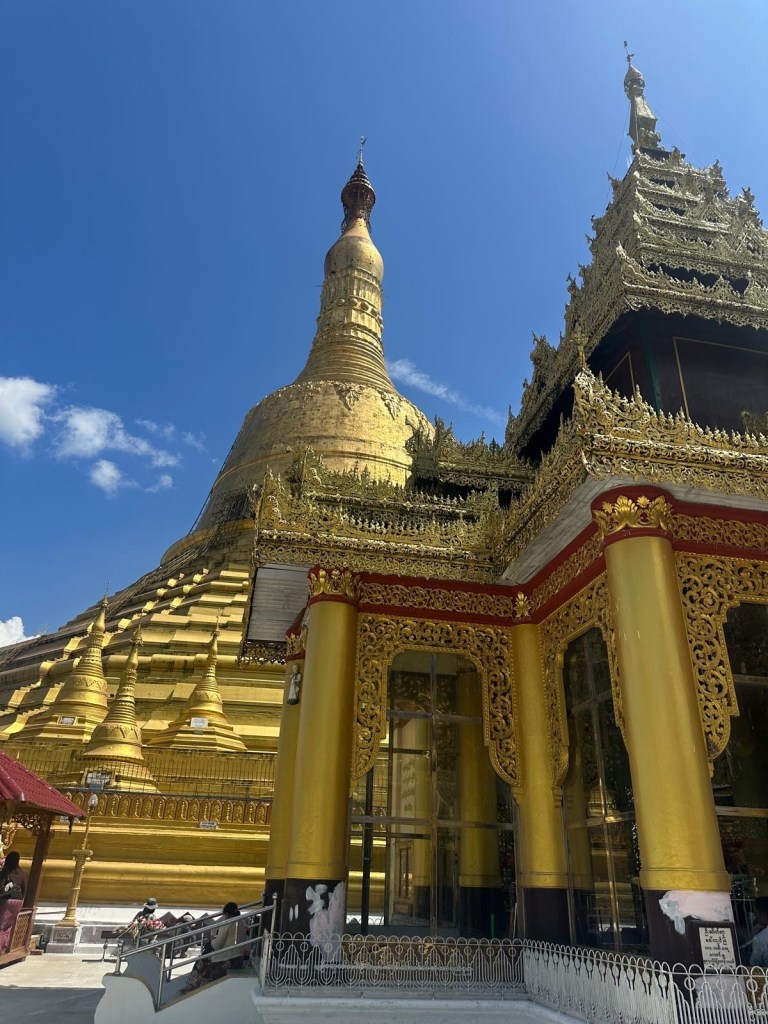
From there we headed to Shwemawdaw Pagoda (Golden God Temple). Shwemawdaw is actually the tallest pagoda in Burma. Standing at at 374 feet (114 meters), it’s taller than the famous Shwedagon Pagoda in Rangoon—which is also very big, and very golden.

According to legend, the original pagoda was founded more than a millennium ago by the ethnic Mon people. Supposedly, two Mon merchant-brothers received relics — two strands of hair from the Buddha — and enshrined them by building a stupa at the site.
Over centuries, more relics — including tooth relics (added in 982 and later 1385) — were said to have been brought and enshrined there. In 1917 and again in 1930, earthquakes nearly leveled the structure, which later was painstakingly rebuilt.
It was around this part of the day that I started to get a bit out of sorts.
It was lunchtime, but we still had multiple stops remaining on the tour before our planned lunch stop (we’d been reminded to bring snacks, and we had.) One cannot wear shoes or sandals on the pagoda grounds, and my bare feet had gotten filthy. And the modesty monitors on the stairs leading up to the pagoda were displeased by the way my dress didn’t button down to the bottom hem, and clung damply to my body in the heat. I understood, and donned their provided wraparound garment from the waist down to better cover myself. The CLO had thoughtfully included fees in the trip tickets to cover such an expense.

But the extra layer made me even hotter, and outside the white sun beat down relentlessly. The heat. I simply cannot explain how much everyone was sweating and how humid it was. Bago in late October somehow made the fetid summer swamp of Washington, D.C. feel like the Sahara Desert.
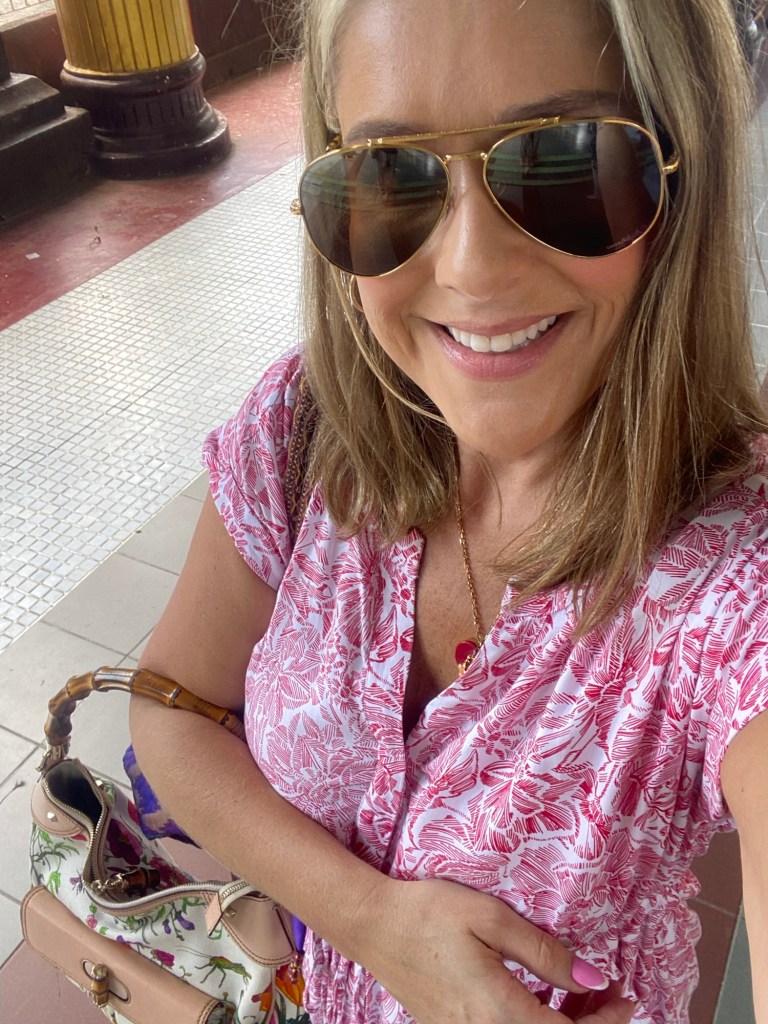
Regrettably, I accidentally sweated on the vachetta of my vintage Gucci purse from the 1990s and I watched in disbelief as small discoloration marks appeared on the pristine raw leather. I hadn’t realized that would happen or I would have carried a more summer-proof bag. Despite a small walkway-style mat leading around the pagoda, my bare feet were getting scorched by the hot marble and I hopped from one odd shady patch to another.
When I realized the group meant to amble around the entire perimeter of the property, including eight planetary shrines and a small museum, it was finally a bridge too far. I was probably very close to heat stroke despite having brought almost a gallon of water. I pulled the plug and went back to the van.
There V and I discovered a couple of other people had also decided to do their own thing by enjoying the market or resting in the shade. Taking charge of your own day is such an essential element of self-management during group tours. You have to preserve your sanity so you can remain pleasant to be around and still have a good time.
Before I knew it, we’d all piled back in the van. The next stop was one of Bago’s cheroot production factories. Cheroots—mild, hand-rolled cigars made from a blend of tobacco and local herbs—have been produced in Bago for generations, often by small family workshops rather than large factories.

Bago has long been known for its traditional cheroot-making industry, a craft that reflects both the region’s agricultural heritage and its cultural rhythms.

Women, in particular, make up much of the workforce, seated in lines rolling, filling, trimming, and tying each cheroot with remarkable speed and uniformity. I forget how much we learned they make per day, but it wasn’t much. As in, I don’t think it would cover many Americans’ daily Starbucks habit.
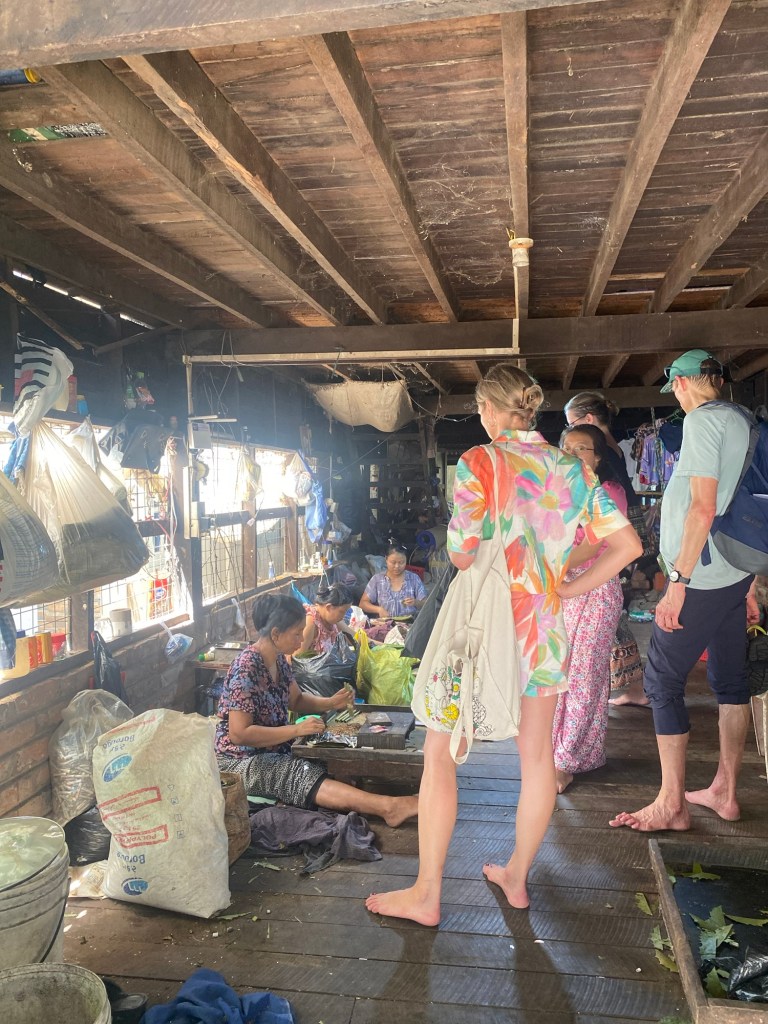
The work is repetitive but highly skilled, and the distinctive rustle of leaves and snap of bamboo filters has become one of the sensory signatures of Bago’s cottage-industry economy. It was surprising how warm it was inside the factory, but at least to me, the heat felt marginally drier and more comfortable than outdoors. Perhaps it was because of the controlled process they use to dry the leaves and the fact we were in the shade.
Those who wanted to pick up packages of cheroot cigars as souvenirs did so, and then it was once more back into the van.

We next made our way to Shwethalyaung Temple, one of Burma’s most impressive reclining Buddhas—a serene, 55-meter-long figure dating back to the 10th century. It was restored to its full grandeur after its rediscovery in the late 1800s.
Unfortunately, the CLO must have mentioned this was the spot to see the reclining Buddha while those of us in the back of the van were still climbing our way out. Or, to be fair, perhaps I missed the announcement when I was gaping around taking a photo. I confess that at this point all I was trying to do was survive the heat, humidity, carsickness, and compressed agenda and just make it back to Rangoon in one piece.
So I wasn’t really focused on this being the place with the reclining Buddha. The main thing I noticed in the plaza was a lively market spilling out along the walkway outside Shwethalyaung’s great hall.
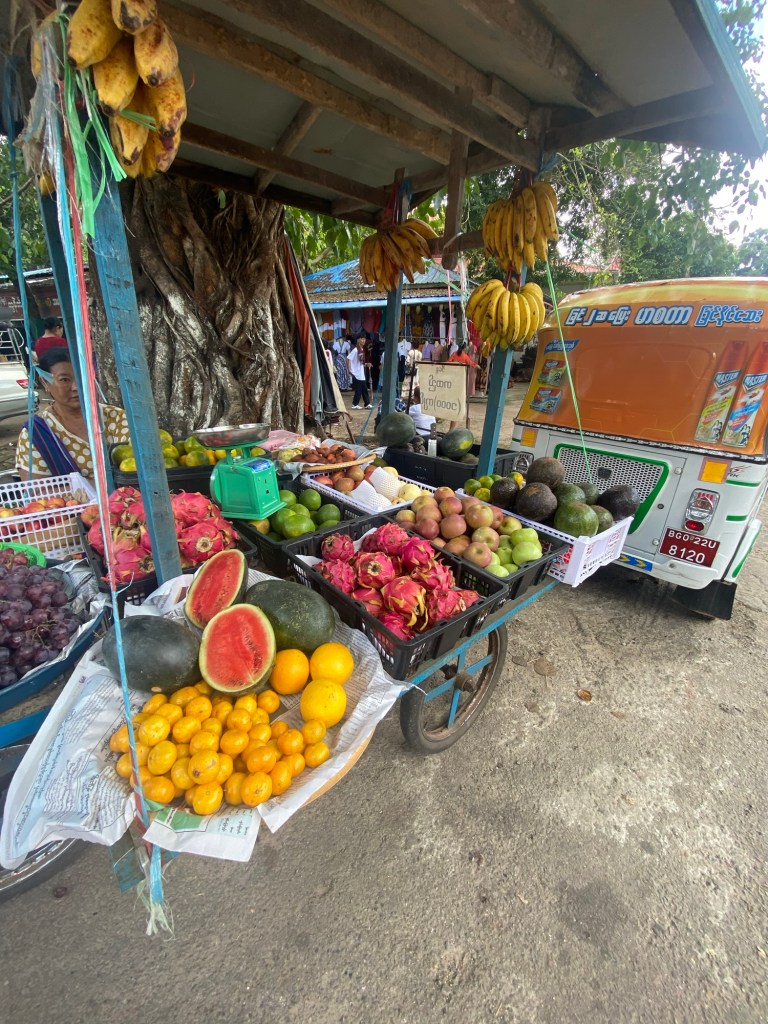
The market was packed with vendors selling everything from lacquerware and wooden carvings to jasmine garlands, produce, snacks, and small Buddhist souvenirs. Some vendors had kiosks and some had permanent shops.
Right away, I spotted a pair of beautifully carved wooden owls on a table. There were actually two sets, and I selected one from each because I preferred the wood coloring and details of those particular pieces. The CLO kindly helped me bargain them down to a fairer price than I could have managed on my own. I never did see the Buddha, but since we spent maybe 20 minutes in the entire plaza, it wasn’t surprising. V caught a glimpse of it as we drove away, finally headed back toward Rangoon.
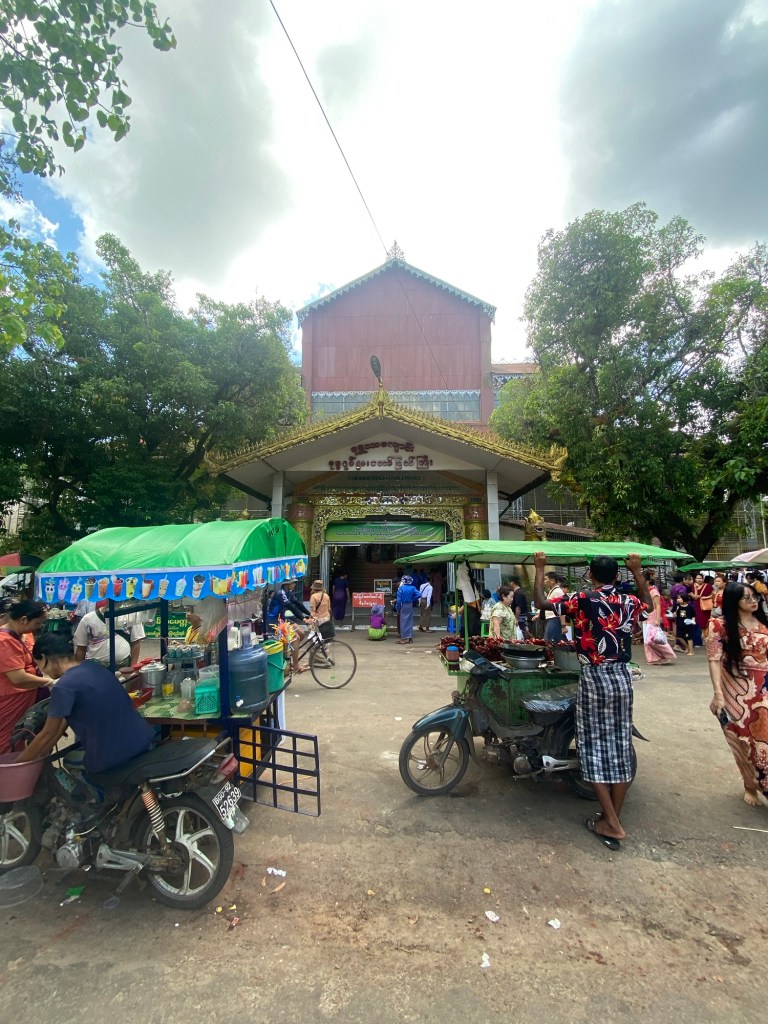
I think going slightly out of Bago for lunch may have been the best food option for a group of our size, because the last stop on our day trip was KMA Shwe Pyi Bago Resort. Shwe Pyi is located on the highway between Bago and Rangoon.
It featured a place to stop and get out, a hotel, and a restaurant that members of our party said had pretty authentic Chinese food. It also offered some outdoor activities like biking and boating, and is surrounded by forested land, gardens, and a small lake. There are lake trails, wood-carving workshops, duck boats, a museum, and more, providing a green, natural environment that feels far removed from city bustle.
Maybe I’ve gotten old and grumpy, but leaving the house by 8:00 a.m., and spending hours in the back of a packed hot van and out in the heat of the day without a meal until 3:00 p.m. almost wiped me out. With age I’ve started to realize, even if I can tolerate it, it’s not my idea of a good time and not how I want to spend my precious weekend days off in the future.
So my mood changed dramatically for the better once we were seated on the breezy terrace and the cold beers and noodles started appearing. Not to mention that this place had a really normal bathroom.

But once we finished our meal and still had a good drive back to Rangoon ahead of us, I realized we still weren’t quite leaving. The plan first was to take the group all over the resort grounds in little buggies to see the resort owner’s extremely large and impressively-curated collection of carved wooden statues—mostly animals. He had just about every type of animal imaginable, and some—like dragons and minotaurs—that only lived in the imagination. Of course there was also a section of said statues for sale, which we skipped most of the obligatory trudge-through.
We left, comfortable and renewed, and ready for the hour-plus drive remaining. Unfortunately, due to barricades and traffic, the trip still took about two more hours from that point. When we got back to our house, it was dark. We were almost laughing we were so relieved. I took one of the best showers I’d felt in ages.
I would highly recommend a trip to Bago to anyone! It’s a neat place and I’m sure there’s a lot more to see. I’m not sorry I went, but I wish I would have pushed back on the schedule timing a little and asked if we could either take two vehicles or make sure the A/C worked for everyone. If you go, mind the time of year and the weather, and have a much more comfortable ride than I had!
 Collecting Postcards