
Two weeks ago in my Burmese class, I hit a couple of exciting milestones. First, I had a breakthrough in how I generate speech, especially when tackling longer discussions—finally, a strategy that clicks!
Second, I not only survived my third progress evaluation but even enjoyed parts of it. The results were a confidence boost, reinforcing my daily experience in the program, and keeping my hopes high for passing the End of Training test (EOT) in four months. Momentum is on my side!
In week 27, I was lucky to make 100% attendance by avoiding several illnesses going around. After missing days here and there throughout the program when not feeling well, it felt like I’d won half the battle just by showing up. I wanted to focus on passing my third progress evaluation at the end of the week.
If you’ve been following the blog for a while, you know I’ve already had two progress evaluations in Burmese. My first was back in November (end of week 9). That one went fairly smoothly. I made mistakes, of course, but the feedback was positive overall.
I don’t remember being too uncomfortable during it, or too nervous beforehand. I did spend around five hours alone that morning to check whether all the things I expected to say were really in my head and not simply in my notes. For the most part, they were.
In retrospect, the material was fairly elementary at that time and mainly limited to biographical details. “I am a diplomat. I work at the State Department. My hometown is x. What is your name? What do you do for work?” And so on. Of course, that was the extent of what I knew at the time so it was challenging for what it was. I scored “on track.”
The second progress evaluation was right before Christmas (end of week 16). In addition to the material having grown more complex, and the ongoing impact of our class size doubling in week 12, the session ended up being a more negative experience. I also scored “behind” for the first time.
My bad day was evident to the tester and examiner because — unlike in larger departments where you may not know your tester or examiner — in the Burmese department we only have two teachers, and they were both facilitating the evaluation!
These people are with me every day. They are intimately aware of what Burmese I know and don’t know after spending five hours a day for months in a small room with me. That doesn’t relieve me of the obligation to demonstrate my learning during the evaluation in addition to during class though, just as if we were strangers (or as if the progress evaluation were really the EOT).
What lingered for me afterwards, though, was the strong feeling of dread and bad mood I’d had beforehand and how much I “knew” it wouldn’t turn out well. Usually when I have these feelings, everything still turns out fine. This was in stark contrast.
But I hadn’t wanted to postpone the evaluation given an impending prospective government shutdown (which fortunately did not come to pass) and my dad’s imminent arrival for the holidays. Ripping the bandaid off felt right, so I’d just gone ahead. I still think it was the right decision.
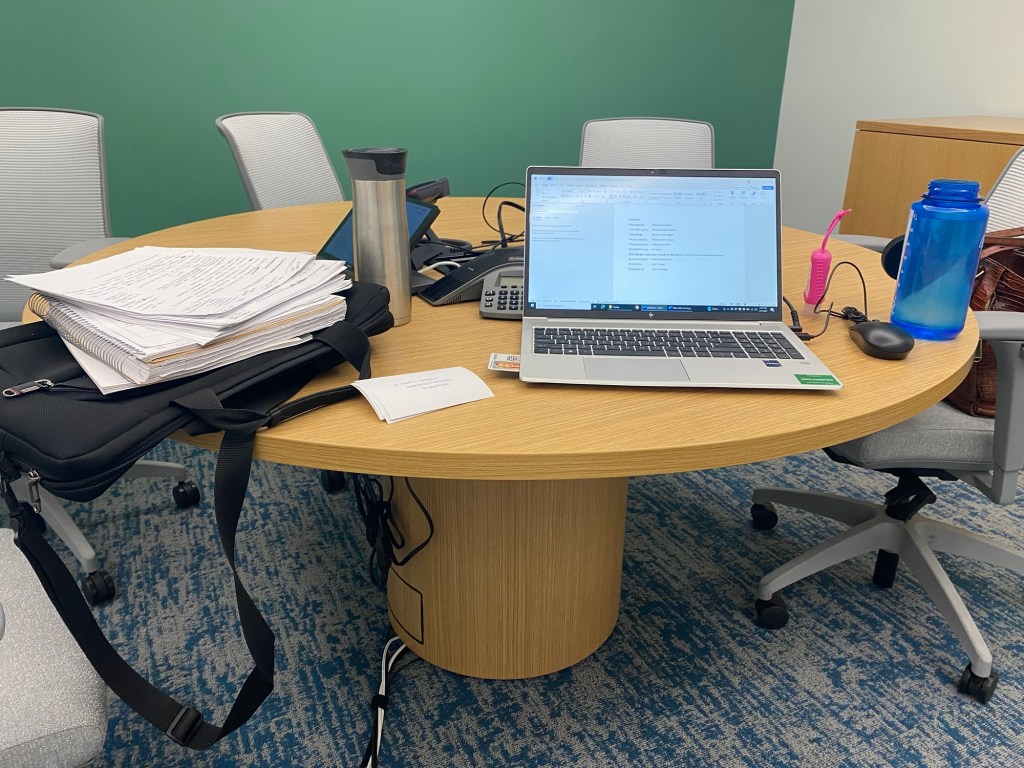
third evaluation…
But I don’t think how I did during the second evaluation was reflective of my overall progress in our 44-week course. Fortunately as I’ve said before, these evaluations are informal. Your score isn’t official. The goal is simply to measure how students are going and whether they need additional support or to change strategies. I definitely wanted to have a less cringey experience the third time anyway.
I spent multiple days prior to the third progress evaluation reviewing and consolidating notes, playing word games, further fleshing out my little scripts on different topics, and practicing extemporaneous thematic speaking in class.

(Bag: Louis Vuitton Limited Edition Fall 2007 Noir Monogram Mirage Griet bag with ombré canvas and leather trim, decorated with the Louis Vuitton x Stephen Sprouse Fall 2006 Limited Edition Leopard Bandeau)
Now, I really do not like doing the latter and at one point found myself with nothing to say. One of the biggest problems I’ve had in any FSI language study is the dreaded, “Here’s a topic; take one minute to prepare and then discuss for 2-3 minutes.”
I don’t know why, but somehow my mind goes blank and it’s like I’ve never heard (or spoken) a word in Burmese!
A related challenge is having a topic and trying to write sentences about it, synthesizing a variety of structures and vocabulary words learned in class lessons. I often would just come up blank, or have a bunch of disorderly pieces jotted down that didn’t form a coherent statement. Then I would hear other students read their sentences and be like, I know 90% of those words. Why can’t I come up with all that??
So during week 27, I started trying harder to defeat these challenges.
After being in class one afternoon with nothing to say (but being able to respond in full sentences to the teacher’s questions), I discovered a helpful strategy: (a) typing up sentences about a topic in Burmese, (b) recording and sending an audio file of my reading the sentences out loud to my teacher, (c) having the teacher correct any errors and give me feedback, and then (d) translating the sentences into English bullet points! This ended up being a great help and the piece I was missing.
I would think of a topic in Burmese — such as economic sanctions, bilateral relations, or environmental conservation — and then write down as many things as I could remember in English. I noticed when I looked at the English, I could -mostly- then trot out the Burmese orally, point by point.
I have no idea why this works for my brain. Perhaps because I don’t feel very creative when talking about some of these topics, but have assembled enough vocabulary and phrases to be able to have a back-and-forth discussion once I feel more prepared (and confident that what I’m saying makes sense).
The new strategy seemed to tick both the boxes of mental organization and having to form the thoughts out loud in Burmese from memory, a little differently each time. This is better for Q&A and real dialogue than memorizing and repeating monosyllabic statements repeatedly and then not being flexible in using the language outside of “presentation mode.” It also has helped me with the dreaded blue screen of death when I open my mouth.
So I arrived at FSI well before 07:00 for my 12:20 evaluation. Cool, cool, cool. As week 27 also marked the large-scale “return to office” initiative across the federal government, the FSI parking lots have become as hectic as they once were a decade ago. I found an empty, quiet workspace in the B Building and began preparing.
One of the things I did was imagine a topic, write down as many English talking points as I could in two minutes, and then speak out loud. I also wrote down 2-3 questions for every topic I could think of to help prepare for the interview portion. I felt really good and was not worried. I reminded myself it would take less than 90 minutes and then it would be THE WEEKEND!
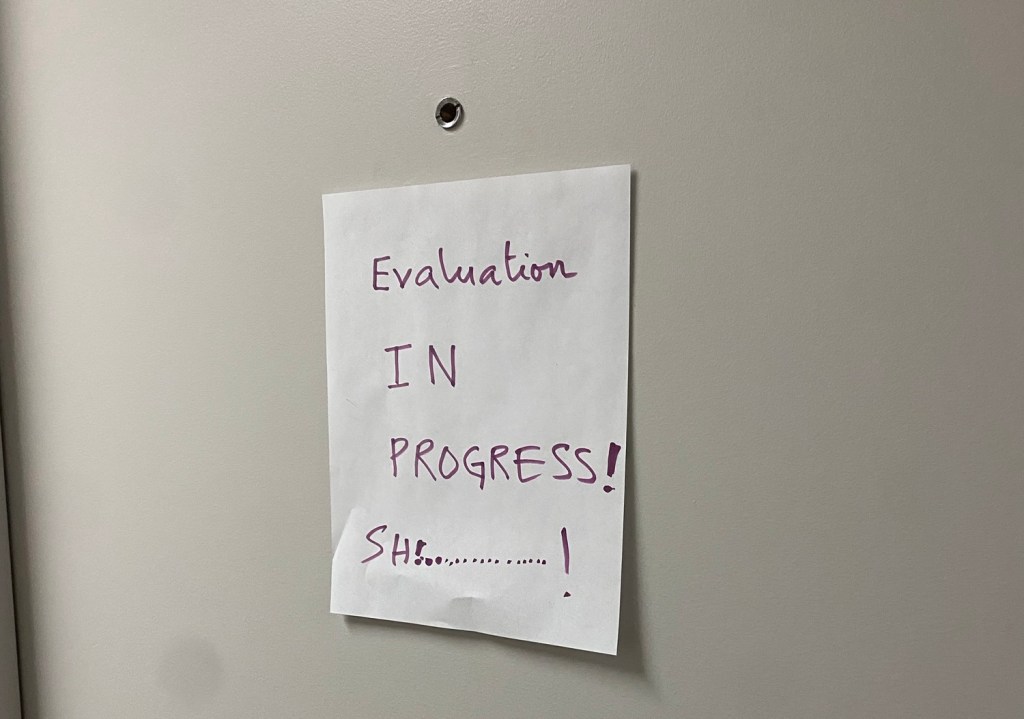
And yet, all morning my stomach was a mess. And as I walked across campus to our F Building classroom, I felt waves of dread and near-panic. On the outside I looked calm and greeted people I knew.
What is wrong with me? I asked myself. By the time I got to the classroom, I felt hot, dizzy, and on the verge of tears. This is ridiculous, my right brain chimed in. Get it together.
When the door opened and one of my classmates came out from his turn at the evaluation, we started chatting in the hallway almost as if it were a regular day. Seconds before I had imagined myself bursting into the room and apologizing to my teachers while asking to reschedule.
But I knew already that would extend my absurd, unnecessary dread into the weekend and into unknown Monday territory, when no evaluations were scheduled because of regular class. All three of your classmates have already done theirs. You can do this too. So I decided to walk in smiling.
I took it one moment at a time, literally. And slowly I saw that everything was fine. I searched for words, and I found them. I was polite, I understood what was being said, a few times I was funny — in a situationally-appropriate way. One time I said something that caused the teacher to practically shout, THAT WAS BEAUTIFUL! once the tape recorder was off. What if I would have fled? I joked to myself silently. I never would have been readier on Monday than I am right now.
The feeling I had walking out of there and as I got into my car and drove away was amazing. I wish I could find a way to not get so nervous about these performative yet totally reasonable demonstrations. Maybe even more, I wish I could find a way to even out the energy drain they cause me as an introvert. I guess what matters is showing up even when you don’t want to and doing your best anyway. That is what a lot of this job is.
The next and final progress evaluation will be in May, and then the EOT falls in July – right before our PCS to Rangoon! Time feels like it’s exponentially speeding up as the months pass.
Onward.
 Collecting Postcards