
The Friday of week 16 in our 44-week Burmese course fell just before Christmas and brought our second progress evaluation. For me, the evaluation was a frustrating experience, the culmination of weeks of discouragement with my slowed progress since our class expanded from two students to four at varying levels.
I pretty much bombed my evaluation, despite intensively studying grammar, reviewing my thematic texts, and dedicating five hours before the evaluation to quiet practice and protecting my energy. By contrast, the effort I put into creating a memorable holiday for my family paid off, which is generally what I expect when I’ve worked tirelessly to achieve something.
I’d devoted a significant amount of time and energy to preparing for my evaluation outside of work time. Concurrently, I took on the endless tasks I hoped would make our last holiday season stateside for the foreseeable future extra special.
In almost every other free moment since Thanksgiving, I had been menu planning, grocery shopping, cooking, baking and decorating holiday treats for gift boxes, sending out several dozen Christmas cards, researching, buying, and wrapping gifts, managing family responsibilities, running last-minute errands, and cleaning and preparing the house for a nine-day visit from my dad. I even brought a small Christmas tree to our classroom and decorated it. I was a little frazzled, but trying to have fun. Your own life and obligations don’t stop because you’re in long-term language study at FSI.
I’d thought about postponing my evaluation because I was filled with an explicable dread and an introvert’s desire to flee that morning. But my dad was arriving two days later on Sunday, and I had volunteered to go on the first day of evaluations this time because I wanted to get work out of the way before he came so I wouldn’t be distracted. I wanted the sweet feeling of relief, enjoying the holidays with my evaluation squarely in the rearview mirror. I knew it wouldn’t get any easier by putting it off.
Adding to the stress, a potential government shutdown loomed at midnight on Friday, threatening to send us home indefinitely without practice. I was convinced that if I postponed my progress evaluation, the shutdown would happen, leaving me at a disadvantage when it was eventually rescheduled. On top of that, I’d be stuck regretting my decision, feeling like I had squandered my opportunity by wussing out just before the holiday break. Just get it over with, I told myself.
I was in a neutral headspace when I walked into the classroom on the afternoon of my evaluation. I was anxious but felt more or less prepared.
Right before I had arrived, I had passed by the old consular training section where students were engaging in mock visa interview role plays. I myself had practiced there 10 years prior in ConGen. One of the instructors paced up and down between the rows of window counters, observing his students. He saw me peering in through the open door and jokingly invited me to join. “Mandarin?” he asked. “Burmese,” I laughed, waving him away from me.
It was a Friday, just five days before Christmas, and a sense of warmth and friendliness washed over me as soon as I saw my teachers. Both were present, including the one who had previously been let go but then had been allowed to temporarily return for weeks 15 and 16 to give us some extra speaking practice.
My evaluation started off rough almost immediately, though. I got nervous out of proportion to the situation. I struggled to organize my thoughts. I had several cringe moments of trying to say something, only to get quickly out of my linguistic depth. I could hear myself making little sense out loud and I thought, What are you doing? Stop it!
Turning it around or pivoting to other talking points when I’d get stuck is the way forward, but I didn’t do it successfully or consistently. I kept repeating myself, struggled to come up with meaningful responses to the prompts, and often couldn’t even understand the questions being asked. It was a weird adversarial feeling, almost like they were intentionally trying to push me beyond what they knew I could do. Every time the tester said something or redirected the conversation, it felt like an interruption I couldn’t manage politely or get back on track from.
I kept trying, over and over, to reset and turn back to what I wanted to convey. But when the floor was mine, I sometimes couldn’t find the words or the structures, or spoke so slowly they looked pained. It felt as though everything I had practiced and tried to learn for weeks had completely vanished. Like I was watching it all unravel from outside myself. This made me even more nervous and anxious, and became a vicious cycle.
It wasn’t as if I had memorized a speech and got derailed by forgetting the order of the lines—I actually knew the material and had been discussing these topics already in class. In class I had also been making mistakes or not having quite as much to say on a topic. But now even things I was sure I knew felt outside my grasp. I could feel myself emotionally and intellectually shutting down.
To make matters worse, the entire session was being recorded, which only added to my discomfort. I wouldn’t be surprised if my instructors felt serious secondhand embarrassment—it was that uncomfortable.
It was so bad, in fact, that afterward the tester and examiner declined to offer any feedback, other than to mention that I’d performed better in the week nine evaluation! Oh, I thought, you mean the evaluation from when we had a 2:1 student-to-teacher ratio, before I became the equivalent of a kindergartner in a fifth-grade class, with half the speaking time I used to have?
At least you’ve learned some new vocab since then, they went on to venture as I sat there feeling shocked and detached on the inside but perfectly composed on the outside. All I could think of was how much more I knew since week nine, yet how difficult it was now for me to generate coherent and articulate speech.
I could blame personal stress, or not feeling up to an evaluation that day. All that morning I’d been in an uncharacteristically pessimistic mood and had an intense stomachache. It was the third anniversary of the tragic death of a loved one that continues to profoundly affect me. I didn’t much feel like talking to anyone about anything in any language, despite trying to rally. I even had a vertigo attack halfway through the evaluation which caused me to walk out three! times! to vomit before I got it under control (comments about which were also recorded).
And we had been notified by email less than 24 hours prior to our progress evaluations that the evaluation format, topics, and expectations we’d used class time to discuss at length had been amended. The email said it would be easier, but I didn’t find it to be so.
Plus, now that FSI had dropped the reading score requirement, I didn’t even have the quiet brain time of a reading evaluation to demonstrate proficiency in something other than producing speech.
But the clearest factor I can point to for my backsliding between the first and second evaluations is that this class structure simply isn’t working well for me. I miss being taught the curriculum at the pace we used to go. Now new material often seems scattershot or ad hoc, and I’m left feeling I should have already known it even though I can’t remember it being taught. Worse, I don’t master things by hearing other people say them with only an oral nod to how the words are written or how to use them.
Even though no one is going to bend you over a chair and spank you at this age, it still feels bad to fail at something. And particularly something you used to do well with and have put a lot of effort into. At present, I’ve lost my enthusiasm about this endeavor.
I can forgive myself for my own errors and improve upon them. But the resolution to my longer-term concerns remains unaddressed. Not meeting students where they are and telling them they’re inflexible or just need to “give it a chance” when it’s actually the program that’s inflexible defies belief.
From my side, I shouldn’t have been so nervous; our informal progress evaluations hold little weight. It’s the End of Training test (EOT) that decides whether we’ve passed language training, and even that allows a waiver vice extra training.

In the end, testers and examiners can only evaluate what a student does during an evaluation, not the sum total of what they could have hypothetically done under ideal conditions. I know I could’ve done better, and now have to contend with being officially not on track. For whatever reasons, fair or not, the curve of what we’re doing has shifted and I find myself not keeping up. And getting my evaluation “over with” didn’t make me feel relieved after all; it only started my holidays on a crummy note.
Fortunately during week 17 we had a break. On the Monday, the other half of our class was being evaluated so those of us who’d gone Friday didn’t have to come in, and POTUS gave us the following day off for Christmas Eve.
Between the Christmas and New Year’s federal holidays there were four business days with no class. I used annual leave to avoid an independent study plan. Enjoying the zero-progress expectation and the only sustained period of easily allowable leave during the 10-month program, I spent almost zero time studying or thinking about Burmese. I truly enjoyed a wonderful holiday with my husband and my dad, which I’ll write about in a separate post.
Then week 18 only had two days, since FSI did not resume classes until Thursday, January 2. It was hard for me to return to class. In a way I dreaded it and felt embarrassed, but I think it was probably rough for every student to think and speak in Burmese again after being gone almost two weeks.
The sun did come out a little for me again despite all of these challenges. One reason was because of the validation I felt after my evaluation when I called my husband and told him how it went and how I felt about it. He believed me, and didn’t try to tell me that it “probably wasn’t that bad,” or minimize how I felt in any way. This helped me understand the complicated factors that contributed to what happened, and begin to formulate a plan of how I wanted to move forward.
The second bright spot was during week 18 when I talked to a colleague and friend who has already been through Burmese training and is currently at post. Through our conversation I was reminded again that although class is my job right now, the “real” job is in Rangoon and that I already know how to do it.
Much like my experience studying Russian and Spanish at FSI, there’s often a significant disconnect between classroom language learning and the practical and emotional intelligence skills needed for consular interviewing and other job duties. Excelling (or not) in class doesn’t necessarily reflect how well you’ll perform in your future role or what kind of tour you’ll have. It also doesn’t define the kind of employee or person you are—obviously. Still, it can be hard to keep this perspective when you’re in the thick of it.
Yet, succeeding in the mental game of language training is essential—whether you frame the challenge as you versus FSI, the language, other students, or even yourself. I’m trying not to see my challenge that way. Instead, I’m focusing on approaching the next seven months not as a battle but as a journey to navigate each day with as much neutrality as possible. One day at a time, I’ll keep stacking building blocks, trusting that progress will eventually lead to a breakthrough.
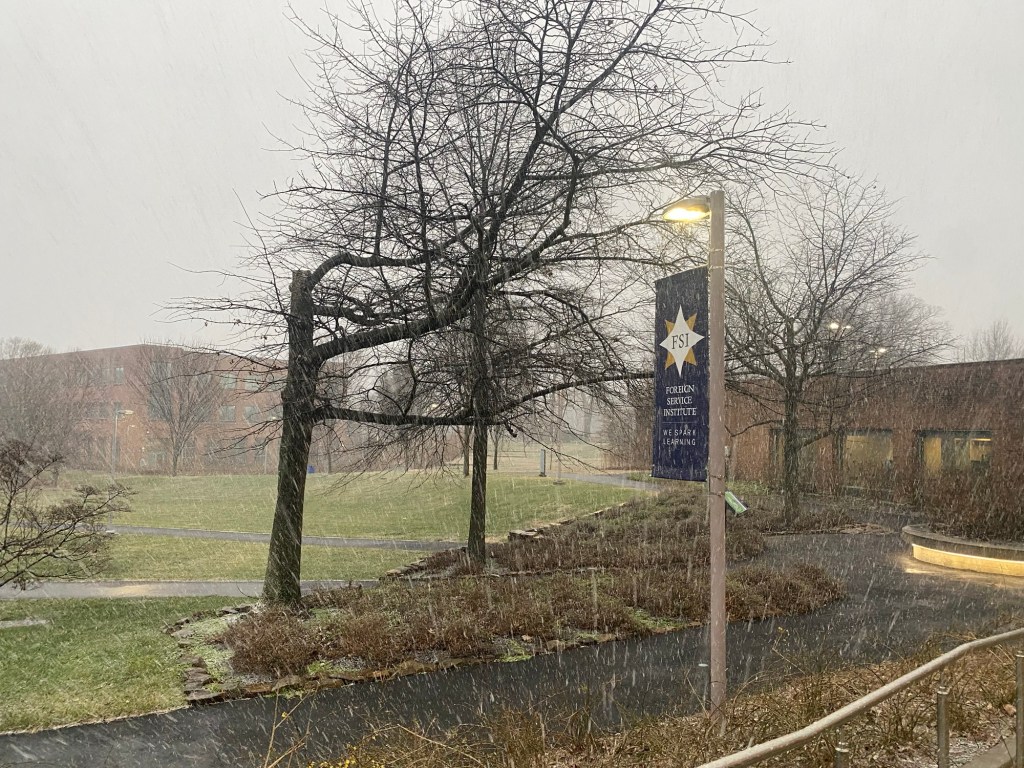
As week 18 ended and we walked out of class, a strong wind and driving snow began to fall at FSI.
 Collecting Postcards
4 comments for “Winter Sun: Learning Burmese, Weeks 16-18”