
In early January, I had eye surgery to free myself from glasses and contact lenses. The procedure was called refractive lens exchange, or custom lens replacement (CLR, pronounced like the word “clear”). During CLR, an ophthalmologist removes the natural lens from behind each eye and replaces them with synthetic interocular lenses (IOLs). In my case, like cataract surgery without the cataracts.
IOLs can never develop cataracts and are free of the age-related hardening and clouding that begins in your 40s. This lens hardening causes presbyopia, which means you may need reading glasses, even if you’ve had LASIK in the past to correct astigmatism. CLR restores the eye’s original refractive ability by dealing with all of your vision problems on the back end. Usually, CLR patients no longer need any vision correction.
Although my first CLR corrected most of my astigmatism, it took three further surgeries to bring my vision up to its present point: clear at all distances. I would have been dumbfounded to know back at the beginning that it would ultimately take four procedures to permanently correct my vision. But fortunately it was all covered by the initial price I’d paid and today I have no regrets.
After having both lenses replaced in early January, in mid-February I also had LASIK to fine-tune the results. LASIK did demonstrably improve my reading and close-up vision within a few days.
But I could tell that something was still wrong. I couldn’t read or focus on things near me. I found it difficult to use my computer at work. I felt motion sickness on a regular basis (more than usual). I had trouble with depth perception when parking my beloved VW in tight DC public garages – a car I’d owned for 14 years and knew the exact dimensions of intimately. In essence, I felt like I still needed glasses but didn’t have any. My IOLs felt like wearing someone else’s glasses.

I went back to my eye surgeon for numerous follow-ups and more tests to determine the source of the problem. I waited out the healing phase as my brain “rewired” and learned to work with my new eyes. We ruled out posterior capsular opacification (PCO), an opaque film that can grow over the membrane holding the IOL in place. I battled headaches and disappointment, and the frustration of being chained to my cheap-looking drugstore cheaters to get any work done.
Then as I wrote about in April, after much discussion and testing, my eye surgeon and I came to the conclusion that I would need to replace the left eye IOL. Again, for no extra charge. I was evidently one of the few qualifying patients that doesn’t “tolerate” a multifocal lens in my non-dominant eye. I needed to switch to something called blended vision – the same lens I already had in my right eye.
My surgeon’s preference is to mix a combination of the two lenses – blended and multifocal – for qualifying patients, but in the end my eyes couldn’t tolerate it. My left lens was great for someone, with its superior astigmatism and presbyopia correction at multiple distances. I wasn’t totally surprised it wasn’t right for me, though. Almost every time I’ve gotten a new glasses or lenses prescription since I started wearing glasses in my 30s, it’s initially been wrong on the left side. So in April I had the lens explanted as soon as I could schedule it.
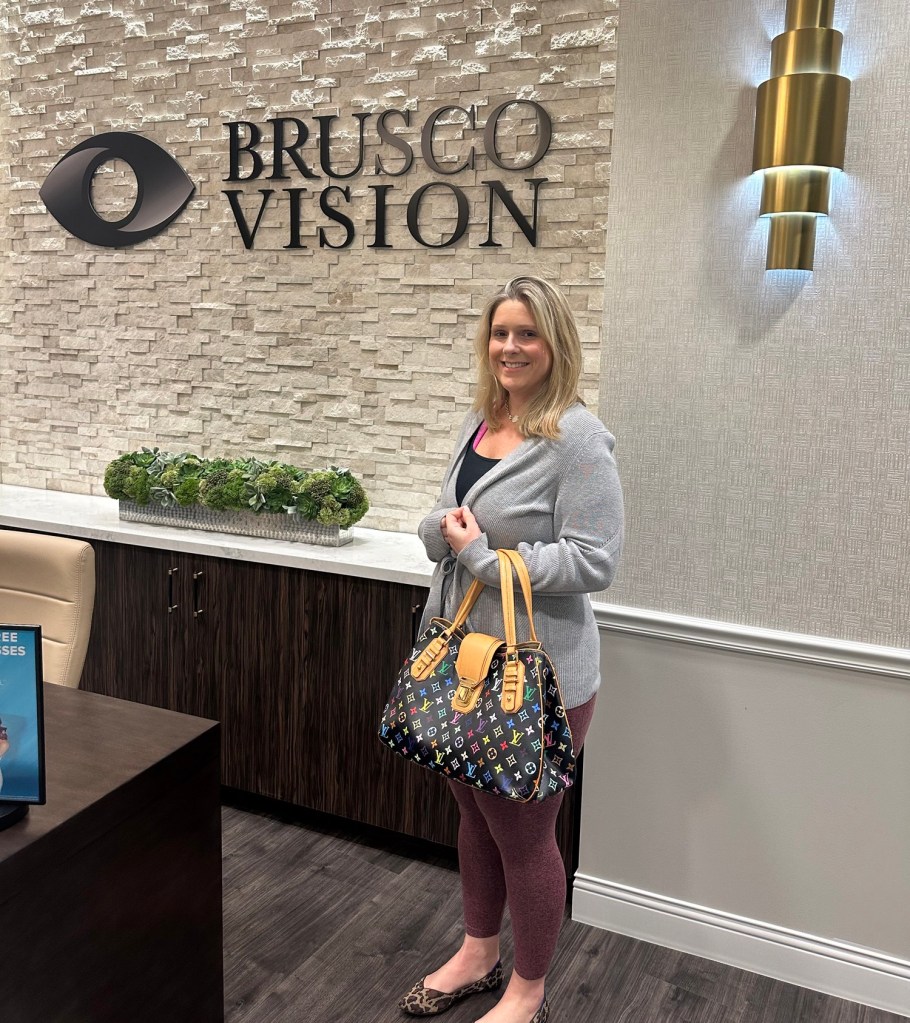
I was partly scared and partly in disbelief when I went in to have to undergo CLR again. Initially, I had been fearful of doing the procedure at all, and now here I was doing it for a second time.
During my original research on CLR in late 2023, I had inadvertently come across a still image from a medical video of the procedure. It showed a close-up view of an eye clamped open. I immediately navigated away from the page and tried hard to forget how it looked. I’m squeamish about surgical things and could never look at images of such a procedure, let alone video of something sharp going into an eye. My main fear had been lying on a table and someone coming toward me with something sharp. I was also freaked out about how I could stop myself from blinking.
Fortunately, blinking wasn’t an issue. During the first CLR, the surgical team had covered one eye at a time while the other was clamped open. This allowed me to satisfy the urge to blink by blinking the covered eye while the eye being operating on was clamped open. It wasn’t painful. During the second CLR, only my left eye was operated on, so presumably I was regularly blinking my right eye. I wasn’t consciously aware of any discomfort around my ability to blink or not at the time, so it ended up not being an issue.
And peripheral vision also wasn’t scary. I couldn’t see the surgeon or his team around me. As soon as I’d laid down on the table, they’d brought a machine right up to my face. I’d had to stare at a very bright light with whichever eye was open, and although that hurt at first, the pain went away within 30 seconds or so.
During CLR, I stared through the machine lens at what looked like a purple nebula floating in outer space. Whenever I would start to zone out, the surgeon would remind me to look right at the image (which I think was actually still the bright light, although I didn’t perceive it that way) – presumably so my eye would stay focused in the position where he needed it to be. I stared at the image even when the nebula collapsed and went blurry, which I understood meant my own lens had just been removed.
It was a very strange experience. Despite the Valium they administered, I felt a low, grim level of semi-panic most of the time. I had to breathe deeply and hold onto a little plush toy they gave me (a veiny eyeball, no less!). I stared at the outer space scene and told myself, You’re not going to freak out and sit up. You’re going to lay here and hold still and think about never wearing glasses again and all the money you paid. And I did. They didn’t post the images they took afterward on their social media – perhaps because I looked a bit wrung out by the end!
I can’t say it was painful, but I was disconcerted during the first CLR by saline irrigation wetting my covered eye and being almost too afraid to ask what all the liquid was, and uncomfortable during the second CLR as the lens was “stuck” during various points of the explanation and I could sense the surgeon was having to really work to get it out. The first CLR took around 45 minutes and the second CLR a little over 30 minutes.
I managed to get through the second CLR procedure in April, but by June I still was getting headaches and feeling a new “pulling” sensation. I went back for more advanced testing and learned I still had some residual astigmatism in my left eye. Thus I had a second and final LASIK procedure – in just the left eye – in June, shortly before I wrapped up my fourth tour in Children’s Issues.
After that second LASIK procedure, my poor left eye was a little beleaguered. The surgeon put in a “bandage” on my left eye that was essentially a contact lens. He said I needed to wear the bandage 24/7 for a week, including while sleeping. I hadn’t been able to wear contact lenses for longer than an hour in almost a year. I knew it wouldn’t work. I protested, but it was already in, and he said keeping the bandage on for even one day would help my healing.
I tried, but of course, my immune system freaked out and rejected the lens, causing my eye to swell up like I’d been punched in the face. I texted a picture of my face to my eye surgeon and he was alarmed. The pain and scratchiness of the lens on my eyeball was almost unbearable. I was afraid to try and remove it, though, lest I hurt the fragile surgical site on my eye; fortunately the lens fell right out the second day post-surgery while I was driving home from my DC office on the George Washington Parkway. (IYKYK – there’s nowhere to pull over for most of the GW Parkway.) I went for an immediate weekend checkup and fortunately, my eye wasn’t scratched or injured.
Soon after the second LASIK (and fourth procedure overall), I could tell my journey to correct my vision was finally coming to an end. I could read email on my phone! I could see my eyebrows in the mirror again. All without glasses.
I had to learn what the optimal distances were between me and the nearest objects I needed to focus on. I also needed to proactively treat my autoimmune dry eye to keep my vision from blurring. And I understood my vision while driving at night might not be sharp for some time yet. But all this was manageable. The headaches and “pulling” feeling totally went away.
Over July and August I adjusted to my new vision and felt a lot of gratitude. By October my night vision seems to have come fully on-board. I have my final follow-up appointment next month, but from my current vantage point, I’ve finally come out on the other side of this.
As I’ve said before, my experience with CLR has been atypical. More than 90% of patients get CLR and within a few days, see perfectly and never even need LASIK afterwards, let alone the somewhat drastic step of swapping out lenses. If you’re considering this procedure and have questions from the patient perspective, I’m happy to talk more about it offline.
I believe having my vision stabilized for life in my mid-40s was a good move and I’m so glad I did it despite the challenges. Picking the right surgeon was such a wonderful gift!
 Collecting Postcards
1 comment for “Distance Vision, Part III”