
Week three of my 44-week Burmese class is drawing to a close. In this short time, we’ve progressed from hand-drawing consonants to reading strings of script, sounding out words we don’t know like kindergarteners. We’ve even written some little paragraphs on easy topics.
Since we aren’t yet proficient in writing Burmese script, and won’t be for some time, everything we write and the notes we take in class are transliterations—using the Latin alphabet to spell out sounds instead of Burmese characters. Mingalaba (hello) instead of မင်္ဂလာပါ, for example. Guess which letters are faster to write?
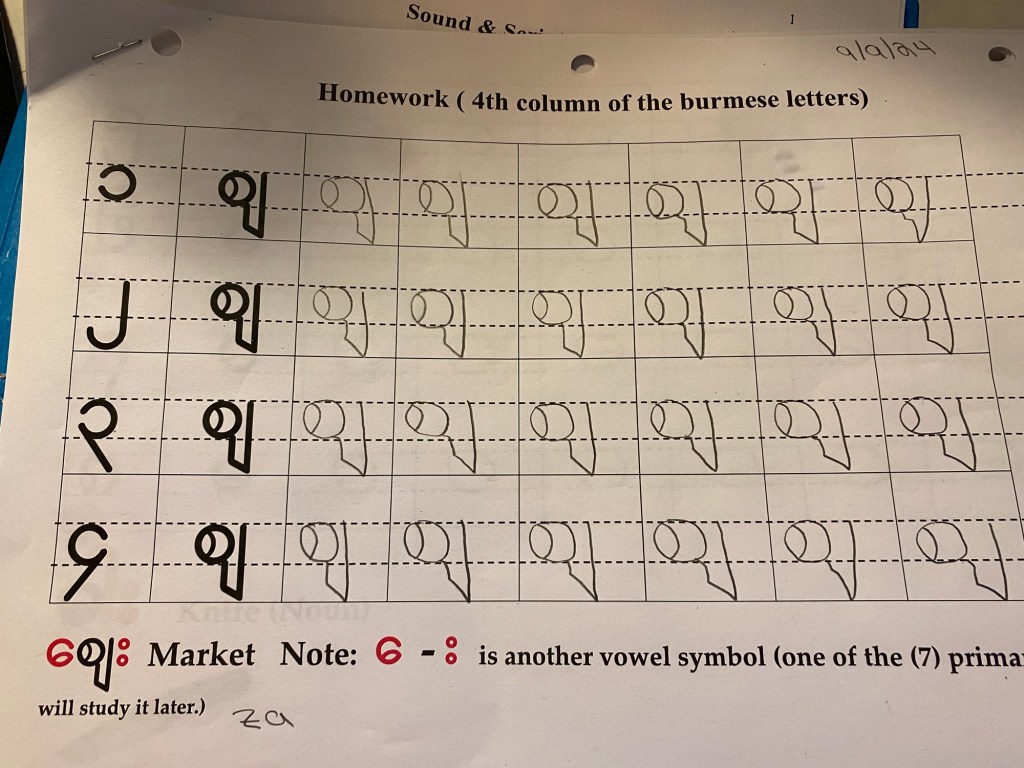
During week one we learned the 33 consonants, which each have their own sound. I now remember them all fairly consistently, though I still confuse a few. And that’s easy to do!
For example, the five characters below make sounds tha, ba, ta, ha, and ya, respectively. Yes, they are consonants, even though they all end in “ah.”
သ ဘ တ က ဟ
When you study them closely, you can see they have subtle differences. In order to distinguish one from the other, I’ve relied on mnemonic devices that probably wouldn’t make sense to anyone but me. Most of the time I identify consonants quickly, but every once in a while I sit there with my mouth hanging open, blinking and inexplicably drawing a blank. The vowels are… coming along.

There are four Burmese students, and two Burmese instructors. We are divided into two classes of two.
Each weekday morning, my class meets for two hours to focus on reading. We work on acquiring consonants and vowels, and we read scripts.
We are getting the basic hang of hearing and speaking the tones – constricted, low, and high. Some of the consonants are “acted upon,” their sounds modified by vowel characters and/or tone markers. These little additions sometimes make consonants hard for me to recognize.
(Speaking of tones, it was mind-blowing for me to learn the same “word” could actually be three different words based on your pronunciation. For example, wa’, waa, and waaah. Really! One means fat. One means bamboo. I forgot what the third means. And I don’t know which is which! There will be misunderstandings.)
Then we go to our speaking class for an hour, followed by a 90-minute lunch and study break, followed by two more hours of speaking class before we’re dismissed to independent study time / going home.
The other class follows the opposite pattern. I’m sure at some point we will switch, or they will mix us up either based on how we’re progressing or simply to keep us on our toes. It isn’t a competition in any case; we’re all on the same path, and have to take the necessary learning steps for ourselves.
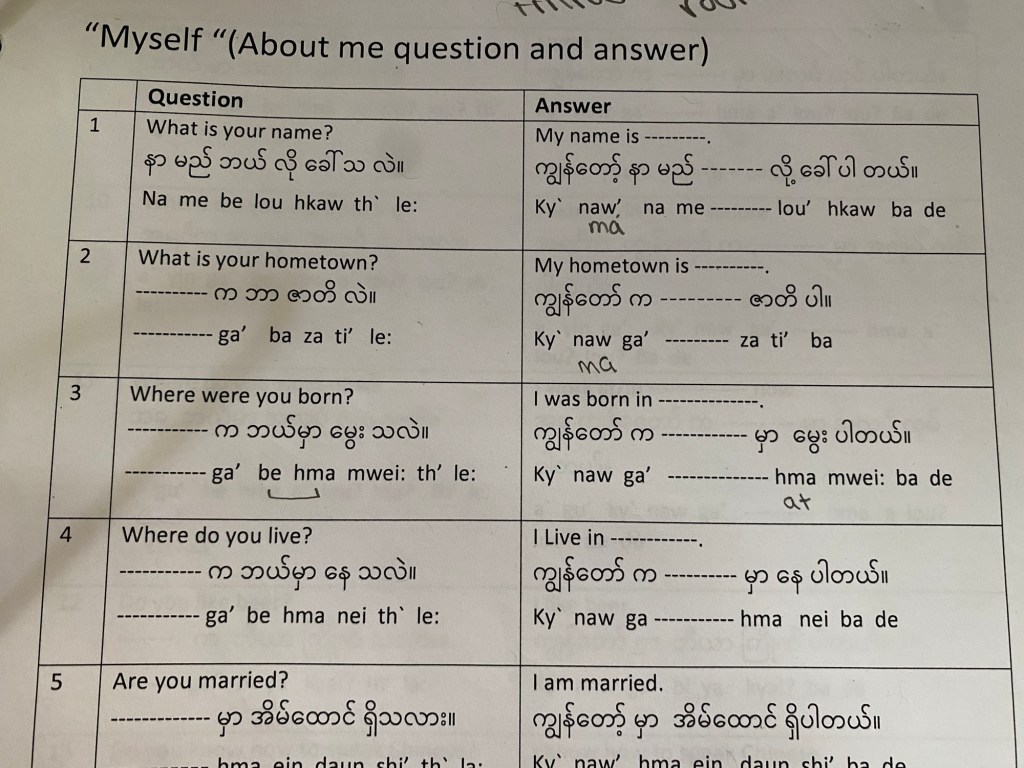
Language classes at FSI progress at a pace that assumes students not only attend five hours of class per day, but also spend up to three hours daily studying independently. There’s nothing abnormal about an eight-hour work day. However, it’s easy to underestimate the energy drain learning a language in a professional context takes. I’ve felt more mentally and physically fatigued the past few weeks than I’ve felt in… months? Years?
Up until week three, I also felt as though I was getting a lot of words and phrases thrown at me. But with daily homework assignments to puzzle through, I didn’t have a lot of brain space to actually just study. But in week three, I began a more intentional practice of what I call “consolidation.” It’s an exercise of reviewing what you learned for the day and aggregating it into the sum total of what you know.

What this looks like probably varies between individuals. My consolidation is mostly focused on writing and speaking – gathering similar words into columns in my notebook, closing my eyes and trying to retrieve the sentence structure and vocabulary I need to express an idea. I review and revisit each homework assignment and classroom worksheet, ideally daily, and try to “lock in” what I learned for the day. In this way, new language is easier to integrate and use.
Otherwise I feel like words I have learned passively are just floating out in the ether, not available for me to grab and pull down when I speak. Bigger periods of consolidation and round-up are useful too, I remember from Russian: every few weeks, a big review to help with retrieval.
I ran into a colleague studying Vietnamese in the hallway today and he told me it’s difficult to hear and replicate the differences between sounds like anh, an, ang. Boy do I know it. But we’re going to keep trying with a positive attitude.
 Collecting Postcards
1 comment for “Building a Foundation: Learning Burmese, Weeks 2-3”