I believe that when someone passes away, especially at a young age, those who knew them have a responsibility to share their memories with the deceased’s family as much as possible. Once a person is gone, memories of them become incredibly precious. Whether something tangible like photos, letters, or mementos, or intangible like stories and reflections, every memory becomes part of a finite legacy—everything that remains is all there will ever be.
Every mourner experiences the loss of a relationship with the deceased that was theirs alone: irreplaceable, and deeply personal. Each person who loses someone loses a unique version of that person only they knew, and in some way, part of themselves along with it. Sharing memories, even if painful, forms part of the lasting echo of the individual. It helps to preserve their essence in the hearts of those left behind.
There is no way to create new photos, memories, or stories about someone who has already passed away. I have railed against the reality of this with a stubbornness that defies measure.
But often, there is a way to discover or rediscover that which exists but lies forgotten in other people’s dusty boxes and dim recesses. A previously unheard story, a handwritten note or doodle, a ticket stub, a never-before-seen photograph. In this manner, the discovery exercise becomes one of collection and presentation.
Assuming one isn’t a person who deals with loss by relegating every trace of the deceased to the most buried and inaccessible corners of heart and mind, how does one collect what’s out there as the years go by and the chances of discovering something unknown grow ever slimmer? I wonder about the memories of particular loved ones that have gotten lost, left uncherished or unshared, including by my own carelessness.
I’ve imagined a parallel universe, a tear in the continuum, where every moment I ever shared with someone now gone is impossibly curated in an exhibit only I can discover. The things I forgot about and still remember and never knew. Suspended in time and space: pictures and video and audio, alive with scent and sound and texture. Displayed chronologically against a backdrop of space and darkness, not polished or perfected by today’s social-image crafting, but twinkling with the 35mm authenticity of yesteryear.
The pictures we took and didn’t keep and never took. Images we never saw of ourselves as we appeared on security cameras at hotels, gas stations, convenience stores. Snippets of other people’s posed photos where we appeared as bystanders in the background. Moving footage from moments I never saw from the third-person perspective, impossibly captured and preserved, as if in a film.
The close-up details of a person’s face, clothing, and voice that fade with time, but return with shocking familiarity and clarity when reintroduced.
If I had something like this, the truth and complexity and returningness of it all would be almost unbearable. But it would be such a gift. For me, it’s better to see it and laugh and cry than to not see it at all. To think that their legacy or how they impacted your life isn’t worth remembering.
The parts of you which once existed with someone in a former life now gone: returned to you, to their rightful place. It all happened in real time and only became clear as the era it truly was in retrospect, once it was too late.
Earlier this year, I was going through a binder of 35mm negatives I’d organized two decades ago when I briefly worked in a photo lab. I was looking for something – a memory, in vain as it turned out. I didn’t find what I imagined existed.
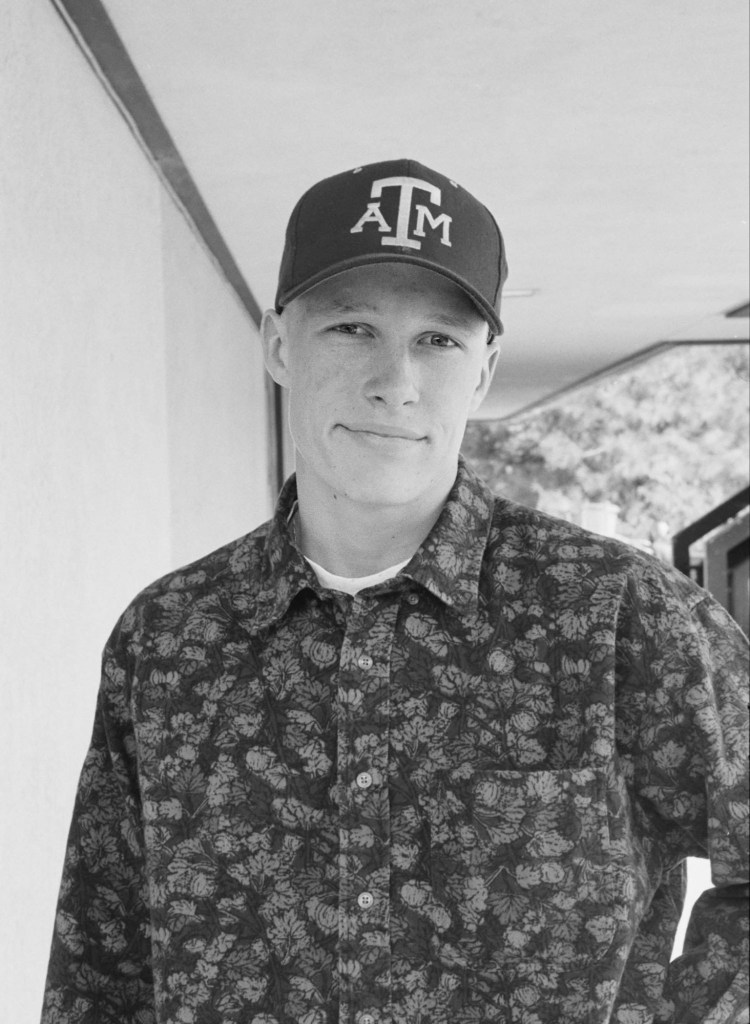
But I found something else: the image of an acquaintance named R that I’d taken for a ninth grade photography class project in March 1994.
This particular class project had been a series on “faces.” Myself and another classmate, K, were walking around with cameras during class, looking for subjects to shoot. We weren’t allowed to check out the cameras outside of class time, so our human subjects were generally who we could find outside on a hall pass.
I hadn’t been close friends with the subject of the photo, R, but we were friendly; we’d been classmates since kindergarten. K and I had run into him coming down an outdoor staircase on campus and engaged in some brief banter. He’d asked about our project and we’d talked to him about the football team – he was a star athlete.
Before R ran to catch up to other friends, I asked him if I could take his picture. He’d said yes. I’d never given him a copy of the photo afterwards.
In fact, R’s photo had never been seen by anyone outside of my instructor and the classmate present when I’d shot and developed the film. I’d only made a couple of darkroom test prints from the roll and had never really displayed the series; my instructor had asked me to reshoot it because he considered most of my photos “portraits,” not focused enough on the face. I’d used different human subjects in the second series, and I forgot about the images on the prior roll. Dusty boxes and dim recesses.
But looking at the negative this spring, a full 30 years later, it occurred to me there was something very important I needed to do as soon as possible: print and send a copy of R’s portrait to his family.
And that’s because R had died in a car accident less than 17 months after the photo was taken.
The July 1995 car accident that claimed the lives of R and another classmate, L, happened between our sophomore and junior years in high school. I was three hours away at my dad’s for the summer, and heard about the crash from my then-longtime boyfriend. It was my first real experience with death, let alone unexpected, sudden death of someone I actually knew well.
The funerals for R and L happened before I returned to my mom’s for the school year. I only felt the post-accident energy as the school year started with two of the Class of 1997 missing. The sadness and unfairness of it all settled over our school and community like a heavy cloak.
Six months later, halfway through our junior year, another member of our class, this time a closer friend of mine, A, also died in a two-vehicle accident on a local highway. We’d been friends for 10 years.
When I heard of A’s death, I denied the news, saying I’d just spoken to him after school the day prior. His funeral was totally unreal. As the reality of it settled upon me, I’d sat down and penned a letter to his parents. I’d included all the snapshots of us I’d taken dating back to second grade.
One of my friends was particularly affected by A’s loss because they had been extremely close. We spent countless hours discussing her grief on the phone. For several months, I was terrified every time my mom took the same highway where A had crashed to town. I understood, finally, that it was possible to promise to come back and not actually make it.

I don’t think anyone in my graduating class forgot about those we lost. We all drove with our headlights on, long before cars had that feature automatically. But somehow I’d forgotten about R’s picture, through three decades of moving in and out of the United States and having my household effects in storage. I vaguely knew the image existed, but hadn’t fully considered how valuable it would be to his parents, still living.
So one day earlier this summer, I had the negative assessed for damage by a professional photography shop that deals with archival and restoration work. Fortunately, there was no damage.
The shop digitized R’s photograph and printed me an 8×10. I was stunned by how beautiful the photo was and couldn’t stop looking at it. I could only imagine how his parents and siblings would feel to see it for the first time. I spent ages choosing the right frame for the portrait and then bubble-wrapped and hand-carried it on the plane with me to the west coast in June.
A mutual friend got in touch with R’s parents on my behalf, and a few days later, the portrait and my letter arrived at their house. I heard back from them, and some of their extended family. They were ecstatic and very appreciative that I had hung onto the negative all those years, and said the never-before-seen photo was “priceless.”
It really touched my heart that I could give them something back of R, and I was grateful I had such a very beautiful photo to give. I later shared the photo on my social media, to the shock and delight of friends who have missed R all this time.
I share the photo publicly in this post because it deserves to be shared and not forgotten.
A lot of people think it’s better not to bring up loved ones who have died because it’s too painful. They have photos but they don’t send them because they think it will “upset” the family. This makes me so sad.
Yes, being confronted with the past can be emotional. But as R’s mom told me, “emotional in the best way.” She understood I had put myself into his family’s shoes to understand how priceless a never-before-seen photo of him, decades deceased, would be. I think ultimately, people appreciate reminders that their loved ones were here and are still remembered. Reminders that their memory is about how they lived, and not how they died or that they died at all.
I wish I would have given R’s family the photo a long time ago, but late in this case was better than never. The gift coincided closely with the 29th anniversary of the accident and a week later, what would have been R’s 46th birthday. A piece of him, back to its rightful place.
In memory of RM, LH, AM, and to TL, for the pictures I don’t have. All of you gone unexpectedly and far too soon.
 Collecting Postcards
1 comment for “To Its Rightful Place”