
I’ve just completed my first three weeks of Rangoon pre-departure training at the Foreign Service Institute (FSI). The one-week courses were for mid-level consular managers and covered fraud and malfeasance (PC541), immigrant and nonimmigrant visas, (PC557), and American Citizens Services matters like crisis management and citizenship (PC558).
I went “back to school” at FSI on Monday, July 8, the day after returning from my west coast trip on a red-eye direct SFO-IAD flight.
I woke up Monday morning tired, not yet totally unpacked, but excited and nervous to finally launch into 54 weeks (!) of training.
I have a tendency to not get out of bed until I have just the amount of time I need to get ready and go somewhere (and nothing else). I also have a tendency to not leave the house until I’ve cut it so close that missing too many lights or someone else’s fender bender leaves me at real risk of being late.
This didn’t bother me enough to change my behavior for years. I have a growing awareness both that I probably thrived on the adrenaline and that it’s no longer the healthiest thing for me.

I didn’t want to start out my new assignment in a stressful way. I wanted to take a long view from the beginning on setting myself up for success and I knew my former 60% telework sleep-whenever mindset wasn’t going to hold up under the pressure of daily commuting to a fully in-person job. I’m Gen X, I thought. I’ve done this American work thing my whole life. It’s not hard. But I reflected upon how things have changed – and how I have changed in recent years, all for the better – and decided to make a few changes to my routine.
One, I instituted a strict sleep schedule of going to bed and getting up at certain times. I’m happy to say that nearly a month later, I’ve adjusted to this very well and have been sleeping better. I noticed even on the weekend, my body wants to stick to the schedule. I still struggle with occasional insomnia, but this was a much-needed (if obvious-sounding) change. Sometimes it’s the simplest things – once incorporated and made routine – that can make the biggest difference.

Two, I generally tried to bring some organization to my week and better use my free time by creating a weekly schedule. I don’t mean the type of schedule where every 15 minutes of your day is blocked out to Increase Maximum Productivity.
No way! My goal was to prioritize certain activities and make sure I still had time for them once I lost three hours a day to the getting ready/commuting rat race.
I slated one day after work for a standing medical appointment; another for a standing professional coaching appointment. I made two other days my “stop by the gym on the way home to work out” weekdays. The fifth day was reserved for doing whatever – errands, dinner with my husband or friends, cleaning house and paying bills, or just being lazy!
The gym schedule worked the first two weeks of training but not the third; the failure was mostly logistical. We dropped down to one car (more on that in a future post) and I was reminded that it’s absurdly hard for me to pack a gym bag with everything I need to work out in it AND remember to bring said bag with me to work in the morning. So I need to try again next week to hit my two gym days because it’s important to me and I don’t want to be just a weekend gym warrior.
And three, I started launching a Google Map every morning when I woke up to check the traffic along the way to work. I left it open and live as I went about my morning routing getting ready. That way I could keep an eye on any worsening congestion and adjust my departure time if needed. This kept me from being surprised more than once by accidents, road work, and needing to take an alternate route. Google Maps isn’t always perfectly reliable, but it did help.
My husband has been working at FSI since 2019, and has driven there a lot since we returned to Virginia in 2022. But I haven’t driven to FSI on a regular basis since 2020, and that was from 10 minutes away in Arlington PCS Lodging – hardly a tough commute. I haven’t driven to FSI from Alexandria since 2015 when we left for Tashkent. So I needed to familiarize myself with the main and alternate routes and make sure I left the house in plenty of time.

I cut it close a couple days the second and third weeks, arriving less than 10 minutes before class. But on all the other days, I was 30-45 minutes early, which allowed me to find my classroom, use the bathroom, check email or make a call, grab a coffee and chat with colleagues. It probably sounds simplistic. But for me, changing my mindset around my commute was very helpful.
These things helped me clear the mental decks and focus on learning and keeping up with the substance and opportunities training provided. I ran into friends and former colleagues and a few times met up with people for a meal. I had a chance to say goodbye to my predecessor D who is just on his way to Rangoon now to start his tour.
I ran into one of my A-100 course coordinators and when he asked me what I was doing, I told him, “More than a year of training!” Whereas many of us grimace and say “Hang in there,” he replied, “Enjoy it! Really, enjoy it.” Of course, I thought. A perfect reframing. It’s actually very true. No demarches to deliver, no cables to write. No parents crying about their abducted children. No mentally ill U.S. citizens who won’t leave your consular district or get help. Just… making sure you’re in a position to open your mind and receive information, all on a beautiful campus.
The campus itself feels bigger to me than I remember in the past. The addition of the brand-new, modern B Building in recent years has really seemed to ease crowding in the F and K buildings. I don’t know if it will still feel that way in the fall when everyone who PCS’d this summer and is currently on home leave in advance of language training shows up. But for now, the extra space feels nice.
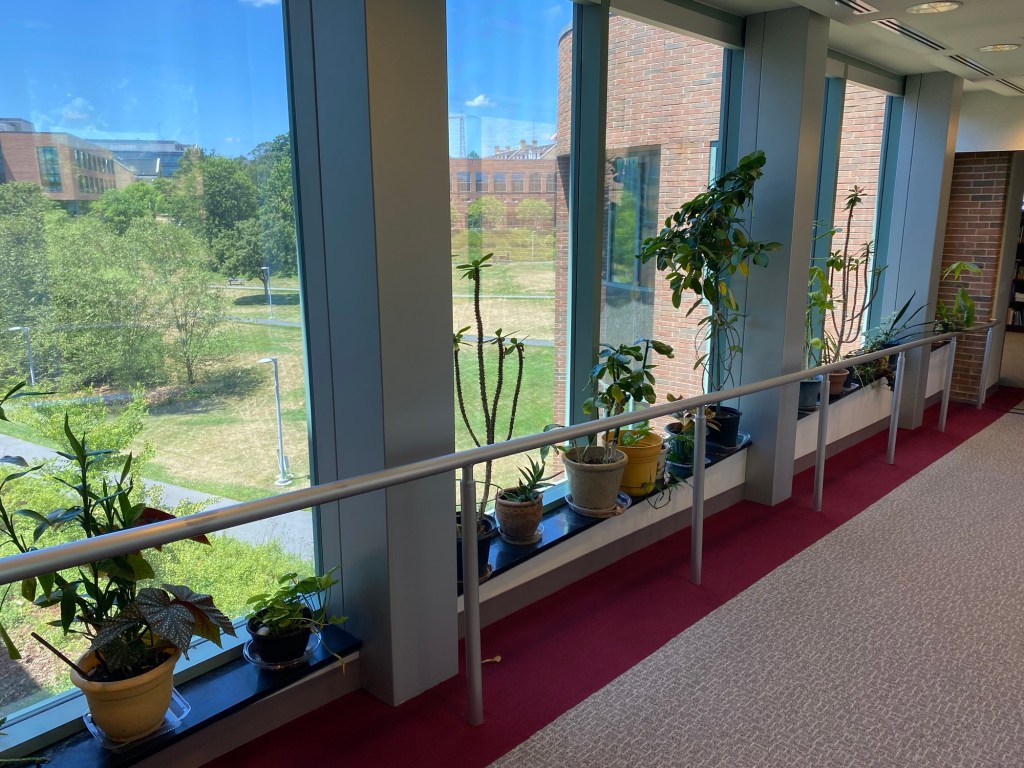
I’m also discovering things about FSI I didn’t know. I knew, for example, there was a roof garden in the F Building – I frequently sat on the windowsill there while I studied Russian almost 10 years ago. But I didn’t know there was a cactus rooftop garden above the cafeteria in the C Building. I didn’t know that the gardens in the F Building courtyards were named the Romila Thapar Garden and the Sasaki Courtyard. I think I’d previously just thought of those spaces as either nooks where I could hide in the shade when I wanted to be alone (or places that were regrettably occupied by others who’d gotten there first).
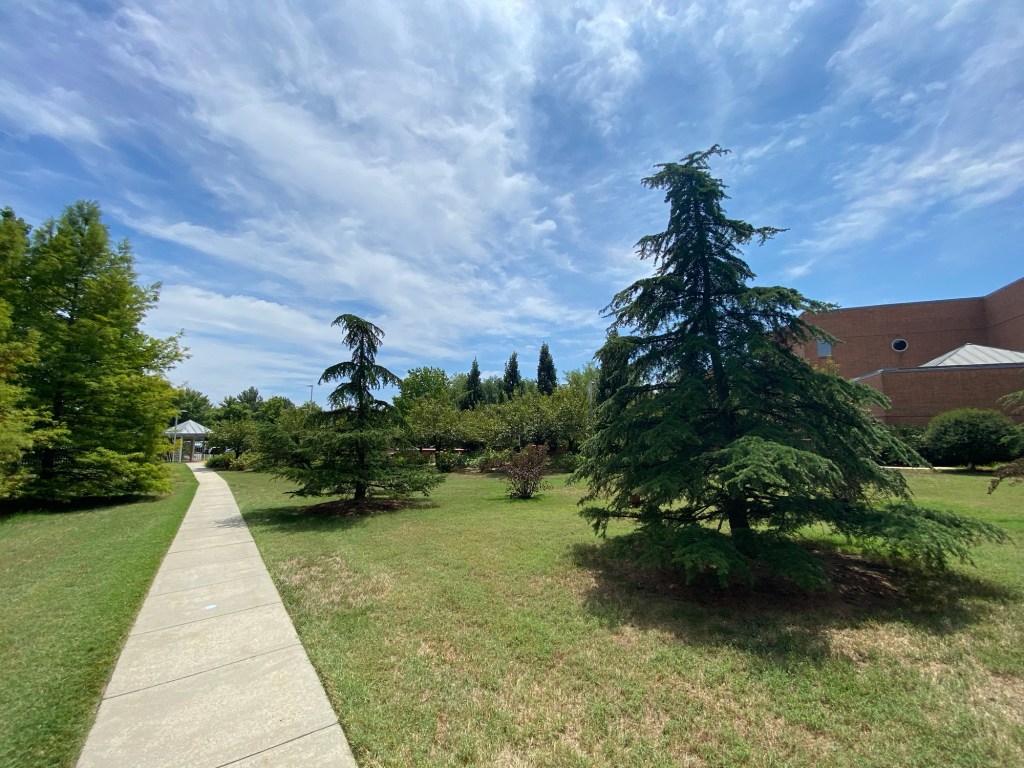
And I didn’t know until my husband showed me that there is now a path starting just outside the main Visitor’s Center entrance (marked with blue dot markers painted on the ground) that leads you on a trail of about a mile all around the campus.
Points of interest are marked with QR codes on the self-guided tour of the grounds. There’s a map and an audio guide by FSI’s horticulturalist that goes into the diversity of nature on the campus. It’s also online: you can listen to the audios here in just a few minutes or read the transcripts and see the accompanying photos. I knew FSI was registered as a wildlife habitat, but I wasn’t aware how important a resource it was for migratory and regional birds and native pollinators.

I walked the trail most days during our one-hour lunch breaks, either with my husband or by myself listening to a podcast, even when it was very hot or trying to rain. It was a good mental break from training and other people. Not to mention a terrific way to add another 2,500 or so steps to my count, especially on days I wouldn’t visit the gym.
I’d always known FSI featured lots of different trees, but I hadn’t realized since 1991 hundreds had been planted – along with thousands of perennials and grasses. I didn’t have words for all the trees until now: Bald Cypress, Sycamore, Dogwood, Poplar, Oak, Cedar, Cherry, Tupelo, Birch, Juniper, Pine, Hickory, Dawn Redwood. A sort of Noah’s Ark.
I knew there were wild and “less tended” elements of some of the gardens, but I hadn’t realized how intentional that was. I had made the obvious link between nature and solitude being conducive to well-being and mentally putting yourself into a learning space. But I hadn’t known the gardens have been watered largely by stormwater conveyances since 2011, or made the connection between the campus and our nation’s history of “plant diplomacy,” going back to the days of Benjamin Franklin trading seeds with our European partners and Tokyo’s gift of the Washington, DC cherry blossoms to the city in 1912.
“FSI is housed at the George P. Shultz National Foreign Affairs Training Center (NFATC), named after the former secretary of state who thought of diplomacy as a garden and the diplomat as a gardener (opens in new tab)—a craft that requires observation, commitment, cultivating relationships, and building resilient networks.”
– The Foreign Service Institute
The diversity of plant and animal life on campus is very clearly connected to the diversity inherent in our own diplomatic work: a rich tapestry of languages, cultures, ethnicities, viewpoints, and ideas.
Three weeks down, 51 weeks to go. So far, so good.
 Collecting Postcards
2 comments for “Back to School”